HABs taxon details
Ostreopsis ovata Fukuyo, 1981
110068 (urn:lsid:marinespecies.org:taxname:110068)
accepted
Species
marine, fresh, terrestrial
Fukuyo Y. 1981. Taxonomical study on benthic dinoflagellates collected in coral reefs. Bull. Jap. Soc. Sci. Fish. 47: 967-978. [details] 
Type locality contained in Ryukyu Islands
type locality contained in Ryukyu Islands [details]
Harmful effect Producer of aerosol, which may cause high fever and serious respiratory distress, due to the presence of toxic compounds,...
Harmful effect Producer of aerosol, which may cause high fever and serious respiratory distress, due to the presence of toxic compounds, ovatoxins (ovatoxin-a to k) (palytoxin analogues) (Hoppenrath et al. 2023). [details]
Guiry, M.D. & Guiry, G.M. (2024). AlgaeBase. World-wide electronic publication, National University of Ireland, Galway (taxonomic information republished from AlgaeBase with permission of M.D. Guiry). Ostreopsis ovata Fukuyo, 1981. Accessed through: Lundholm, N.; Churro, C.; Escalera, L.; Fraga, S.; Hoppenrath, M.; Iwataki, M.; Larsen, J.; Mertens, K.; Moestrup, Ø.; Murray, S.; Tillmann, U.; Zingone, A. (Eds) (2009 onwards) IOC-UNESCO Taxonomic Reference List of Harmful Micro Algae at: https://www.marinespecies.org/hab/aphia.php?p=taxdetails&id=110068 on 2024-09-24
Lundholm, N.; Churro, C.; Escalera, L.; Fraga, S.; Hoppenrath, M.; Iwataki, M.; Larsen, J.; Mertens, K.; Moestrup, Ø.; Murray, S.; Tillmann, U.; Zingone, A. (Eds) (2009 onwards). IOC-UNESCO Taxonomic Reference List of Harmful Micro Algae. Ostreopsis ovata Fukuyo, 1981. Accessed at: https://www.marinespecies.org/hab/aphia.php?p=taxdetails&id=110068 on 2024-09-24
Date
action
by
original description
Fukuyo Y. 1981. Taxonomical study on benthic dinoflagellates collected in coral reefs. Bull. Jap. Soc. Sci. Fish. 47: 967-978. [details]
basis of record Gómez, F. (2005). A list of free-living dinoflagellate species in the world's oceans. <em>Acta Bot. Croat.</em> 64(1): 129-212. [details]
additional source Streftaris, N., A. Zenetos & E. Papathanassiou. (2005). Globalisation in marine ecosystems: the story of non-indigenous marine species across European seas. <em>Oceanogry and Marine Biology: an Annual Review.</em> 43: 419-453. (look up in IMIS) [details] Available for editors
additional source Guiry, M.D. & Guiry, G.M. (2024). AlgaeBase. <em>World-wide electronic publication, National University of Ireland, Galway.</em> searched on YYYY-MM-DD., available online at http://www.algaebase.org [details]
additional source Tomas, C.R. (Ed.). (1997). Identifying marine phytoplankton. Academic Press: San Diego, CA [etc.] (USA). ISBN 0-12-693018-X. XV, 858 pp., available online at http://www.sciencedirect.com/science/book/9780126930184 [details]
additional source Brandt, S. (2001). Dinoflagellates, <B><I>in</I></B>: Costello, M.J. <i>et al.</i> (Ed.) (2001). <i>European register of marine species: a check-list of the marine species in Europe and a bibliography of guides to their identification. Collection Patrimoines Naturels,</i> 50: pp. 47-53 (look up in IMIS) [details]
additional source Zenetos, A.; Çinar, M.E.; Pancucci-Papadopoulou, M.A.; Harmelin, J.-G.; Furnari, G.; Andaloro, F.; Bellou, N.; Streftaris, N.; Zibrowius, H. (2005). Annotated list of marine alien species in the Mediterranean with records of the worst invasive species. <em>Mediterranean Marine Science.</em> 6 (2): 63-118., available online at https://www.researchgate.net/publication/273213810_Annotated_list_of_marine_alien_species_in_the_Mediterranean_with_records_of_the_worst_invasive_species [details] Available for editors
additional source Steidinger, K. A., M. A. Faust, and D. U. Hernández-Becerril. 2009. Dinoflagellates (Dinoflagellata) of the Gulf of Mexico, Pp. 131–154 in Felder, D.L. and D.K. Camp (eds.), Gulf of Mexico–Origins, Waters, and Biota. Biodiversity. Texas A&M Press, College [details]
additional source Penna, A., Fraga, S., Battocchi, C., Casabianca, S., Giacobbe, M. G., Riobó, P. & Vernesi, C. 2010. A phylogeographical study of the toxic benthic dinoflagellate genus <i>Ostreopsis</i> Schmidt. Journal of Biogeography 37:830-41. [details]
additional source Moestrup, Ø., Akselman, R., Cronberg, G., Elbraechter, M., Fraga, S., Halim, Y., Hansen, G., Hoppenrath, M., Larsen, J., Lundholm, N., Nguyen, L. N., Zingone, A. (Eds) (2009 onwards). IOC-UNESCO Taxonomic Reference List of Harmful Micro Algae., available online at http://www.marinespecies.org/HAB [details]
additional source Chang, F.H.; Charleston, W.A.G.; McKenna, P.B.; Clowes, C.D.; Wilson, G.J.; Broady, P.A. (2012). Phylum Myzozoa: dinoflagellates, perkinsids, ellobiopsids, sporozoans, in: Gordon, D.P. (Ed.) (2012). New Zealand inventory of biodiversity: 3. Kingdoms Bacteria, Protozoa, Chromista, Plantae, Fungi. pp. 175-216. [details]
toxicology source Nakajima I., Oshima Y. & Yasumoto T. 1981. Toxicity of benthic dinoflagellates in Okinawa. Bull. Jap. Soc. Sci. Fish. 47: 1029-1033. [details]
toxicology source Lenoir S., Ten-Hage L., Turquet J., Quod J.-P., Bernard C. & Hennion M.-C. 2004. First evidence of palytoxin analogues from an <i>Ostreopsis mascarenensis</i> (Dinophyceae) benthic bloom in Southwestern Indian Ocean. J. Phycol. 40: 1042-1051. [details]
ecology source Leles, S. G.; Mitra, A.; Flynn, K. J.; Tillmann, U.; Stoecker, D.; Jeong, H. J.; Burkholder, J.; Hansen, P. J.; Caron, D. A.; Glibert, P. M.; Hallegraeff, G.; Raven, J. A.; Sanders, R. W.; Zubkov, M. (2019). Sampling bias misrepresents the biogeographical significance of constitutive mixotrophs across global oceans. <em>Global Ecology and Biogeography.</em> 28(4): 418-428., available online at https://doi.org/10.1111/geb.12853 [details] Available for editors
ecology source Mitra, A.; Caron, D. A.; Faure, E.; Flynn, K. J.; Leles, S. G.; Hansen, P. J.; McManus, G. B.; Not, F.; Do Rosario Gomes, H.; Santoferrara, L. F.; Stoecker, D. K.; Tillmann, U. (2023). The Mixoplankton Database (MDB): Diversity of photo‐phago‐trophic plankton in form, function, and distribution across the global ocean. <em>Journal of Eukaryotic Microbiology.</em> 70(4)., available online at https://doi.org/10.1111/jeu.12972 [details]
ecology source Faust, M.A. (1998). Mixotrophy in tropical benthic dinoflagellates. In: Reguera, B., Blanco, J., Fernandez, L., Wyatt, T. (Eds.), Harmful Algae. Proceedings of the VIII International Conference on Harmful Algae, Vigo, Spain, 1997, Xunta de Galicia and Intergovernmental Oceanographic Commission of UNESCO, Paris, France, pp. 390–393. [details]
basis of record Gómez, F. (2005). A list of free-living dinoflagellate species in the world's oceans. <em>Acta Bot. Croat.</em> 64(1): 129-212. [details]
additional source Streftaris, N., A. Zenetos & E. Papathanassiou. (2005). Globalisation in marine ecosystems: the story of non-indigenous marine species across European seas. <em>Oceanogry and Marine Biology: an Annual Review.</em> 43: 419-453. (look up in IMIS) [details] Available for editors
additional source Guiry, M.D. & Guiry, G.M. (2024). AlgaeBase. <em>World-wide electronic publication, National University of Ireland, Galway.</em> searched on YYYY-MM-DD., available online at http://www.algaebase.org [details]
additional source Tomas, C.R. (Ed.). (1997). Identifying marine phytoplankton. Academic Press: San Diego, CA [etc.] (USA). ISBN 0-12-693018-X. XV, 858 pp., available online at http://www.sciencedirect.com/science/book/9780126930184 [details]
additional source Brandt, S. (2001). Dinoflagellates, <B><I>in</I></B>: Costello, M.J. <i>et al.</i> (Ed.) (2001). <i>European register of marine species: a check-list of the marine species in Europe and a bibliography of guides to their identification. Collection Patrimoines Naturels,</i> 50: pp. 47-53 (look up in IMIS) [details]
additional source Zenetos, A.; Çinar, M.E.; Pancucci-Papadopoulou, M.A.; Harmelin, J.-G.; Furnari, G.; Andaloro, F.; Bellou, N.; Streftaris, N.; Zibrowius, H. (2005). Annotated list of marine alien species in the Mediterranean with records of the worst invasive species. <em>Mediterranean Marine Science.</em> 6 (2): 63-118., available online at https://www.researchgate.net/publication/273213810_Annotated_list_of_marine_alien_species_in_the_Mediterranean_with_records_of_the_worst_invasive_species [details] Available for editors
additional source Steidinger, K. A., M. A. Faust, and D. U. Hernández-Becerril. 2009. Dinoflagellates (Dinoflagellata) of the Gulf of Mexico, Pp. 131–154 in Felder, D.L. and D.K. Camp (eds.), Gulf of Mexico–Origins, Waters, and Biota. Biodiversity. Texas A&M Press, College [details]
additional source Penna, A., Fraga, S., Battocchi, C., Casabianca, S., Giacobbe, M. G., Riobó, P. & Vernesi, C. 2010. A phylogeographical study of the toxic benthic dinoflagellate genus <i>Ostreopsis</i> Schmidt. Journal of Biogeography 37:830-41. [details]
additional source Moestrup, Ø., Akselman, R., Cronberg, G., Elbraechter, M., Fraga, S., Halim, Y., Hansen, G., Hoppenrath, M., Larsen, J., Lundholm, N., Nguyen, L. N., Zingone, A. (Eds) (2009 onwards). IOC-UNESCO Taxonomic Reference List of Harmful Micro Algae., available online at http://www.marinespecies.org/HAB [details]
additional source Chang, F.H.; Charleston, W.A.G.; McKenna, P.B.; Clowes, C.D.; Wilson, G.J.; Broady, P.A. (2012). Phylum Myzozoa: dinoflagellates, perkinsids, ellobiopsids, sporozoans, in: Gordon, D.P. (Ed.) (2012). New Zealand inventory of biodiversity: 3. Kingdoms Bacteria, Protozoa, Chromista, Plantae, Fungi. pp. 175-216. [details]
toxicology source Nakajima I., Oshima Y. & Yasumoto T. 1981. Toxicity of benthic dinoflagellates in Okinawa. Bull. Jap. Soc. Sci. Fish. 47: 1029-1033. [details]
toxicology source Lenoir S., Ten-Hage L., Turquet J., Quod J.-P., Bernard C. & Hennion M.-C. 2004. First evidence of palytoxin analogues from an <i>Ostreopsis mascarenensis</i> (Dinophyceae) benthic bloom in Southwestern Indian Ocean. J. Phycol. 40: 1042-1051. [details]
ecology source Leles, S. G.; Mitra, A.; Flynn, K. J.; Tillmann, U.; Stoecker, D.; Jeong, H. J.; Burkholder, J.; Hansen, P. J.; Caron, D. A.; Glibert, P. M.; Hallegraeff, G.; Raven, J. A.; Sanders, R. W.; Zubkov, M. (2019). Sampling bias misrepresents the biogeographical significance of constitutive mixotrophs across global oceans. <em>Global Ecology and Biogeography.</em> 28(4): 418-428., available online at https://doi.org/10.1111/geb.12853 [details] Available for editors
ecology source Mitra, A.; Caron, D. A.; Faure, E.; Flynn, K. J.; Leles, S. G.; Hansen, P. J.; McManus, G. B.; Not, F.; Do Rosario Gomes, H.; Santoferrara, L. F.; Stoecker, D. K.; Tillmann, U. (2023). The Mixoplankton Database (MDB): Diversity of photo‐phago‐trophic plankton in form, function, and distribution across the global ocean. <em>Journal of Eukaryotic Microbiology.</em> 70(4)., available online at https://doi.org/10.1111/jeu.12972 [details]
ecology source Faust, M.A. (1998). Mixotrophy in tropical benthic dinoflagellates. In: Reguera, B., Blanco, J., Fernandez, L., Wyatt, T. (Eds.), Harmful Algae. Proceedings of the VIII International Conference on Harmful Algae, Vigo, Spain, 1997, Xunta de Galicia and Intergovernmental Oceanographic Commission of UNESCO, Paris, France, pp. 390–393. [details]
 Present Inaccurate Introduced: alien Containing type locality
From regional or thematic species database
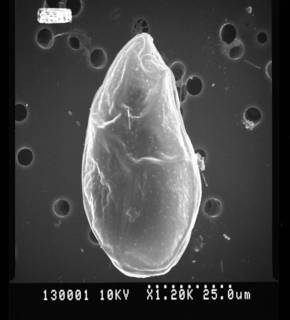
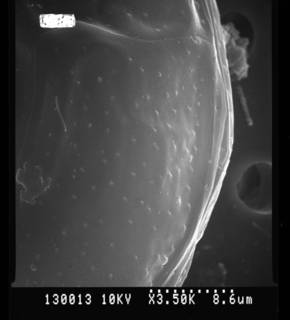
Description Cells ovate and ventrally slender. Antero-posterior length nearly equal to the transdiameter (width). Dorsoventral diameter 1.5 to 2 times larger than transdiameter. The shape and configuration of thecal plates are similar to those of O. siamensis. Thecal plates with numerous minute pores visible in LM. The size of 0.07 μm given by Faust et al. (1996) is probably mistaken. In the Mediterranean Sea and Atlantic Ocean, Penna et al. (2005) found specimens smaller than O. ovata and genetically different from the Pacific populations. They named it O. cf. ovata and reported pores ranging from 0.16 to 0.55 μm in two classes: 0.25–0.30 μm and 0.45–0.50 μm. Smaller pores were also observed in this taxon, but they can not be resolved in LM. [details]Harmful effect Producer of aerosol, which may cause high fever and serious respiratory distress, due to the presence of toxic compounds, ovatoxins (ovatoxin-a to k) (palytoxin analogues) (Hoppenrath et al. 2023). [details]