| About | | Search taxa | | Taxon tree | | Search literature | | Checklist | | Stats | | Log in |
Traits taxon detailsAstrangia Milne Edwards & Haime, 1848
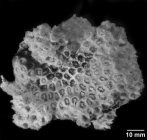 135126 (urn:lsid:marinespecies.org:taxname:135126)
accepted
Genus
marine,
recent + fossil
Milne Edwards, H.; Haime, J. (1848). Observations sur les Polypiers de la famille des Astréides. <em>Comptes Rendus de l'Académie Des Sciences, Paris.</em> 27: 465–470. [details]
Hoeksema, B. W.; Cairns, S. (2024). World List of Scleractinia. Astrangia Milne Edwards & Haime, 1848. Accessed through: Marine Species Traits editorial board (2024) Marine Species Traits at: https://marinespecies.org/traits/aphia.php?p=taxdetails&id=135126 on 2024-09-22
Marine Species Traits editorial board (2024). Marine Species Traits. Astrangia Milne Edwards & Haime, 1848. Accessed at: https://marinespecies.org/traits./aphia.php?p=taxdetails&id=135126 on 2024-09-22
Date action by 2006-09-06 06:55:51Z changed Martinez, Olga
original description
Milne Edwards, H.; Haime, J. (1848). Observations sur les Polypiers de la famille des Astréides. <em>Comptes Rendus de l'Académie Des Sciences, Paris.</em> 27: 465–470. [details]
taxonomy source Löser H, Angel Fernández-Mendiola P, Pérez-Malo J, Domínguez Pascual S, Cahuzac B. (2021). Redefinition of the family Rhizangiidae (Scleractinia; Cretaceous to Recent) and description of a new genus from the Early Cretaceous of Spain. <em>Neues Jahrbuch für Geologie und Paläontologie - Abhandlungen.</em> 299(3): 259-274., available online at https://doi.org/10.1127/njgpa/2021/0968 [details] basis of record Cairns, S.D., Hoeksema, B.W., and J. van der Land, 2001. Scleractinia, <B><I>in</I></B>: Costello, M.J. <i>et al.</i> (Ed.) (2001). <i>European register of marine species: a check-list of the marine species in Europe and a bibliography of guides to their identification. Collection Patrimoines Naturels,</i> 50: pp. 109-110 (look up in IMIS) [details] additional source Neave, Sheffield Airey. (1939-1996). Nomenclator Zoologicus vol. 1-10 Online. <em>[Online Nomenclator Zoologicus at Checklistbank. Ubio link has gone].</em> , available online at https://www.checklistbank.org/dataset/126539/about [details] additional source Veron JEN. (1986). Corals of Australia and the Indo-Pacific. <em>Angus & Robertson Publishers.</em> [details] additional source Cairns, S.D., V. Häussermann & G. Försterra. (2005). A review of the Scleractinia (Cnidaria: Anthozoa) of Chile, with the description of two new species. <em>Zootaxa.</em> 1018: 15-46., available online at https://doi.org/10.11646/zootaxa.1018.1.2 page(s): 16-17, 20-21 [details] Available for editors  additional source Duncan PM (1884) A revision of the families and genera of the sclerodermic Zoantharia, Ed. & H., or Madreporaria (M. Rugosa excepted). Journal of the Linnean Society of London, 18: 1-204. [details] additional source Kitahara, M.V., J. Stolarski, S.D. Cairns, F. Benzoni, J.L. Stake & D.J. Miller. (2012). The first modern solitary Agariciidae (Anthozoa, Scleractinia) revealed by molecular and microstructural analysis. <em>Invertebrate Systematics.</em> 26 (3): 303-315., available online at https://doi.org/10.1071/is11053 page(s): 306, 307 [details] Available for editors additional source Hubbard, R. H.; Wells, J. W. (1986). Ahermatypic shallow-water scleractinian corals of Trinidad. Studies on the Fauna of Curaçao and other Caribbean Islands, 68(211): 121-144 page(s): 128, Figure 8, 9 (USNM 68466) [details] additional source Brugler, M. R.; France, S. C. (2007). The complete mitochondrial genome of the black coral Chrysopathes formosa (Cnidaria: Anthozoa: Antipatharia) supports classification of antipatharians within the subclass Hexacorallia. Molecular Phylogenetics and Evolution, 42, 776-788 page(s): 778, 779, 781, 782 [details] additional source Medina, M.; Collins, A. G.; Takaoka, T. L.; Kuehl, J. V.; Boore, J. L. (2006). Naked corals: skeleton loss in Scleractinia. Proceedings of the National Academy of Sciences of the United States of America, 103(24): 9096-9100 page(s): 9097, 9099 [details] additional source Smith FGW. (1954). Gulf of Mexico Madreporaria. <em>Fisheries Bulletin of the Fish and Wildlife Service (U.S.).</em> 55, 291-295. page(s): 294 [details] additional source Kühlmann, D. H. H. (2006). Die Steinkorallensammlung im Naturhistorischen Museum in Rudolstadt (Thüringen) nebst ökologischen Bemerkungen. Rudolstädter Naturhistorische Schriften, 13, 37-113 page(s): 63, 95, 113 [details] redescription Cairns, S.D. (2000). A revision of the shallow-water azooxanthellate Scleractinia of the western Atlantic. <em>Studies on the Natural History of the Caribbean Region.</em> 75: 1-231. [details] Available for editors  Present Inaccurate Introduced: alien Containing type locality Present Inaccurate Introduced: alien Containing type locality
|