| About | | Search taxa | | Taxon tree | | Search literature | | Specimens | | Distribution | | Checklist | | Stats | | Log in |
WoRMS taxon detailsPholoe minuta (Fabricius, 1780)
130603 (urn:lsid:marinespecies.org:taxname:130603)
accepted
Species
Aphrodita minuta Fabricius, 1780 · unaccepted (basionym)
Palmyra ocellata Johnston, 1827 · unaccepted (subjective synonym)
Pholoe eximia Johnston, 1865 · unaccepted (subjective synonym)
Pholoe minuta eximia Johnson, 1839 · unaccepted (superseded original combination)
Pholoe synophthalmica dinardensis Saint Joseph, 1888 · unaccepted (subjective synonym)
Polynoe minuta Castelnau, 1842 · unaccepted (subjective synonym)
Sigalion ocellatum Bobretzky, 1868 · unaccepted (subjective synonym)
marine,
recent only
(of Aphrodita minuta Fabricius, 1780) Fabricius, O. (1780). Fauna Groenlandica, systematice sistens animalia groenlandiae occidentalis hactenus indagata, quoad nomen specificium, triviale, vernaculumque, synonyma auctorum plurimum, descriptionem, locum, victum, generationem, mores, usum capturamque singuli, pro ut detegendi occasio fuit, maximaque parte secundum proprias observationes. <em>Hafniae [= Copenhagen] & Lipsiae [= Leipzig], Ioannis Gottlob Rothe.</em> xvi + 452 pp., 1 pl., available online at https://www.biodiversitylibrary.org/page/13442285 [details]

Type locality contained in Greenlandic part of the Arctic Ocean
type locality contained in Greenlandic part of the Arctic Ocean [from synonym] [view taxon] [details]
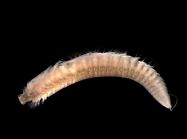
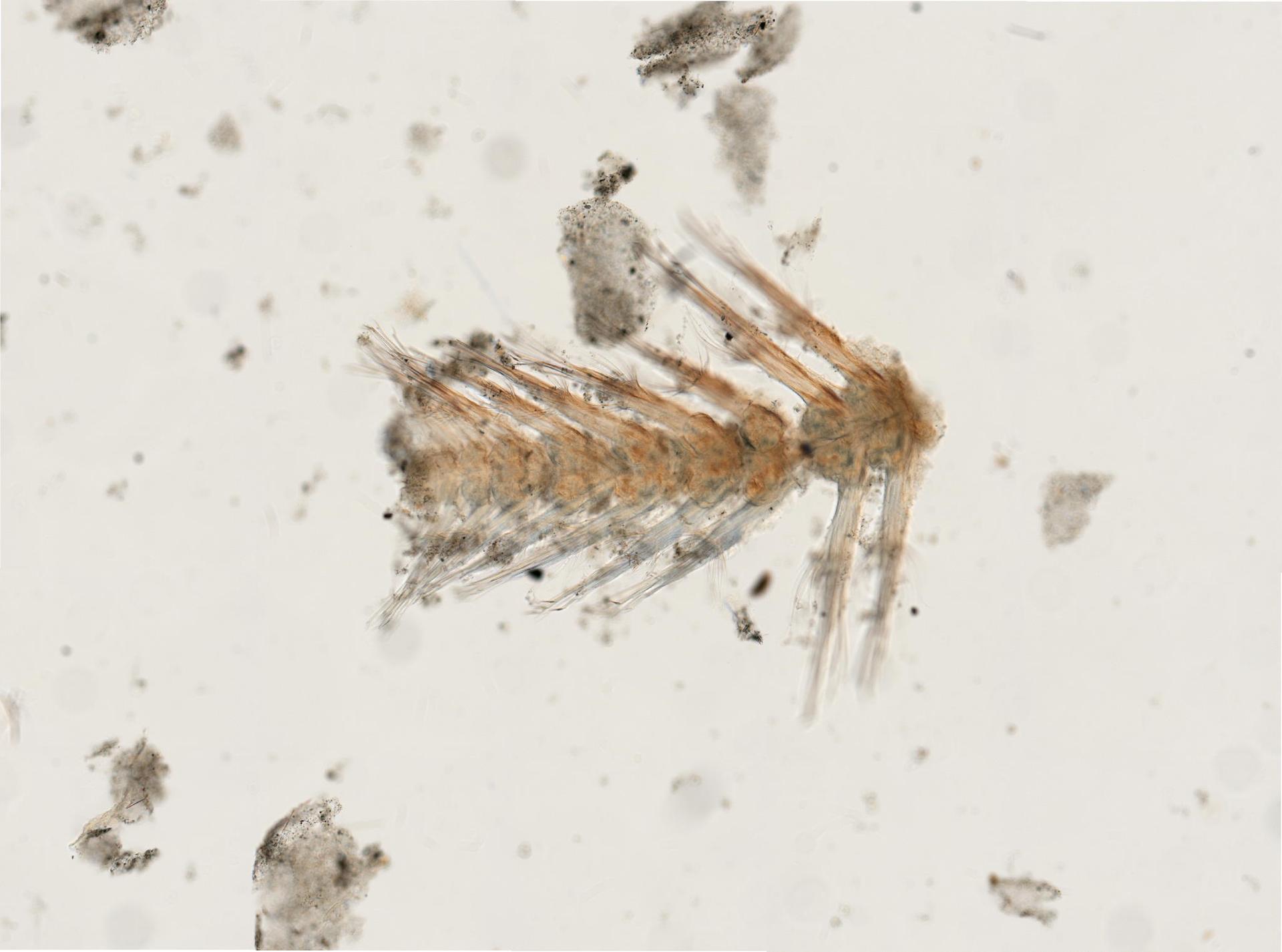
Description A small bristle worm, usually not larger than 10 mm. The body is flat, elongated and covered with soft scales (elytra) on...
Description A small bristle worm, usually not larger than 10 mm. The body is flat, elongated and covered with soft scales (elytra) on the dorsal side. The head has four small eyes and one median antenna. Its colour ranges from colourless, flesh colour, greenish to black; the elytra are brownish speckled. [details] Distribution The distribution of P. minuta in the area comprises the brackish waters of the Delta area and the Wadden Sea, the coastal...
Distribution The distribution of P. minuta in the area comprises the brackish waters of the Delta area and the Wadden Sea, the coastal zone and the Oyster Ground, where the species is quite abundant. lt is absent from the clean sandy substrates in a large part of the Southern Bight. [details] Distribution In the 1976-1986 period Pholoe minuta was found across the entire Belgian part of the North Sea with a low frequency of...
Distribution In the 1976-1986 period Pholoe minuta was found across the entire Belgian part of the North Sea with a low frequency of occurrence. In the 1994-2001 period this wide distribution was limited to especially the western near-coastal zone, which was characterised by a relatively high frequency of occurrence. The density of P. minuta during both periods was relatively low (maximum 100 ind./m2). [details] Distribution Arctic; Iceland, Norway to France; Labrador to Long Island Sound, Bering Sea to Central California, n. Japan Sea
Distribution Arctic; Iceland, Norway to France; Labrador to Long Island Sound, Bering Sea to Central California, n. Japan Sea [details] Taxonomy this species does NOT !! occur in European waters; misidentification with several other Pholoe species possible (cf....
Taxonomy this species does NOT !! occur in European waters; misidentification with several other Pholoe species possible (cf. Petersen 1998)) (R. Barnich) [details]
Read, G.; Fauchald, K. (Ed.) (2024). World Polychaeta Database. Pholoe minuta (Fabricius, 1780). Accessed through: World Register of Marine Species at: https://www.marinespecies.org/aphia.php?p=taxdetails&id=130603 on 2024-09-23
Date action by
original description
(of Aphrodita minuta Fabricius, 1780) Fabricius, O. (1780). Fauna Groenlandica, systematice sistens animalia groenlandiae occidentalis hactenus indagata, quoad nomen specificium, triviale, vernaculumque, synonyma auctorum plurimum, descriptionem, locum, victum, generationem, mores, usum capturamque singuli, pro ut detegendi occasio fuit, maximaque parte secundum proprias observationes. <em>Hafniae [= Copenhagen] & Lipsiae [= Leipzig], Ioannis Gottlob Rothe.</em> xvi + 452 pp., 1 pl., available online at https://www.biodiversitylibrary.org/page/13442285 [details]
original description (of Palmyra ocellata Johnston, 1827) Johnston, George. (1827). [Part 2] Art. XXXVI Contributions to the British Fauna. [Continued from p.181.]. <em>The Zoological Journal.</em> 3: 321-336., available online at https://biodiversitylibrary.org/page/27485847 [details] original description (of Polynoe minuta Castelnau, 1842) Potts, F.A. (1910). Polychaeta of the Indian Ocean. Part II. The Palmyridae, Aphroditidae, Polynoidae, Acoetidae and Sigalionidae. <em>The Transactions of the Linnean Society of London, Second Series, Zoology.</em> 13(2): 325-353, plates 18-21., available online at https://www.biodiversitylibrary.org/page/16399262 [details] original description (of Polynoe minuta Castelnau, 1842) Castelnau, F. L. de Laporte de. (1842). L'Histoire naturelle des Annélides. p.1-46, pls.1-7, in P.H. Lucas ed., Histoire naturelle des animaux articulés. 1. Histoire naturelle des Crustaces, des Arachnides et des Myriopodes: Paris. 600 pp., 46 pls., available online at https://www.biodiversitylibrary.org/page/33043318 [details] original description (of Pholoe eximia Johnston, 1865) Johnston, G. (1865). A catalogue of the British non-parasitical worms in the collection of the British Museum. <em>[book].</em> 1-365. British Museum. London. [See also separate entry for Baird supplement]., available online at http://www.biodiversitylibrary.org/bibliography/12291 [details] original description (of Sigalion ocellatum Bobretzky, 1868) Bobretzky, N. (1868). [Bristle worms (Annulata Chaetopoda) Bay of Sebastopol] [Original] Щетинконогие черви (Annulata Chaetopoda) Севастопольской бухты. <em>Verhandlunger der Naturforschender Versammlung, St.Petersburg, Ser. Zoologie [also Russian journal title: Труды 1-го съезда русских естествоиспытателей в Санкт-Петербурге, Отдел зоологии (Proceedings of the 1st Congress of Russian Naturalists in St. Petersburg, Department of Zoology)].</em> 137-160, plates 1-2 [In Russian]. page(s): p.140 (fig. 1-5) [details] original description (of Pholoe synophthalmica dinardensis Saint Joseph, 1888) Saint-Joseph, Arthur d'Anthoine de. (1888). Les annélides polychètes des côtes de Dinard. Seconde partie. <em>Annales des Sciences Naturelles, Zoologie et Paléontologie, Paris.</em> Série 7, 5(2): 141-338, plates VI-XIII., available online at https://www.biodiversitylibrary.org/page/33078545 [details] context source (Deepsea) Intergovernmental Oceanographic Commission (IOC) of UNESCO. The Ocean Biogeographic Information System (OBIS), available online at http://www.iobis.org/ [details] context source (Schelde) Maris, T.; Beauchard, O.; Van Damme, S.; Van den Bergh, E.; Wijnhoven, S.; Meire, P. (2013). Referentiematrices en Ecotoopoppervlaktes Annex bij de Evaluatiemethodiek Schelde-estuarium Studie naar “Ecotoopoppervlaktes en intactness index”. <em>Monitor Taskforce Publication Series, 2013-01. NIOZ: Yerseke.</em> 35 pp. (look up in IMIS) [details] context source (BeRMS 2020) Bio-environmental research group; Institute of Agricultural and Fisheries research (ILVO), Belgium; (2015): Macrobenthos monitoring in function of the Water Framework Directive in the period 2007-2009. [details] additional source Fauchald, K. (1977). The polychaete worms, definitions and keys to the orders, families and genera. <em>Natural History Museum of Los Angeles County: Los Angeles, CA (USA), Science Series.</em> 28:1-188., available online at http://www.vliz.be/imisdocs/publications/123110.pdf [details] additional source Integrated Taxonomic Information System (ITIS). , available online at http://www.itis.gov [details] additional source Petersen, M.E. (1998). <I>Pholoe</I> (Polychaeta: Pholoidae) from northern Europe: a key and notes on the nearshore species. <i>J. Mar. Biol. Ass. U.K. 78(4)</i>: 1373-1376 (look up in IMIS) [details] additional source Bellan, G. (2001). Polychaeta, <i>in</i>: Costello, M.J. <i>et al.</i> (Ed.) (2001). European register of marine species: a check-list of the marine species in Europe and a bibliography of guides to their identification. <em>Collection Patrimoines Naturels.</em> 50: 214-231. (look up in IMIS) note: checklist [details] additional source Brunel, P., L. Bosse & G. Lamarche. (1998). Catalogue of the marine invertebrates of the estuary and Gulf of St. Lawrence. <em>Canadian Special Publication of Fisheries and Aquatic Sciences, 126.</em> 405 pp. (look up in IMIS) [details] Available for editors  [request] [request] additional source Pettibone, M. H. (1952). Checklist of Polychaeta of New England region. 1-32. [details] additional source Day, J. H. (1967). [Errantia] A monograph on the Polychaeta of Southern Africa. Part 1. Errantia. British Museum (Natural History), London. pp. vi, 1–458, xxix., available online at http://www.biodiversitylibrary.org/bibliography/8596 [details] additional source Bobretzky, N. (1881). Dopolnenia k faune Annelid Chernogo morya [Additions/supplement to the annelid fauna of the Black Sea]. <em>Zapiski Kievskago obshchestva estestvoispytateleĭ [Mémoires de la Société des Naturalistes de Kiew].</em> 6(2): 183-212, plates 6 & 7., available online at https://catalog.hathitrust.org/Record/100422735 note: usage for Black Sea and description [details] additional source Hartman, Olga. (1959). Catalogue of the Polychaetous Annelids of the World. Parts 1 and 2. <em>Allan Hancock Foundation Occasional Paper.</em> 23: 1-628. [details] Available for editors [request] additional source Malmgren, Anders Johan. (1865). Nordiska Hafs-Annulater. [part one of three]. <em>Öfversigt af Königlich Vetenskapsakademiens förhandlingar, Stockholm.</em> 22(1): 51-110, plates VIII-XV., available online at https://biodiversitylibrary.org/page/32339323 page(s): 89-92, plate XI fig. 13 [details] additional source McIntosh, W.C. 1900. A monograph of British Annelids. vol.1. pt.2. Polychaeta Amphinomidae to Sigalionidae. Ray Society of London, 1(l2): 215-442., available online at https://www.biodiversitylibrary.org/page/38577949 [details] additional source Örsted, Anders Sandoe. (1843). Grönlands Annulata dorsibranchiata. <em>Det Kongelige Danske videnskabernes selskabs. Naturvidenskabelige og mathematiske afhandlinger.</em> 10 (series 4): 153-216. 8 plates., available online at https://biodiversitylibrary.org/page/13597198 [details] additional source Fauchald, K.; Granados-Barba, A.; Solís-Weiss, V. (2009). Polychaeta (Annelida) of the Gulf of Mexico, Pp. 751–788 in D.L. Felder and D.K. Camp (eds.). <em>Gulf of Mexico. Origin, Waters, and Biota. Volume 1, Biodiversity.</em> Texas A&M University Press, College Station, Texas., available online at https://books.google.es/books?id=CphA8hiwaFIC&lpg=PR1&pg=PA751 [details] additional source Liu, J.Y. [Ruiyu] (ed.). (2008). Checklist of marine biota of China seas. <em>China Science Press.</em> 1267 pp. (look up in IMIS) [details] Available for editors [request] additional source Trott, T. J. (2004). Cobscook Bay inventory: a historical checklist of marine invertebrates spanning 162 years. <em>Northeastern Naturalist.</em> 11, 261-324., available online at http://www.gulfofmaine.org/kb/files/9793/TROTT-Cobscook%20List.pdf [details] Available for editors [request] redescription Meißner, Karin; Bick, Andreas; Götting, Miriam. (2016). Arctic Pholoe (Polychaeta: Pholoidae): when integrative taxonomy helps to sort out barcodes. <em>Zoological Journal of the Linnean Society.</em> 179(2): 237-262., available online at https://academic.oup.com/zoolinnean/article/179/2/237/2957734 page(s): 244, figures 5-8; note: neotype created, explanation on page 241 [details] Available for editors [request]  Present Present in aphia/obis/gbif/idigbio Inaccurate Introduced: alien Containing type locality Present Present in aphia/obis/gbif/idigbio Inaccurate Introduced: alien Containing type locality
From other sources
Biology Reproduction takes place in spring and summer. The species has planktonic larvae. P. minuta is considered to be an opportunistic species that prefers to colonize newly available habitats, thereby taking advantage of a relatively fast growth.
Description A small bristle worm, usually not larger than 10 mm. The body is flat, elongated and covered with soft scales (elytra) on the dorsal side. The head has four small eyes and one median antenna. Its colour ranges from colourless, flesh colour, greenish to black; the elytra are brownish speckled. [details] Distribution The distribution of P. minuta in the area comprises the brackish waters of the Delta area and the Wadden Sea, the coastal zone and the Oyster Ground, where the species is quite abundant. lt is absent from the clean sandy substrates in a large part of the Southern Bight. [details] Distribution In the 1976-1986 period Pholoe minuta was found across the entire Belgian part of the North Sea with a low frequency of occurrence. In the 1994-2001 period this wide distribution was limited to especially the western near-coastal zone, which was characterised by a relatively high frequency of occurrence. The density of P. minuta during both periods was relatively low (maximum 100 ind./m2). [details] Distribution Arctic; Iceland, Norway to France; Labrador to Long Island Sound, Bering Sea to Central California, n. Japan Sea [details] Habitat P. minuta prefers to live in very fine sand with more than 10% mud. It is also recorded from under stones, among old shells, in empty tubes of Sabellaria spinulosa and in black anoxic mud (Hartmann-Schröder, 1971; Hayward & Ryland, 1990). [details] Habitat Pholoe minuta is found in sediments with a median grain size ranging from 100 to 500 μm, but displays a slight preference for fine-grained sediments (100 to 250 μm). However, the relative occurrence of the species remains low at all times (< 20%). With regard to the mud content the P. minuta displays a clear preference for sediments with a mud content up to 50%. [details] Habitat intertidal, bathyal, infralittoral and circalittoral of the Gulf and estuary [details] Morphology A small species, usually not more than 1 cm long. The body is flat, oblong and on the dorsal side covered with soft scales (elytra). In contrast to Harmothoe species the elytra leave the mid-dorsal part of the body free. The head bears four small eyes and one median antenna. The 40-60 elytra show concentric rings. The worm is black and pale pink, the elytra speckled with rusty brown (Hartmann-Schröder, 1971; Hayward & Ryland, 1990). [details] Taxonomy this species does NOT !! occur in European waters; misidentification with several other Pholoe species possible (cf. Petersen 1998)) (R. Barnich) [details]
To Barcode of Life (59 barcodes)
To Biodiversity Heritage Library (124 publications) To Biodiversity Heritage Library (29 publications) (from synonym Aphrodita minuta Fabricius, 1780) To European Nucleotide Archive, ENA (Pholoe minuta) To GenBank (75 nucleotides; 39 proteins) To Global Biotic Interactions (GloBI) To PESI To The Arctic Traits Database (36 traits) To USNM Invertebrate Zoology Annelida Collection (270 records) To Yale Peabody Museum of Natural History (YPM IZ 095767) To ITIS |