WoRMS taxon details
Galaxea fascicularis (Linnaeus, 1767)
207366 (urn:lsid:marinespecies.org:taxname:207366)
accepted
Species
Anthophyllum cuspidatum (Esper, 1789) · unaccepted > junior subjective synonym
Anthophyllum esperi Schweigger, 1820 · unaccepted > junior subjective synonym
Anthophyllum fasciculare Ehrenberg, 1834 · unaccepted > junior subjective synonym
Anthophyllum fasciculatum (Linnaeus, 1767) · unaccepted > superseded combination
Anthophyllum hystrix Dana, 1846 · unaccepted > junior subjective synonym
Caryophyllia fascicularis (Linnaeus, 1767) · unaccepted > superseded combination
Caryophyllia fasciculata (Linnaeus, 1767) · unaccepted > superseded combination
Galaxea anthophyllites Faurot, 1894 · unaccepted > junior subjective synonym
Galaxea aspera Quelch, 1886 · unaccepted > junior subjective synonym
Galaxea caryophyllites Krüger, 1823 · unaccepted > junior subjective synonym
Galaxea caryophyllites fascicularis (Linnaeus, 1767) · unaccepted > superseded combination
Galaxea colamnaris Eguchi & Shirai, 1977 · unaccepted > junior subjective synonym
Galaxea columnaris Eguchi & Shirai, 1977 · unaccepted > junior subjective synonym (misspelling)
Galaxea cuspidata (Esper, 1789) · unaccepted > junior subjective synonym
Galaxea ellisi (Milne Edwards & Haime, 1848) · unaccepted > junior subjective synonym
Galaxea esperi (Schweigger, 1820) · unaccepted > junior subjective synonym
Galaxea fascicularis var. anthophyllites Faurot, 1894 · unaccepted > junior subjective synonym
Galaxea fascicularis var. aspera Quelch, 1886 · unaccepted > junior subjective synonym
Galaxea fascicularis var. columnaris Chevalier, 1971 · unaccepted > junior subjective synonym
Galaxea fascicularis var. ellisi (Milne Edwards & Haime, 1848) · unaccepted > junior subjective synonym
Galaxea fascicularis var. lawisiana Nemenzo, 1959 · unaccepted > junior subjective synonym
Galaxea fascicularis var. minima Chevalier, 1971 · unaccepted > junior subjective synonym
Galaxea fascicularis var. solida Chevalier, 1971 · unaccepted > junior subjective synonym
Galaxea fragilis Quelch, 1886 · unaccepted > junior subjective synonym
Galaxea heterocyathus Ortmann, 1889 · unaccepted > junior subjective synonym
Galaxea hexagonalis (Milne Edwards & Haime, 1848) · unaccepted > junior subjective synonym (?)
Galaxea hystrix Dana, 1846 · unaccepted > junior subjective synonym
Galaxea irregularis (Milne Edwards & Haime, 1848) · unaccepted > junior subjective synonym
Galaxea lawisiana Nemenzo, 1959 · unaccepted > junior subjective synonym
Galaxea prolifera Nemenzo & Ferraris, 1982 · unaccepted > junior subjective synonym (?)
Galaxea quoyi (Milne Edwards & Haime, 1848) · unaccepted > junior subjective synonym
Galaxea tenella Brüggemann, 1879 · unaccepted > junior subjective synonym
Madrepora cuspidata Esper, 1789 · unaccepted > junior subjective synonym
Madrepora divergens Forskål, 1775 · unaccepted > junior subjective synonym
Madrepora fascicularis Linnaeus, 1767 · unaccepted > superseded combination (basionym)
Matrepora cuspidata (Esper, 1789) · unaccepted > junior subjective synonym
Sarcinula divergens (Forskål, 1775) · unaccepted > junior subjective synonym
Sarcinula ellisii Milne Edwards & Haime, 1848 · unaccepted > junior subjective synonym
Sarcinula fascicularis (Linnaeus, 1767) · unaccepted > superseded combination
Sarcinula hexagonalis Milne Edwards & Haime, 1848 · unaccepted > junior subjective synonym
Sarcinula hystrix (Dana, 1846) · unaccepted > junior subjective synonym
Sarcinula irregularis Milne Edwards & Haime, 1848 · unaccepted > junior subjective synonym
Sarcinula quoyi Milne Edwards & Haime, 1848 · unaccepted > junior subjective synonym
- Variety Galaxea fascicularis var. anthophyllites Faurot, 1894 accepted as Galaxea fascicularis (Linnaeus, 1767) (unaccepted > junior subjective synonym)
- Variety Galaxea fascicularis var. aspera Quelch, 1886 accepted as Galaxea fascicularis (Linnaeus, 1767) (unaccepted > junior subjective synonym)
- Variety Galaxea fascicularis var. columnaris Chevalier, 1971 accepted as Galaxea fascicularis (Linnaeus, 1767) (unaccepted > junior subjective synonym)
- Variety Galaxea fascicularis var. ellisi (Milne Edwards & Haime, 1848) accepted as Galaxea fascicularis (Linnaeus, 1767) (unaccepted > junior subjective synonym)
- Variety Galaxea fascicularis var. lawisiana Nemenzo, 1959 accepted as Galaxea fascicularis (Linnaeus, 1767) (unaccepted > junior subjective synonym)
- Variety Galaxea fascicularis var. minima Chevalier, 1971 accepted as Galaxea fascicularis (Linnaeus, 1767) (unaccepted > junior subjective synonym)
- Variety Galaxea fascicularis var. solida Chevalier, 1971 accepted as Galaxea fascicularis (Linnaeus, 1767) (unaccepted > junior subjective synonym)
marine, fresh, terrestrial
(of Madrepora fascicularis Linnaeus, 1767) Linnaeus, C. (1767). Systema naturae per regna tria naturae: secundum classes, ordines, genera, species, cum characteribus, differentiis, synonymis, locis. Ed. 12. 1., Regnum Animale. 1 & 2. <em>Holmiae [Stockholm], Laurentii Salvii.</em> pp. 1-532 [1766] pp. 533-1327 [1767]., available online at http://www.biodiversitylibrary.org/item/83650#5 [details] 
Lectotype (of Madrepora fascicularis Linnaeus, 1767) , ...
Holotype (of Madrepora fascicularis Linnaeus, 1767) [details]
Lectotype (of Madrepora cuspidata Esper, 1789) USNM 3969, geounit French Polynesian Exclusive Economic Zone [details]
Description The skeleton of Galaxea is very distinctive. Corallites are extremely plocoid, 3-15 mm tall cylinders set into a flat and...
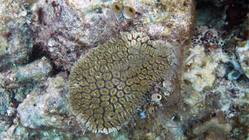
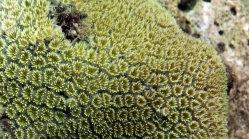
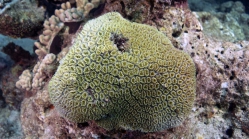
Description The skeleton of Galaxea is very distinctive. Corallites are extremely plocoid, 3-15 mm tall cylinders set into a flat and rather blistery coenosteum. Further enhancing this appearance of tall corallites are the extremely protuberant primary septa, projecting a further 3 - 5 mm above the corallite wall. Septa usually number over 24 in mature corallites. These are very attractive corals when living, due to the daytime extension of pale yellow, green or blue translucent tentacles. Colonies of this species are commonly less than 40 cm across, forming cushions, or are encrusting to sub-massive. Occasionally, such as in turbid waters, the species can provide over 50% cover over several hundred square metres, and these colonies may develop both foliaceous and sub-ramose parts, with smaller corallites on fast growing extensions. However, on the sub-ramose parts of giant colonies, calices are much smaller and have only 12 septa. (This is a character of Galaxea astreata. Where such fragments come from the same colonies as typical G. fascicularis, it seems likely that they represent young, fast growing edges.) Its depth range is 5-20 m deep (Sheppard, 1998).
Small colonies are cushion-shaped or low domes or irregular. Large colonies are of mixed sizes, commonly up to 6 mm in diameter with numerous septa reaching the corallite centre. Colour: Usually green, red and brown in various mixtures. Polyps are frequently extended during the day, and tentacles often have conspicuous white tips. Abundance: very common in a wide range of habitats and may be dominant on inshore fringing reefs, where columnar colonies frequently exceed 5 m in diameter (Veron, 1986).
The small, cushion-shaped colonies are readily recognised because of the spiky appearance caused by the protuberant radiating septa of the tubular corallites. Often feeds during the day. Colour: A vivid green, brown or red with white-tipped tentacles. Habitat: diverse, especially in turbid, shallow waters (Richmond, 1997); rocks (Kalk, 1959).
Tropical Indo-Pacific in Kalk (1958). [details]
Small colonies are cushion-shaped or low domes or irregular. Large colonies are of mixed sizes, commonly up to 6 mm in diameter with numerous septa reaching the corallite centre. Colour: Usually green, red and brown in various mixtures. Polyps are frequently extended during the day, and tentacles often have conspicuous white tips. Abundance: very common in a wide range of habitats and may be dominant on inshore fringing reefs, where columnar colonies frequently exceed 5 m in diameter (Veron, 1986).
The small, cushion-shaped colonies are readily recognised because of the spiky appearance caused by the protuberant radiating septa of the tubular corallites. Often feeds during the day. Colour: A vivid green, brown or red with white-tipped tentacles. Habitat: diverse, especially in turbid, shallow waters (Richmond, 1997); rocks (Kalk, 1959).
Tropical Indo-Pacific in Kalk (1958). [details]
Hoeksema, B. W.; Cairns, S. (2024). World List of Scleractinia. Galaxea fascicularis (Linnaeus, 1767). Accessed through: World Register of Marine Species at: https://www.marinespecies.org/aphia.php?p=taxdetails&id=207366 on 2024-09-19
Date
action
by
2000-09-28 07:24:50Z
changed
Garcia, Maria
 The webpage text is licensed under a Creative Commons Attribution 4.0 License
original description
(of Madrepora fascicularis Linnaeus, 1767) Linnaeus, C. (1767). Systema naturae per regna tria naturae: secundum classes, ordines, genera, species, cum characteribus, differentiis, synonymis, locis. Ed. 12. 1., Regnum Animale. 1 & 2. <em>Holmiae [Stockholm], Laurentii Salvii.</em> pp. 1-532 [1766] pp. 533-1327 [1767]., available online at http://www.biodiversitylibrary.org/item/83650#5 [details]
original description (of Sarcinula hexagonalis Milne Edwards & Haime, 1848) Milne Edwards, H.; Haime, J. (1848). Recherches sur les polypiers. Mémoire 4. Monographie des Astréides (1). <em>Annales des Sciences Naturelles, Zoologie, Series 3.</em> 10: 209-320, pls. 5-9. [details]
original description (of Galaxea lawisiana Nemenzo, 1959) Nemenzo F (1959) Systematic studies on Philippine shallow water scleractinians: II. Suborder Faviida. Natural and Applied Science Bulletin, University of the Philippines 16: 73-135, pls. 1-24. [details]
original description (of Galaxea fragilis Quelch, 1886) Quelch JJ. (1886). Report on the Reef-corals collected by H.M.S. 'Challenger' during the years 1873-76. <em>Report on the Scientific Results of the Voyage of H.M.S. Challenger during the years 1873–1876. Zoology.</em> 16 (46): 1-203, pl. 1-12., available online at http://www.19thcenturyscience.org/HMSC/HMSC-Reports/Zool-46/README.htm [details]
original description (of Galaxea aspera Quelch, 1886) Quelch JJ. (1886). Report on the Reef-corals collected by H.M.S. 'Challenger' during the years 1873-76. <em>Report on the Scientific Results of the Voyage of H.M.S. Challenger during the years 1873–1876. Zoology.</em> 16 (46): 1-203, pl. 1-12., available online at http://www.19thcenturyscience.org/HMSC/HMSC-Reports/Zool-46/README.htm [details]
original description (of Galaxea heterocyathus Ortmann, 1889) Ortmann, A. (1889). Beobachtungen an Steinkorallen von der Südküste Ceylons. <em>Zoologische Jahrbüchern, Abteilung für Systematik, Biologie und Biogeographie der Tiere.</em> 4: 493-590, pls. 11-17. [details]
original description (of Galaxea fascicularis var. solida Chevalier, 1971) Chevalier JP (1971) Les Scléractiniaires de la Mélanésie Française (Nouvelle-Caledonie, Iles Chesterfield, Iles Loyauté, Nouvelles Hébrides). I. Expedition Française sur les Récifs Coralliens Nouv.-Calédonie 5: 1-307, pls. 1-38. Paris. [details]
original description (of Galaxea anthophyllites Faurot, 1894) Faurot, L. (1894). Description du Galaxea anthophyllites, nouvelle espèce de polypier de la mer Rouge. <em>Bulletin de la Société zoologique de France 19: 114-116.</em> [details]
original description (of Galaxea colamnaris Eguchi & Shirai, 1977) Eguchi M, Shirai S. (1977). In: Shirai S (ed.) Ecological encyclopedia of the marine animals of the Rykyu Islands. Shinsei-Tosho, Okinawa. [details]
original description (of Galaxea fascicularis var. minima Chevalier, 1971) Chevalier JP (1971) Les Scléractiniaires de la Mélanésie Française (Nouvelle-Caledonie, Iles Chesterfield, Iles Loyauté, Nouvelles Hébrides). I. Expedition Française sur les Récifs Coralliens Nouv.-Calédonie 5: 1-307, pls. 1-38. Paris. [details]
original description (of Galaxea fascicularis var. columnaris Chevalier, 1971) Chevalier JP (1971) Les Scléractiniaires de la Mélanésie Française (Nouvelle-Caledonie, Iles Chesterfield, Iles Loyauté, Nouvelles Hébrides). I. Expedition Française sur les Récifs Coralliens Nouv.-Calédonie 5: 1-307, pls. 1-38. Paris. [details]
original description (of Galaxea columnaris Eguchi & Shirai, 1977) Eguchi M, Shirai S. (1977). In: Shirai S (ed.) Ecological encyclopedia of the marine animals of the Rykyu Islands. Shinsei-Tosho, Okinawa. [details]
original description (of Galaxea prolifera Nemenzo & Ferraris, 1982) Nemenzo F, CJ Ferraris (1982) Some scleractinian corals from the reefs of Cebu and Mactan Islands. Kalikasan: The Philippine Journal of Biology 11: 111-135. [details]
original description (of Sarcinula irregularis Milne Edwards & Haime, 1848) Milne Edwards, H.; Haime, J. (1848). Recherches sur les polypiers. Mémoire 4. Monographie des Astréides (1). <em>Annales des Sciences Naturelles, Zoologie, Series 3.</em> 10: 209-320, pls. 5-9. [details]
original description (of Sarcinula quoyi Milne Edwards & Haime, 1848) Milne Edwards, H.; Haime, J. (1848). Recherches sur les polypiers. Mémoire 4. Monographie des Astréides (1). <em>Annales des Sciences Naturelles, Zoologie, Series 3.</em> 10: 209-320, pls. 5-9. [details]
original description (of Anthophyllum fasciculare Ehrenberg, 1834) Ehrenberg, C. G. (1834). Beiträge zur physiologischen Kenntniss der Corallenthiere im allgemeinen, und besonders des rothen Meeres, nebst einem Versuche zur physiologischen Systematik derselben. <em>Abhandlungen der Königlichen Akademie der Wissenschaften, Berlin.</em> 1: 225-380., available online at https://www.biodiversitylibrary.org/page/29725862 [details]
original description (of Sarcinula ellisii Milne Edwards & Haime, 1848) Milne Edwards, H.; Haime, J. (1848). Recherches sur les polypiers. Mémoire 4. Monographie des Astréides (1). <em>Annales des Sciences Naturelles, Zoologie, Series 3.</em> 10: 209-320, pls. 5-9. [details]
original description (of Anthophyllum esperi Schweigger, 1820) Schweigger, A. F. (1820). Handbuch der Naturgeschichte der skelettlosen ungegliederten Thiere. <em>Leipzig, Im Verlag der Dyk'schen Buchhandlung.</em> 1-802., available online at https://www.biodiversitylibrary.org/page/39152641 [details]
original description (of Anthophyllum hystrix Dana, 1846) Dana, J.D. (1846-1849). Zoophytes. United States Exploring Expedition during the years 1838-1842. <em>Lea and Blanchard, Philadelphia.</em> 7: 1-740, 61 pls. (1846: 1-120, 709-720; 1848: 121-708, 721-740; 1849: atlas pls. 1-61)., available online at http://www.sil.si.edu/digitalcollections/usexex/navigation/ScientificText/USExEx19_08select.cfm [details]
original description (of Madrepora cuspidata Esper, 1789) Esper, E.J.C. (1788-1830). Die Pflanzenthiere in Abbildungen nach der Natur mit Farben erleuchtet nebst Beschreibungen. Raspischen Buchhandlung, Nuremberg. 3 vols text, 2 vols pls. , available online at https://doi.org/10.11588/diglit.2885 [details]
original description (of Madrepora divergens Forskål, 1775) Forskål P. (1775). Descriptiones Animalium, Avium, Amphibiorum, Piscium, Insectorum, Vermium; quae in Itinere Orientali Observavit Petrus Forskål. Post Mortem Auctoris editit Carsten Niebuhr. Adjuncta est materia Medica Kahirina. Mölleri, Hafniae, 19 + xxxiv + 164 pp. , available online at https://www.biodiversitylibrary.org/page/2088059 [details]
original description (of Galaxea caryophyllites Krüger, 1823) Krüger, J.F. (1823). Geschichte der Urwelt: in Umrissen entworfen. Zweiter Theil. <em>Gottfried Basse, Quedlinburg und Leipzig.</em> [details]
context source (HKRMS) AFCD. (2004). Ecological Status and Revised Species Records of Hong Kong's Scleractinian Corals. Agriculture, Fisheries and Conservation Department,The Hong Kong SAR Government. [details]
context source (Hexacorallia) Fautin, Daphne G. (2013). Hexacorallians of the World. (look up in IMIS) [details]
basis of record Veron JEN. (1986). Corals of Australia and the Indo-Pacific. <em>Angus & Robertson Publishers.</em> [details]
additional source Dunn, D.F., 1970. Some observations on marine life at Pulau Aur, Johore. Malay. Nat. J. 23 : 158-167.
page(s): 162 [details]
additional source Hoffmeister, J.E. (1925). Some corals from America Samoa and the Fiji Islands. <em>Papers from the Department of Marine Biology of the Carnegie Institution of Washington.</em> 22: 1-90, pls. 1-23.
page(s): 8, 9, 11, 12, 21 [details]
additional source Vaughan TW. (1918). Some shallow-water corals from Murray Island (Australia), Cocos-Keeling Island, and Fanning Island. <em>Papers from the Department of Marine Biology of the Carnegie Institution of Washington.</em> 9 (213): 49-234, pls. 20-93. [details]
additional source Quelch JJ. (1886). Report on the Reef-corals collected by H.M.S. 'Challenger' during the years 1873-76. <em>Report on the Scientific Results of the Voyage of H.M.S. Challenger during the years 1873–1876. Zoology.</em> 16 (46): 1-203, pl. 1-12., available online at http://www.19thcenturyscience.org/HMSC/HMSC-Reports/Zool-46/README.htm
page(s): 15, 17, 28, 71, 72, 197 [details]
additional source Verrill, A. E. (1864). List of the polyps and corals sent by the Museum of Comparative Zoology to other institutions in exchange, with annotations. <em>Bulletin of the Museum of Comparative Zoology.</em> 1: 29-60., available online at https://www.biodiversitylibrary.org/page/6587563
page(s): 50 [details]
additional source Cairns, S.D., B.W. Hoeksema & J. van der Land. (1999). Appendix: List of extant stony corals. <em>Atoll Research Bulletin.</em> 459: 13-46.
page(s): 35 [details]
additional source Cairns, S.D., B.W. Hoeksema & J. van der Land. (2007). as a contribution to UNESCO-IOC Register of Marine Organisms. (look up in IMIS) [details]
additional source Liu, J.Y. [Ruiyu] (ed.). (2008). Checklist of marine biota of China seas. <em>China Science Press.</em> 1267 pp. (look up in IMIS) [details] Available for editors [request]
additional source Veron JEN. (2000). Corals of the World. Vol. 1–3. <em>Australian Institute of Marine Science and CRR, Queensland, Australia.</em> [details]
additional source Veron JEN. (2002). New species described in Corals of the World. <em>Australian Institute of Marine Science Monograph Series.</em> 11: 1-209.
page(s): 93 [details]
additional source Gardiner JS. (1905). Madreporaria III. Fungida IV. Turbinolidae. <em>Fauna and geography of the Maldives and Laccadives Archipelagoes, Cambridge.</em> 2: 933-957, pls. 89-93.
page(s): 783 [details]
additional source Klunzinger CB. (1879). Die Korallthiere des Rothen Meeres, 2. Theil: Die Steinkorallen. Erster Abschnitt: Die Madreporaceen und Oculinaceen. <em>Gutmann, Berlin.</em> pp. 1-88, pls. 1-10. [details]
additional source Studer T. (1878). Übersicht der Steinkorallen aus der Familie der Madreporaria aporosa, Eupsammina und Turbinaria, welche auf der Reise S.M.S. Gazelle um die Erde gesammelt wurden. <em>Monatsberichte der Königlichen Preussischen Akademie der Wissenschaften zu Berlin.</em> 1877: 625-655, pls. 1-4.
page(s): 637 [details]
additional source Wells JW. (1961). Notes on Indo-Pacific scleractinian corals. Part 3, A new reef coral from New Caledonia. <em>Pacific Science.</em> 15: 189-191.
page(s): 189, 190, 191 [details]
additional source Scheer G, Pillai CSG. (1974). Report on Scleractinia from the Nicobar Islands. <em>Zoologica, Stuttgart.</em> 42(122): 1-75.
page(s): 9, 56, 74 [details]
additional source Matthai G. (1914). A revision of the recent colonial Astraeidae possessing distinct corallites. <em>Transactions of the Linnean Society of London, 2nd Series Zoology.</em> 17(1): 1-140, pls. 1-38. [details]
additional source Umbgrove JHF. (1940). Madreporaria from the Togian Reefs (Gulf of Tomini, North-Celebes. <em>Zoologische Mededelingen, Leiden.</em> 22: 265-310.
page(s): 267, 268, 270, 277 [details]
additional source Umbgrove JHF. (1939). Madreporaria from the Bay of Batavia. <em>Zoologische Mededelingen, Leiden.</em> 22: 1-64.
page(s): 10, 14, 15, 17, 27 [details]
additional source Yabe H, Sugiyama T, Eguchi M. (1936). Recent reef-building corals from Japan and the South Sea Islands under the Japanese mandate. I. <em>The Science reports of the Tôhoku Imperial University, Sendai, 2nd Series (Geologie).</em> Special Volume 1: 1-66, pls. 1-59.
page(s): 27 [details]
additional source Yabe H, Sugiyama T. (1935). Revised list of the reef-corals from the Japanese seas and of the fossil reef corals of the raised reefs and the Ryukyu limestone of Japan. <em>Journal of the Geological Society of Japan.</em> 42: 379-403.
page(s): 383, 385, 388, 392, 393 [details]
additional source Pillai CSG, Scheer G (1976) Report on the stony corals from the Maldive Archipelago. Results of the Xarifa Expedition 1957/58. Zoologica, Stuttgart 43 (126): 1-83, pls. 1-32. [details]
additional source Studer, T. (1880). Beitrag zur Fauna der Steinkorallen von Singapore. <em>Mittheilungen der Naturforschenden Gesellschaft in Bern.</em> 979: 15-53., available online at https://www.biodiversitylibrary.org/page/12090774
page(s): 28 [details]
additional source Crossland C (1952) Madreporaria, Hydrocorallinae, Heliopora and Tubipora. Scientific Report Great Barrier Reef Expedition 1928-29 VI(3): 85-257.
page(s): 90, 99 [details]
additional source Chevalier JP (1971) Les Scléractiniaires de la Mélanésie Française (Nouvelle-Caledonie, Iles Chesterfield, Iles Loyauté, Nouvelles Hébrides). I. Expedition Française sur les Récifs Coralliens Nouv.-Calédonie 5: 1-307, pls. 1-38. Paris. [details]
additional source Gardiner JS (1899) On the astraeid corals collected by the author in the South Pacific. Proceedings of the Zoological Society of London 1899: 734-764. [details]
additional source Nemenzo F (1959) Systematic studies on Philippine shallow water scleractinians: II. Suborder Faviida. Natural and Applied Science Bulletin, University of the Philippines 16: 73-135, pls. 1-24.
page(s): 75, 80 [details]
additional source Pichon, M.; Benzoni, F. (2007). Taxonomic re-appraisal of zooxanthellate Scleractinian Corals in the Maldive Archipelago. <em>Zootaxa.</em> 1441: 21–33.
page(s): 32 [details]
additional source Scheer G (1967). Korallen von den Sarso-Inseln im Roten Meer. Senckenbergiana Biologica 48: 421-436. [details]
additional source Bedot M (1907) Madreporaires d'Amboine. Revue Suisse de Zoologie 15: 143-292, pls. 5-50.
page(s): 165-168, 169, 170 [details]
additional source Matthai G (1924) Report on the madreporarian corals in the collection of the Indian Museum, Calcutta. Memoirs of the Indian Museum 8: 1-59. [details]
additional source Kitahara, M.V., J. Stolarski, S.D. Cairns, F. Benzoni, J.L. Stake & D.J. Miller. (2012). The first modern solitary Agariciidae (Anthozoa, Scleractinia) revealed by molecular and microstructural analysis. <em>Invertebrate Systematics.</em> 26 (3): 303-315., available online at https://doi.org/10.1071/is11053
page(s): 305, 306, 307, 311 [details] Available for editors [request]
additional source Gravier C. (1911). Les récifs de coraux et les Madréporaires de la baie de Tadjourah (Golfe d'Aden). <em>Annales de l'Institut Océanographique de Monaco.</em> 2 (3): 1-101, pls 1-12. [details]
additional source Verrill AE. (1869). Synopsis of the polyps and corals of the North Pacific Exploring Expedition, under Commodore C. Ringgold and Capt. John Rodgers, U.S.N., from 1853 to 1856. Collected by Dr. Wm. Stimpson, Naturalist to the Expedition. <em>Communications of the Essex Institute, Salem.</em> 6 (1): 51-104, pls. 1-2., available online at https://doi.org/10.1086/270634
page(s): 102 [68] [details]
additional source Faustino LA. (1927). Recent Madreporaria of the Philippine Islands. <em>Bureau of Science Manila Monograph.</em> 22: 1-310, pls. 1-100.
page(s): 11, 38, 40, 124-126, 128 [details]
additional source Veron JEN, Marsh LM. (1988). Hermatypic corals of Western Australia : records and annotated species list. <em>Records Western Australian Museum Supplement.</em> 29: 1-136., available online at https://doi.org/10.5962/bhl.title.60555
page(s): 29, 87 [details]
additional source Pillai CSG. (1972). Stony corals of the seas around India. <em>Proceedings of the First International Symposium on Corals and Coral Reefs, 1969. Marine Biological Association of India Symposium.</em> 5: 191-216.
page(s): 208 [details]
additional source Boshoff, P.H. (1981). An annotated checklist of Southern Africa Scleractinia. <em>Oceanographic Research Institute Investigational Report, Durban.</em> 49: 1-45.
page(s): 27 [details]
additional source Randall RH, Myers RF. (1983). The corals. Guide to the Coastal Resources of Guam: Vol. 2. <em>University of Guam Press, Guam, pp. 128.</em> [details]
additional source den Hartog, J. C. (1980). Caribbean Shallow Water Corallimorpharia. Zoologische Verhandelingen, (176): 83 pp.
page(s): 67-68 [details]
additional source Ryland, J. S. (1981). Reefs of southwest Viti Levu and their tourism potential. Proceedings of the Fourth International Coral Reef Symposium, 1, 293-298
page(s): 296-297 [details]
additional source Uchida, H.; Soyama, I. (2001). Sea Anemones in Japanese Waters. TBS. Japan., pp. 157.
page(s): 138, 151, 152 [details]
additional source Ortmann, A. (1892). Die Korallriffe von Dar-es-Salaam und Umgegend. <em>Zoologische Jahrbücher Abteilung für Systematik.</em> 6: 631-670., available online at https://biodiversitylibrary.org/page/10195227
page(s): 638, 665 [details]
additional source Robson, E. A. (2004). Cnidogenesis in the jewel anemone Corynactis californica (Carlgren, 1936) and C. viridis (Allman, 1846) (Anthozoa: Corallimorpharia). Zoologische Mededelingen, Leiden, 78(27): 461-476
page(s): 462, 469 [details]
additional source Wells JW. (1954). Recent corals of the Marshall Islands: Bikini and nearby atolls, part 2, oceanography (biologic). <em>U.S. Geological Survey Professional Paper.</em> 260(I): 385-486.
page(s): 394 [details]
additional source Pillai CSG. (1983). Structure and generic diversity of recent Scleractinia of India. <em>Journal of the Marine Biological Association of India.</em> 25, 1-2, 78-90.
page(s): 83, 87 [details]
additional source Veron, J. E. N.; Pichon, M. (1979). Scleractinia of Eastern Australia, part III: Families Agariciidae, Siderastreidae, Fungiidae, Oculinidae, Merulinidae, Mussidae, Pectiniidae, Caryophylliidae, Dendrophylliidae. Australian Government Publishing Service. Canberra., volume 4, pp. 422.
page(s): 6, 204-210, 212 [details]
additional source Sheppard, C. R. C. (1985). Fringing reefs in the southern region, Jeddah to Jizan. Fauna of Saudi Arabia, 7, 37-58
page(s): 46 [details]
additional source Studer T. (1879). Übersicht der Anthozoa Alcyonaria, welche während der Reise S.M.S. Gazelle um die Erde gesammelt wurden. <em>Monatsberichte der könglich preussischen Akademie der Wissenschaften zu Berlin.</em> 1878, 632-688.
page(s): 681 [details]
additional source Verrill, A. E. (1867). Madreporaria [continued]. Communications of the Essex Institute, 5, 33-50
page(s): 39-40 [details]
additional source Möbius, K. (1880). Eine Reise nach der Insel Mauritius in Jahre 1874-75. In (K. Möbius, F. Richters, E. von Martens): Beiträge zur Meeresfauna der Insel Mauritius und der Seychellen nach Sammlungen, angelegt auf einer Reise nach Mauritius von K. Möbius. <em>Gutmann'schen Buchhandlung. Berlin.</em> pp. 1-61.
page(s): 45 [details]
additional source Kühlmann, D. H. H. (2006). Die Steinkorallensammlung im Naturhistorischen Museum in Rudolstadt (Thüringen) nebst ökologischen Bemerkungen. Rudolstädter Naturhistorische Schriften, 13, 37-113
page(s): 63, 96, 111 [details]
original description (of Sarcinula hexagonalis Milne Edwards & Haime, 1848) Milne Edwards, H.; Haime, J. (1848). Recherches sur les polypiers. Mémoire 4. Monographie des Astréides (1). <em>Annales des Sciences Naturelles, Zoologie, Series 3.</em> 10: 209-320, pls. 5-9. [details]
original description (of Galaxea lawisiana Nemenzo, 1959) Nemenzo F (1959) Systematic studies on Philippine shallow water scleractinians: II. Suborder Faviida. Natural and Applied Science Bulletin, University of the Philippines 16: 73-135, pls. 1-24. [details]
original description (of Galaxea fragilis Quelch, 1886) Quelch JJ. (1886). Report on the Reef-corals collected by H.M.S. 'Challenger' during the years 1873-76. <em>Report on the Scientific Results of the Voyage of H.M.S. Challenger during the years 1873–1876. Zoology.</em> 16 (46): 1-203, pl. 1-12., available online at http://www.19thcenturyscience.org/HMSC/HMSC-Reports/Zool-46/README.htm [details]
original description (of Galaxea aspera Quelch, 1886) Quelch JJ. (1886). Report on the Reef-corals collected by H.M.S. 'Challenger' during the years 1873-76. <em>Report on the Scientific Results of the Voyage of H.M.S. Challenger during the years 1873–1876. Zoology.</em> 16 (46): 1-203, pl. 1-12., available online at http://www.19thcenturyscience.org/HMSC/HMSC-Reports/Zool-46/README.htm [details]
original description (of Galaxea heterocyathus Ortmann, 1889) Ortmann, A. (1889). Beobachtungen an Steinkorallen von der Südküste Ceylons. <em>Zoologische Jahrbüchern, Abteilung für Systematik, Biologie und Biogeographie der Tiere.</em> 4: 493-590, pls. 11-17. [details]
original description (of Galaxea fascicularis var. solida Chevalier, 1971) Chevalier JP (1971) Les Scléractiniaires de la Mélanésie Française (Nouvelle-Caledonie, Iles Chesterfield, Iles Loyauté, Nouvelles Hébrides). I. Expedition Française sur les Récifs Coralliens Nouv.-Calédonie 5: 1-307, pls. 1-38. Paris. [details]
original description (of Galaxea anthophyllites Faurot, 1894) Faurot, L. (1894). Description du Galaxea anthophyllites, nouvelle espèce de polypier de la mer Rouge. <em>Bulletin de la Société zoologique de France 19: 114-116.</em> [details]
original description (of Galaxea colamnaris Eguchi & Shirai, 1977) Eguchi M, Shirai S. (1977). In: Shirai S (ed.) Ecological encyclopedia of the marine animals of the Rykyu Islands. Shinsei-Tosho, Okinawa. [details]
original description (of Galaxea fascicularis var. minima Chevalier, 1971) Chevalier JP (1971) Les Scléractiniaires de la Mélanésie Française (Nouvelle-Caledonie, Iles Chesterfield, Iles Loyauté, Nouvelles Hébrides). I. Expedition Française sur les Récifs Coralliens Nouv.-Calédonie 5: 1-307, pls. 1-38. Paris. [details]
original description (of Galaxea fascicularis var. columnaris Chevalier, 1971) Chevalier JP (1971) Les Scléractiniaires de la Mélanésie Française (Nouvelle-Caledonie, Iles Chesterfield, Iles Loyauté, Nouvelles Hébrides). I. Expedition Française sur les Récifs Coralliens Nouv.-Calédonie 5: 1-307, pls. 1-38. Paris. [details]
original description (of Galaxea columnaris Eguchi & Shirai, 1977) Eguchi M, Shirai S. (1977). In: Shirai S (ed.) Ecological encyclopedia of the marine animals of the Rykyu Islands. Shinsei-Tosho, Okinawa. [details]
original description (of Galaxea prolifera Nemenzo & Ferraris, 1982) Nemenzo F, CJ Ferraris (1982) Some scleractinian corals from the reefs of Cebu and Mactan Islands. Kalikasan: The Philippine Journal of Biology 11: 111-135. [details]
original description (of Sarcinula irregularis Milne Edwards & Haime, 1848) Milne Edwards, H.; Haime, J. (1848). Recherches sur les polypiers. Mémoire 4. Monographie des Astréides (1). <em>Annales des Sciences Naturelles, Zoologie, Series 3.</em> 10: 209-320, pls. 5-9. [details]
original description (of Sarcinula quoyi Milne Edwards & Haime, 1848) Milne Edwards, H.; Haime, J. (1848). Recherches sur les polypiers. Mémoire 4. Monographie des Astréides (1). <em>Annales des Sciences Naturelles, Zoologie, Series 3.</em> 10: 209-320, pls. 5-9. [details]
original description (of Anthophyllum fasciculare Ehrenberg, 1834) Ehrenberg, C. G. (1834). Beiträge zur physiologischen Kenntniss der Corallenthiere im allgemeinen, und besonders des rothen Meeres, nebst einem Versuche zur physiologischen Systematik derselben. <em>Abhandlungen der Königlichen Akademie der Wissenschaften, Berlin.</em> 1: 225-380., available online at https://www.biodiversitylibrary.org/page/29725862 [details]
original description (of Sarcinula ellisii Milne Edwards & Haime, 1848) Milne Edwards, H.; Haime, J. (1848). Recherches sur les polypiers. Mémoire 4. Monographie des Astréides (1). <em>Annales des Sciences Naturelles, Zoologie, Series 3.</em> 10: 209-320, pls. 5-9. [details]
original description (of Anthophyllum esperi Schweigger, 1820) Schweigger, A. F. (1820). Handbuch der Naturgeschichte der skelettlosen ungegliederten Thiere. <em>Leipzig, Im Verlag der Dyk'schen Buchhandlung.</em> 1-802., available online at https://www.biodiversitylibrary.org/page/39152641 [details]
original description (of Anthophyllum hystrix Dana, 1846) Dana, J.D. (1846-1849). Zoophytes. United States Exploring Expedition during the years 1838-1842. <em>Lea and Blanchard, Philadelphia.</em> 7: 1-740, 61 pls. (1846: 1-120, 709-720; 1848: 121-708, 721-740; 1849: atlas pls. 1-61)., available online at http://www.sil.si.edu/digitalcollections/usexex/navigation/ScientificText/USExEx19_08select.cfm [details]
original description (of Madrepora cuspidata Esper, 1789) Esper, E.J.C. (1788-1830). Die Pflanzenthiere in Abbildungen nach der Natur mit Farben erleuchtet nebst Beschreibungen. Raspischen Buchhandlung, Nuremberg. 3 vols text, 2 vols pls. , available online at https://doi.org/10.11588/diglit.2885 [details]
original description (of Madrepora divergens Forskål, 1775) Forskål P. (1775). Descriptiones Animalium, Avium, Amphibiorum, Piscium, Insectorum, Vermium; quae in Itinere Orientali Observavit Petrus Forskål. Post Mortem Auctoris editit Carsten Niebuhr. Adjuncta est materia Medica Kahirina. Mölleri, Hafniae, 19 + xxxiv + 164 pp. , available online at https://www.biodiversitylibrary.org/page/2088059 [details]
original description (of Galaxea caryophyllites Krüger, 1823) Krüger, J.F. (1823). Geschichte der Urwelt: in Umrissen entworfen. Zweiter Theil. <em>Gottfried Basse, Quedlinburg und Leipzig.</em> [details]
context source (HKRMS) AFCD. (2004). Ecological Status and Revised Species Records of Hong Kong's Scleractinian Corals. Agriculture, Fisheries and Conservation Department,The Hong Kong SAR Government. [details]
context source (Hexacorallia) Fautin, Daphne G. (2013). Hexacorallians of the World. (look up in IMIS) [details]
basis of record Veron JEN. (1986). Corals of Australia and the Indo-Pacific. <em>Angus & Robertson Publishers.</em> [details]
additional source Dunn, D.F., 1970. Some observations on marine life at Pulau Aur, Johore. Malay. Nat. J. 23 : 158-167.
page(s): 162 [details]
additional source Hoffmeister, J.E. (1925). Some corals from America Samoa and the Fiji Islands. <em>Papers from the Department of Marine Biology of the Carnegie Institution of Washington.</em> 22: 1-90, pls. 1-23.
page(s): 8, 9, 11, 12, 21 [details]
additional source Vaughan TW. (1918). Some shallow-water corals from Murray Island (Australia), Cocos-Keeling Island, and Fanning Island. <em>Papers from the Department of Marine Biology of the Carnegie Institution of Washington.</em> 9 (213): 49-234, pls. 20-93. [details]
additional source Quelch JJ. (1886). Report on the Reef-corals collected by H.M.S. 'Challenger' during the years 1873-76. <em>Report on the Scientific Results of the Voyage of H.M.S. Challenger during the years 1873–1876. Zoology.</em> 16 (46): 1-203, pl. 1-12., available online at http://www.19thcenturyscience.org/HMSC/HMSC-Reports/Zool-46/README.htm
page(s): 15, 17, 28, 71, 72, 197 [details]
additional source Verrill, A. E. (1864). List of the polyps and corals sent by the Museum of Comparative Zoology to other institutions in exchange, with annotations. <em>Bulletin of the Museum of Comparative Zoology.</em> 1: 29-60., available online at https://www.biodiversitylibrary.org/page/6587563
page(s): 50 [details]
additional source Cairns, S.D., B.W. Hoeksema & J. van der Land. (1999). Appendix: List of extant stony corals. <em>Atoll Research Bulletin.</em> 459: 13-46.
page(s): 35 [details]
additional source Cairns, S.D., B.W. Hoeksema & J. van der Land. (2007). as a contribution to UNESCO-IOC Register of Marine Organisms. (look up in IMIS) [details]
additional source Liu, J.Y. [Ruiyu] (ed.). (2008). Checklist of marine biota of China seas. <em>China Science Press.</em> 1267 pp. (look up in IMIS) [details] Available for editors
[request] additional source Veron JEN. (2000). Corals of the World. Vol. 1–3. <em>Australian Institute of Marine Science and CRR, Queensland, Australia.</em> [details]
additional source Veron JEN. (2002). New species described in Corals of the World. <em>Australian Institute of Marine Science Monograph Series.</em> 11: 1-209.
page(s): 93 [details]
additional source Gardiner JS. (1905). Madreporaria III. Fungida IV. Turbinolidae. <em>Fauna and geography of the Maldives and Laccadives Archipelagoes, Cambridge.</em> 2: 933-957, pls. 89-93.
page(s): 783 [details]
additional source Klunzinger CB. (1879). Die Korallthiere des Rothen Meeres, 2. Theil: Die Steinkorallen. Erster Abschnitt: Die Madreporaceen und Oculinaceen. <em>Gutmann, Berlin.</em> pp. 1-88, pls. 1-10. [details]
additional source Studer T. (1878). Übersicht der Steinkorallen aus der Familie der Madreporaria aporosa, Eupsammina und Turbinaria, welche auf der Reise S.M.S. Gazelle um die Erde gesammelt wurden. <em>Monatsberichte der Königlichen Preussischen Akademie der Wissenschaften zu Berlin.</em> 1877: 625-655, pls. 1-4.
page(s): 637 [details]
additional source Wells JW. (1961). Notes on Indo-Pacific scleractinian corals. Part 3, A new reef coral from New Caledonia. <em>Pacific Science.</em> 15: 189-191.
page(s): 189, 190, 191 [details]
additional source Scheer G, Pillai CSG. (1974). Report on Scleractinia from the Nicobar Islands. <em>Zoologica, Stuttgart.</em> 42(122): 1-75.
page(s): 9, 56, 74 [details]
additional source Matthai G. (1914). A revision of the recent colonial Astraeidae possessing distinct corallites. <em>Transactions of the Linnean Society of London, 2nd Series Zoology.</em> 17(1): 1-140, pls. 1-38. [details]
additional source Umbgrove JHF. (1940). Madreporaria from the Togian Reefs (Gulf of Tomini, North-Celebes. <em>Zoologische Mededelingen, Leiden.</em> 22: 265-310.
page(s): 267, 268, 270, 277 [details]
additional source Umbgrove JHF. (1939). Madreporaria from the Bay of Batavia. <em>Zoologische Mededelingen, Leiden.</em> 22: 1-64.
page(s): 10, 14, 15, 17, 27 [details]
additional source Yabe H, Sugiyama T, Eguchi M. (1936). Recent reef-building corals from Japan and the South Sea Islands under the Japanese mandate. I. <em>The Science reports of the Tôhoku Imperial University, Sendai, 2nd Series (Geologie).</em> Special Volume 1: 1-66, pls. 1-59.
page(s): 27 [details]
additional source Yabe H, Sugiyama T. (1935). Revised list of the reef-corals from the Japanese seas and of the fossil reef corals of the raised reefs and the Ryukyu limestone of Japan. <em>Journal of the Geological Society of Japan.</em> 42: 379-403.
page(s): 383, 385, 388, 392, 393 [details]
additional source Pillai CSG, Scheer G (1976) Report on the stony corals from the Maldive Archipelago. Results of the Xarifa Expedition 1957/58. Zoologica, Stuttgart 43 (126): 1-83, pls. 1-32. [details]
additional source Studer, T. (1880). Beitrag zur Fauna der Steinkorallen von Singapore. <em>Mittheilungen der Naturforschenden Gesellschaft in Bern.</em> 979: 15-53., available online at https://www.biodiversitylibrary.org/page/12090774
page(s): 28 [details]
additional source Crossland C (1952) Madreporaria, Hydrocorallinae, Heliopora and Tubipora. Scientific Report Great Barrier Reef Expedition 1928-29 VI(3): 85-257.
page(s): 90, 99 [details]
additional source Chevalier JP (1971) Les Scléractiniaires de la Mélanésie Française (Nouvelle-Caledonie, Iles Chesterfield, Iles Loyauté, Nouvelles Hébrides). I. Expedition Française sur les Récifs Coralliens Nouv.-Calédonie 5: 1-307, pls. 1-38. Paris. [details]
additional source Gardiner JS (1899) On the astraeid corals collected by the author in the South Pacific. Proceedings of the Zoological Society of London 1899: 734-764. [details]
additional source Nemenzo F (1959) Systematic studies on Philippine shallow water scleractinians: II. Suborder Faviida. Natural and Applied Science Bulletin, University of the Philippines 16: 73-135, pls. 1-24.
page(s): 75, 80 [details]
additional source Pichon, M.; Benzoni, F. (2007). Taxonomic re-appraisal of zooxanthellate Scleractinian Corals in the Maldive Archipelago. <em>Zootaxa.</em> 1441: 21–33.
page(s): 32 [details]
additional source Scheer G (1967). Korallen von den Sarso-Inseln im Roten Meer. Senckenbergiana Biologica 48: 421-436. [details]
additional source Bedot M (1907) Madreporaires d'Amboine. Revue Suisse de Zoologie 15: 143-292, pls. 5-50.
page(s): 165-168, 169, 170 [details]
additional source Matthai G (1924) Report on the madreporarian corals in the collection of the Indian Museum, Calcutta. Memoirs of the Indian Museum 8: 1-59. [details]
additional source Kitahara, M.V., J. Stolarski, S.D. Cairns, F. Benzoni, J.L. Stake & D.J. Miller. (2012). The first modern solitary Agariciidae (Anthozoa, Scleractinia) revealed by molecular and microstructural analysis. <em>Invertebrate Systematics.</em> 26 (3): 303-315., available online at https://doi.org/10.1071/is11053
page(s): 305, 306, 307, 311 [details] Available for editors
[request] additional source Gravier C. (1911). Les récifs de coraux et les Madréporaires de la baie de Tadjourah (Golfe d'Aden). <em>Annales de l'Institut Océanographique de Monaco.</em> 2 (3): 1-101, pls 1-12. [details]
additional source Verrill AE. (1869). Synopsis of the polyps and corals of the North Pacific Exploring Expedition, under Commodore C. Ringgold and Capt. John Rodgers, U.S.N., from 1853 to 1856. Collected by Dr. Wm. Stimpson, Naturalist to the Expedition. <em>Communications of the Essex Institute, Salem.</em> 6 (1): 51-104, pls. 1-2., available online at https://doi.org/10.1086/270634
page(s): 102 [68] [details]
additional source Faustino LA. (1927). Recent Madreporaria of the Philippine Islands. <em>Bureau of Science Manila Monograph.</em> 22: 1-310, pls. 1-100.
page(s): 11, 38, 40, 124-126, 128 [details]
additional source Veron JEN, Marsh LM. (1988). Hermatypic corals of Western Australia : records and annotated species list. <em>Records Western Australian Museum Supplement.</em> 29: 1-136., available online at https://doi.org/10.5962/bhl.title.60555
page(s): 29, 87 [details]
additional source Pillai CSG. (1972). Stony corals of the seas around India. <em>Proceedings of the First International Symposium on Corals and Coral Reefs, 1969. Marine Biological Association of India Symposium.</em> 5: 191-216.
page(s): 208 [details]
additional source Boshoff, P.H. (1981). An annotated checklist of Southern Africa Scleractinia. <em>Oceanographic Research Institute Investigational Report, Durban.</em> 49: 1-45.
page(s): 27 [details]
additional source Randall RH, Myers RF. (1983). The corals. Guide to the Coastal Resources of Guam: Vol. 2. <em>University of Guam Press, Guam, pp. 128.</em> [details]
additional source den Hartog, J. C. (1980). Caribbean Shallow Water Corallimorpharia. Zoologische Verhandelingen, (176): 83 pp.
page(s): 67-68 [details]
additional source Ryland, J. S. (1981). Reefs of southwest Viti Levu and their tourism potential. Proceedings of the Fourth International Coral Reef Symposium, 1, 293-298
page(s): 296-297 [details]
additional source Uchida, H.; Soyama, I. (2001). Sea Anemones in Japanese Waters. TBS. Japan., pp. 157.
page(s): 138, 151, 152 [details]
additional source Ortmann, A. (1892). Die Korallriffe von Dar-es-Salaam und Umgegend. <em>Zoologische Jahrbücher Abteilung für Systematik.</em> 6: 631-670., available online at https://biodiversitylibrary.org/page/10195227
page(s): 638, 665 [details]
additional source Robson, E. A. (2004). Cnidogenesis in the jewel anemone Corynactis californica (Carlgren, 1936) and C. viridis (Allman, 1846) (Anthozoa: Corallimorpharia). Zoologische Mededelingen, Leiden, 78(27): 461-476
page(s): 462, 469 [details]
additional source Wells JW. (1954). Recent corals of the Marshall Islands: Bikini and nearby atolls, part 2, oceanography (biologic). <em>U.S. Geological Survey Professional Paper.</em> 260(I): 385-486.
page(s): 394 [details]
additional source Pillai CSG. (1983). Structure and generic diversity of recent Scleractinia of India. <em>Journal of the Marine Biological Association of India.</em> 25, 1-2, 78-90.
page(s): 83, 87 [details]
additional source Veron, J. E. N.; Pichon, M. (1979). Scleractinia of Eastern Australia, part III: Families Agariciidae, Siderastreidae, Fungiidae, Oculinidae, Merulinidae, Mussidae, Pectiniidae, Caryophylliidae, Dendrophylliidae. Australian Government Publishing Service. Canberra., volume 4, pp. 422.
page(s): 6, 204-210, 212 [details]
additional source Sheppard, C. R. C. (1985). Fringing reefs in the southern region, Jeddah to Jizan. Fauna of Saudi Arabia, 7, 37-58
page(s): 46 [details]
additional source Studer T. (1879). Übersicht der Anthozoa Alcyonaria, welche während der Reise S.M.S. Gazelle um die Erde gesammelt wurden. <em>Monatsberichte der könglich preussischen Akademie der Wissenschaften zu Berlin.</em> 1878, 632-688.
page(s): 681 [details]
additional source Verrill, A. E. (1867). Madreporaria [continued]. Communications of the Essex Institute, 5, 33-50
page(s): 39-40 [details]
additional source Möbius, K. (1880). Eine Reise nach der Insel Mauritius in Jahre 1874-75. In (K. Möbius, F. Richters, E. von Martens): Beiträge zur Meeresfauna der Insel Mauritius und der Seychellen nach Sammlungen, angelegt auf einer Reise nach Mauritius von K. Möbius. <em>Gutmann'schen Buchhandlung. Berlin.</em> pp. 1-61.
page(s): 45 [details]
additional source Kühlmann, D. H. H. (2006). Die Steinkorallensammlung im Naturhistorischen Museum in Rudolstadt (Thüringen) nebst ökologischen Bemerkungen. Rudolstädter Naturhistorische Schriften, 13, 37-113
page(s): 63, 96, 111 [details]
 Present Present in aphia/obis/gbif/idigbio Inaccurate Introduced: alien Containing type locality
Holotype (of Madrepora fascicularis Linnaeus, 1767) [details]
Lectotype (of Madrepora cuspidata Esper, 1789) USNM 3969, geounit French Polynesian Exclusive Economic Zone [details]
Nontype HLD X2: 127-62 (1,2), geounit Indian Exclusive Economic Zone [details]
Nontype HLD X2: 136-21, geounit Indian Exclusive Economic Zone [details]
Nontype IGPS 39175, geounit Japanese Exclusive Economic Zone [details]
Nontype IGPS 40168, geounit Japanese Exclusive Economic Zone [details]
Nontype IGPS 41110, geounit Japanese Exclusive Economic Zone [details]
Nontype IGPS 41319, geounit Japanese Exclusive Economic Zone [details]
Nontype IGPS 44647, geounit Japanese Exclusive Economic Zone [details]
Nontype IGPS 44687, geounit Japanese Exclusive Economic Zone [details]
Nontype IGPS 44861, geounit Japanese Exclusive Economic Zone [details]
Nontype IGPS 47881, geounit Japanese Exclusive Economic Zone [details]
Nontype IGPS 48213, geounit Japanese Exclusive Economic Zone [details]
Nontype IGPS 48606, geounit Japanese Exclusive Economic Zone [details]
Nontype IGPS 48739, geounit Marshall Islands Exclusive Economic Zone [details]
Nontype IGPS 48740, geounit Northern Mariana Exclusive Economic Zone [details]
Nontype IGPS 48746, geounit Marshall Islands Exclusive Economic Zone [details]
Nontype IGPS 49229, geounit Taiwanese Exclusive Economic Zone [details]
Nontype IGPS 50223, geounit Micronesian Exclusive Economic Zone [details]
Nontype WAM 108-73, geounit Australian Exclusive Economic Zone [details]
Nontype WAM 109-73, geounit Australian Exclusive Economic Zone [details]
Nontype WAM 110-73, geounit Australian Exclusive Economic Zone [details]
Nontype WAM 111-73, geounit Australian Exclusive Economic Zone [details]
Nontype WAM 159-74, geounit Australian Exclusive Economic Zone [details]
Nontype WAM 267-78, geounit Australian Exclusive Economic Zone [details]
Nontype WAM 356-78, geounit Australian Exclusive Economic Zone [details]
Nontype WAM 376-80, geounit Australian Exclusive Economic Zone [details]
Nontype WAM 378-80, geounit Australian Exclusive Economic Zone [details]
Nontype WAM 387-78, geounit Australian Exclusive Economic Zone [details]
Nontype WAM 388-78, geounit Australian Exclusive Economic Zone [details]
Nontype WAM 419-83, geounit Australian Exclusive Economic Zone [details]
Nontype WAM 447-81, geounit Australian Exclusive Economic Zone [details]
Nontype WAM 44-81, geounit Australian Exclusive Economic Zone [details]
Nontype WAM 45-59, geounit Australian Exclusive Economic Zone [details]
Nontype WAM 47-59, geounit Australian Exclusive Economic Zone [details]
Nontype WAM 514-85, geounit Australian Exclusive Economic Zone [details]
Nontype WAM 515-85, geounit Australian Exclusive Economic Zone [details]
Nontype WAM 53-72, geounit Australian Exclusive Economic Zone [details]
Nontype WAM 57-78, geounit Australian Exclusive Economic Zone [details]
Nontype WAM 58-78, geounit Australian Exclusive Economic Zone [details]
Nontype WAM 59-78, geounit Australian Exclusive Economic Zone [details]
Nontype WAM 60-78, geounit Australian Exclusive Economic Zone [details]
Nontype WAM 61-78, geounit Australian Exclusive Economic Zone [details]
Nontype WAM 62-78, geounit Australian Exclusive Economic Zone [details]
Nontype WAM 63-78, geounit Australian Exclusive Economic Zone [details]
Unknown type IMC [details]
Unknown type IMC [details]
Unknown type IMC apr-76, geounit Myanmar Exclusive Economic Zone [details]
Unknown type IMC, geounit Indian Exclusive Economic Zone [details]
Unknown type IMC, geounit Mauritian Exclusive Economic Zone [details]
Unknown type IMC, geounit Myanmar Exclusive Economic Zone [details]
From editor or global species database
Biology zooxanthellate [details]From other sources
Description The skeleton of Galaxea is very distinctive. Corallites are extremely plocoid, 3-15 mm tall cylinders set into a flat and rather blistery coenosteum. Further enhancing this appearance of tall corallites are the extremely protuberant primary septa, projecting a further 3 - 5 mm above the corallite wall. Septa usually number over 24 in mature corallites. These are very attractive corals when living, due to the daytime extension of pale yellow, green or blue translucent tentacles. Colonies of this species are commonly less than 40 cm across, forming cushions, or are encrusting to sub-massive. Occasionally, such as in turbid waters, the species can provide over 50% cover over several hundred square metres, and these colonies may develop both foliaceous and sub-ramose parts, with smaller corallites on fast growing extensions. However, on the sub-ramose parts of giant colonies, calices are much smaller and have only 12 septa. (This is a character of Galaxea astreata. Where such fragments come from the same colonies as typical G. fascicularis, it seems likely that they represent young, fast growing edges.) Its depth range is 5-20 m deep (Sheppard, 1998).Small colonies are cushion-shaped or low domes or irregular. Large colonies are of mixed sizes, commonly up to 6 mm in diameter with numerous septa reaching the corallite centre. Colour: Usually green, red and brown in various mixtures. Polyps are frequently extended during the day, and tentacles often have conspicuous white tips. Abundance: very common in a wide range of habitats and may be dominant on inshore fringing reefs, where columnar colonies frequently exceed 5 m in diameter (Veron, 1986).
The small, cushion-shaped colonies are readily recognised because of the spiky appearance caused by the protuberant radiating septa of the tubular corallites. Often feeds during the day. Colour: A vivid green, brown or red with white-tipped tentacles. Habitat: diverse, especially in turbid, shallow waters (Richmond, 1997); rocks (Kalk, 1959).
Tropical Indo-Pacific in Kalk (1958). [details]
Spelling Spelled G. fasicularis in Sheppard (1998). Type locality: Torres Strait, Great Barrier Reef (Veron, 1986). [details]

| Language | Name | |
|---|---|---|
| English | octopus coralcrystal coral | [details] |
| German | Kristallkoralle | [details] |
| Japanese | アザミサンゴ | [details] |
To Barcode of Life (23 barcodes)
To Biodiversity Heritage Library (35 publications) (from synonym Madrepora fascicularis Linnaeus, 1767)
To Biodiversity Heritage Library (45 publications)
To Biological Information System for Marine Life (BISMaL)
To European Nucleotide Archive, ENA (Galaxea fascicularis)
To Fishipedia
To GenBank (1249 nucleotides; 105 proteins)
To GenBank (1249 nucleotides; 105 proteins) (from synonym Madrepora fascicularis Linnaeus, 1767)
To IUCN Red List (Near Threatened)
To USNM Invertebrate Zoology Cnidaria Collection (141 records)
To USNM Invertebrate Zoology Cnidaria Collection (3 records) (from synonym Galaxea hexagonalis (Milne Edwards & Haime, 1848))
To ITIS
To Biodiversity Heritage Library (35 publications) (from synonym Madrepora fascicularis Linnaeus, 1767)
To Biodiversity Heritage Library (45 publications)
To Biological Information System for Marine Life (BISMaL)
To European Nucleotide Archive, ENA (Galaxea fascicularis)
To Fishipedia
To GenBank (1249 nucleotides; 105 proteins)
To GenBank (1249 nucleotides; 105 proteins) (from synonym Madrepora fascicularis Linnaeus, 1767)
To IUCN Red List (Near Threatened)
To USNM Invertebrate Zoology Cnidaria Collection (141 records)
To USNM Invertebrate Zoology Cnidaria Collection (3 records) (from synonym Galaxea hexagonalis (Milne Edwards & Haime, 1848))
To ITIS