WoRMS taxon details
Porites lutea Milne Edwards & Haime, 1851
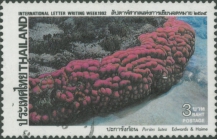
207246 (urn:lsid:marinespecies.org:taxname:207246)
accepted
Species
Madrepora arenosa Esper, 1797 · unaccepted (synonym ?)
Matrepora arenosa (Esper, 1797) · unaccepted (synonym ?)
Porites (Porites) lutea Milne Edwards & Haime, 1851 · unaccepted > superseded combination
Porites arenacea Lamarck, 1816 · unaccepted > junior subjective synonym (?)
Porites arenosa (Esper, 1797) · unaccepted > junior subjective synonym (?)
Porites arenosa lutea Milne Edwards & Haime, 1851 · unaccepted > superseded combination
Porites arenosa parvicellata Gardiner, 1898 · unaccepted > junior subjective synonym
Porites arenosa var. lutea Milne Edwards & Haime, 1851 · unaccepted > superseded combination
Porites arenosa var. parvicellata Gardiner, 1898 · unaccepted > junior subjective synonym
Porites arenosa var. parvistella Gardiner, 1898 · unaccepted > junior subjective synonym
Porites conglomerata var. lutea Milne Edwards & Haime, 1851 · unaccepted > superseded combination
Porites haddoni Vaughan, 1918 · unaccepted > junior subjective synonym
Porites lutea haddoni Vaughan, 1918 · unaccepted > junior subjective synonym
Porites tenuis Verrill, 1866 · unaccepted > junior subjective synonym
Synaraea lutea (Milne Edwards & Haime, 1851) · unaccepted > superseded combination
- Subspecies Porites lutea haddoni Vaughan, 1918 accepted as Porites lutea Milne Edwards & Haime, 1851 (unaccepted > junior subjective synonym)
marine, fresh, terrestrial
Milne Edwards H, Haime J (1851) Recherches sur les polypiers. Mémoire 7. Monographie des Poritides. Annales des Sciences Naturelles, Zoologie, Series 3, 16: 21-70. [details]
Type locality contained in Fijian Exclusive Economic Zone
, Note Fiji (Veron, 1986). Spelled P. luta in Sloan...
type locality contained in Fijian Exclusive Economic Zone [details]
From other sources
Type locality Fiji (Veron, 1986). Spelled P. luta in Sloan et al. (1979). [details]
Description Colonies reach several metres across when fully grown. They are basically hemispherical, but in moderately or strongly...
Description Colonies reach several metres across when fully grown. They are basically hemispherical, but in moderately or strongly sedimented conditions tend to develop thick, upward growing columns. Important comparative features are that in P. lutea the septal triplet fuse to form a trident, and calices are smaller and walls usually thicker than in P. solida. Also, calices have five or six large pali which help to distinguish this from P. solida. This species is very widespread. It is at its most abundant in sheltered areas such as on back reef slopes of patch reefs and in bays, where huge colonies cover over 75% of the substrate over thousands of square metres, between the surface and 15 m deep. These colonies tend to be columnar in shape, a condition which seems to be initiated by sedimentation into depressions of the surface of the coral and death of the covered sections (Sheppard, 1998).
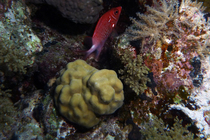
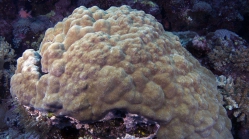
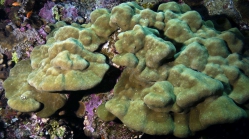
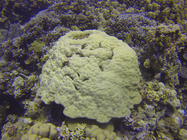
Colonies are hemispherical or helmet-shaped and may be very large. The surface is usually smooth. Colour: usually cream or yellow but may be bright colours in shallow water. Abundance: very common and occurs with P. lobata and P. australiensis on back reef margins, lagoons and fringing reefs (Veron, 1986).
Characteristic of the massive species, which are difficult to tell apart. Colonies are hemispherical, often very large, and may be undercut at the base. The outer surface may be loosely folded in flat mounds and ridges but is smooth in texture. Corallites are 1-1.5 mm in diameter. Colour: usually varies from pale grey to yellow, lime-green or pink. Habitat: shallow lagoons, where they may form micro-atolls, and fringing reefs (Richmond, 1997). [details]
Colonies are hemispherical or helmet-shaped and may be very large. The surface is usually smooth. Colour: usually cream or yellow but may be bright colours in shallow water. Abundance: very common and occurs with P. lobata and P. australiensis on back reef margins, lagoons and fringing reefs (Veron, 1986).
Characteristic of the massive species, which are difficult to tell apart. Colonies are hemispherical, often very large, and may be undercut at the base. The outer surface may be loosely folded in flat mounds and ridges but is smooth in texture. Corallites are 1-1.5 mm in diameter. Colour: usually varies from pale grey to yellow, lime-green or pink. Habitat: shallow lagoons, where they may form micro-atolls, and fringing reefs (Richmond, 1997). [details]
Hoeksema, B. W.; Cairns, S. (2024). World List of Scleractinia. Porites lutea Milne Edwards & Haime, 1851. Accessed through: World Register of Marine Species at: https://www.marinespecies.org/aphia.php?p=taxdetails&id=207246 on 2024-09-17
Date
action
by
2000-09-13 07:19:12Z
changed
Garcia, Maria
 The webpage text is licensed under a Creative Commons Attribution 4.0 License
original description
Milne Edwards H, Haime J (1851) Recherches sur les polypiers. Mémoire 7. Monographie des Poritides. Annales des Sciences Naturelles, Zoologie, Series 3, 16: 21-70. [details]
original description (of Porites tenuis Verrill, 1866) Verrill AE. (1866). Synopsis of the polyps and corals of the North Pacific Exploring Expedition, under Commodore C. Ringgold and Capt. John Rodgers, U.S.N., from 1853 to 1856. Collected by Dr. Wm. Stimpson, Naturalist to the Expedition. With descriptions of some additional species from the west coast of North America. Part III. Madreporaria. <em>Communications of the Essex Institute, Salem.</em> 5(3): 17-50, pls. 1-2., available online at https://www.biodiversitylibrary.org/page/33204514 [details]
original description (of Madrepora arenosa Esper, 1797) Esper, E.J.C. (1797). Fortsetzungen der Pflanzenthiere in Abbildungennach der Natur mit Farben erleuchtet nebst Beschreibungen. Erster Theil.(Nürnberg): 1-230, pls XXXII-LXI., available online at https://doi.org/10.5962/bhl.title.118730 [details]
original description (of Porites haddoni Vaughan, 1918) Vaughan TW. (1918). Some shallow-water corals from Murray Island (Australia), Cocos-Keeling Island, and Fanning Island. <em>Papers from the Department of Marine Biology of the Carnegie Institution of Washington.</em> 9 (213): 49-234, pls. 20-93. [details]
original description (of Porites lutea haddoni Vaughan, 1918) Vaughan TW. (1918). Some shallow-water corals from Murray Island (Australia), Cocos-Keeling Island, and Fanning Island. <em>Papers from the Department of Marine Biology of the Carnegie Institution of Washington.</em> 9 (213): 49-234, pls. 20-93. [details]
original description (of Porites arenosa var. parvistella Gardiner, 1898) Gardiner JS (1898) On the perforate corals collected by the author in the South Pacific. Proceedings of the Zoological Society of London 1898: 257-276, pls. 23-24. [details]
original description (of Porites arenacea Lamarck, 1816) Lamarck, J.-B. M. de. (1816). Histoire naturelle des animaux sans vertèbres. Tome second. <em>Paris. Verdière.</em> Vol. 2 pp. 1-568., available online at http://www.biodiversitylibrary.org/item/47698
page(s): 270 [details]
original description (of Porites arenosa var. parvicellata Gardiner, 1898) Gardiner JS (1898) On the perforate corals collected by the author in the South Pacific. Proceedings of the Zoological Society of London 1898: 257-276, pls. 23-24. [details]
context source (HKRMS) Ang, P. O.; McCorry, D.; Si, C. C. L. (2003). Establishing a reference collection and field guides for Hong Kong scleractinian coral. <em>Final report submitted to the Agriculture, Fisheries and Conservation Department, The Hong Kong SAR Government.</em> [details]
context source (Hexacorallia) Fautin, Daphne G. (2013). Hexacorallians of the World. (look up in IMIS) [details]
basis of record Veron JEN. (1986). Corals of Australia and the Indo-Pacific. <em>Angus & Robertson Publishers.</em> [details]
additional source Sheppard CRC. (1987). Coral species of the Indian Ocean and adjacent seas: a synonymised compilation and some regional distribution patterns. <em>Atoll Research Bulletin.</em> 307: 1-32., available online at http:// https://doi.org/10.5479/si.00775630.307.1 [details]
additional source Ortmann, A. (1889). Beobachtungen an Steinkorallen von der Südküste Ceylons. <em>Zoologische Jahrbüchern, Abteilung für Systematik, Biologie und Biogeographie der Tiere.</em> 4: 493-590, pls. 11-17.
page(s): 501, 540 [details]
additional source Hoffmeister, J.E. (1925). Some corals from America Samoa and the Fiji Islands. <em>Papers from the Department of Marine Biology of the Carnegie Institution of Washington.</em> 22: 1-90, pls. 1-23.
page(s): 8, 12, 73-75, Pl. 21, figs. 2a, 2b, 2c, 3 [details]
additional source Vaughan TW. (1918). Some shallow-water corals from Murray Island (Australia), Cocos-Keeling Island, and Fanning Island. <em>Papers from the Department of Marine Biology of the Carnegie Institution of Washington.</em> 9 (213): 49-234, pls. 20-93. [details]
additional source Quelch JJ. (1886). Report on the Reef-corals collected by H.M.S. 'Challenger' during the years 1873-76. <em>Report on the Scientific Results of the Voyage of H.M.S. Challenger during the years 1873–1876. Zoology.</em> 16 (46): 1-203, pl. 1-12., available online at http://www.19thcenturyscience.org/HMSC/HMSC-Reports/Zool-46/README.htm
page(s): 15, 19, 26, 29, 183, 184 [details]
additional source Cairns, S.D., B.W. Hoeksema & J. van der Land. (1999). Appendix: List of extant stony corals. <em>Atoll Research Bulletin.</em> 459: 13-46.
page(s): 38 [details]
additional source Cairns, S.D., B.W. Hoeksema & J. van der Land. (2007). as a contribution to UNESCO-IOC Register of Marine Organisms. (look up in IMIS) [details]
additional source Liu, J.Y. [Ruiyu] (ed.). (2008). Checklist of marine biota of China seas. <em>China Science Press.</em> 1267 pp. (look up in IMIS) [details] Available for editors [request]
additional source Benzoni, F., Stefani, F. 2012. Porites fontanesii, a new species of hard coral (Scleractinia, Poritidae) from the southern Red Sea, the Gulf of Tadjoura, and the Gulf of Aden, and its phylogenetic relationships within the genus. Zootaxa 3447: 56–68.
page(s): 65 [details]
additional source Nemenzo, F. (1955). Systematic studies on Philippine shallow water scleractinians: I. Suborder Fungiida. <em>Natural and Applied Science Bulletin, University of the Philippines.</em> 15: 3-84.
page(s): 6, 29, 40-41 [details]
additional source Veron JEN. (2000). Corals of the World. Vol. 1–3. <em>Australian Institute of Marine Science and CRR, Queensland, Australia.</em> [details]
additional source Klunzinger CB. (1879). Die Korallthiere des Rothen Meeres, 2. Theil: Die Steinkorallen. Erster Abschnitt: Die Madreporaceen und Oculinaceen. <em>Gutmann, Berlin.</em> pp. 1-88, pls. 1-10. [details]
additional source Scheer G, Pillai CSG. (1974). Report on Scleractinia from the Nicobar Islands. <em>Zoologica, Stuttgart.</em> 42(122): 1-75.
page(s): 9, 43, 75 [details]
additional source Umbgrove JHF. (1939). Madreporaria from the Bay of Batavia. <em>Zoologische Mededelingen, Leiden.</em> 22: 1-64.
page(s): 6, 9, 14, 16, 19, 58, 59 [details]
additional source Yabe H, Sugiyama T. (1935). Revised list of the reef-corals from the Japanese seas and of the fossil reef corals of the raised reefs and the Ryukyu limestone of Japan. <em>Journal of the Geological Society of Japan.</em> 42: 379-403.
page(s): 401 [details]
additional source Milne Edwards H (1860) Histoire naturelle des coralliaires ou polypes proprement dits 3: 1-560. Librairie Encyclopédique de Roret, Paris. (look up in IMIS) [details]
additional source Bassett-Smith, P.W. (1890). Report on the corals from Tizard and Macclesfield Banks, China Sea. <em>Annals and Magazine of Natural History,.</em> 6(35): 353-374, 443-458, pls. 12-14., available online at https://doi.org/10.1080/00222939008694050
page(s): 361, 456 [details]
additional source Ortmann, A. (1888). Studien über Systematik und geographische Verbreitung der Steinkorallen. <em>Zoologische Jahrbücher, Abtheilung für Systematik, Biologie und Biogeographie der Tiere.</em> 3: 143-188, pl. 6.
page(s): 157, 187 [details]
additional source Forsman, Z. H.; Birkeland, C. (2009). Porites randalli: a new coral species (Scleractinia, Poritidae) from American Samoa. <em>Zootaxa.</em> 2244: 51-59.
page(s): 52 [details]
additional source Pichon, M.; Benzoni, F. (2007). Taxonomic re-appraisal of zooxanthellate Scleractinian Corals in the Maldive Archipelago. <em>Zootaxa.</em> 1441: 21–33.
page(s): 31 [details]
additional source Reyes-Bonilla, H. (2002). Checklist of valid names and synonyms of stony corals (Anthozoa: Scleractinia) from the eastern Pacific. <em>Journal of Natural History.</em> 36(1): 1-13., available online at https://doi.org/10.1080/713833841 [details]
additional source Faustino LA. (1927). Recent Madreporaria of the Philippine Islands. <em>Bureau of Science Manila Monograph.</em> 22: 1-310, pls. 1-100.
page(s): 30, 294 [details]
additional source Veron JEN, Marsh LM. (1988). Hermatypic corals of Western Australia : records and annotated species list. <em>Records Western Australian Museum Supplement.</em> 29: 1-136., available online at https://doi.org/10.5962/bhl.title.60555
page(s): 33, 65 [details]
additional source Pillai CSG. (1972). Stony corals of the seas around India. <em>Proceedings of the First International Symposium on Corals and Coral Reefs, 1969. Marine Biological Association of India Symposium.</em> 5: 191-216.
page(s): 204 [details]
additional source Whitelegge, T. (1898). The Madroporaria of Funafuti. <em>The Australian Museum Memoir.</em> 3(6): 349-368.
page(s): 366 [details]
additional source Fenner, D. P. (2005). Corals of Hawai'i. A Field Guide to the Hard, Black, and Soft Corals of Hawai'i and the Northwest Hawaiian Islands, Including Midway. <em>Mutual Publishing, Ltd., Honolulu.</em> 144 pp.
page(s): 20, 31, 112 [details]
additional source Umbgrove JHF. (1924). Report on Plistocene and Pliocene corals from Ceram. <em>Geological, Petrographical, and Paleontological Results of explorations carried out from September 1917 till June 1919 in the island of Ceram, Second Series: Palaeontology.</em> 1: 1-22, map, pls. 1-2. [details]
additional source Rathbun, R. (1887). Annotated catalogue of the species of Porites and Synaraea in the U.S.N.M., with the description of a new species of Porites. Proceedings of the United States National Museum, 10: 354-366
page(s): 364 [details]
additional source Veron, J. E. N. (2000). Corals of the World, Volume III: Families Mussidae, Faviidae, Trachyphylliidae, Poritidae. Australian Institute of Marine Science. Townsville., volume 3, pp. 490.
page(s): 287 [details]
additional source Ryland, J. S. (1981). Reefs of southwest Viti Levu and their tourism potential. Proceedings of the Fourth International Coral Reef Symposium, 1, 293-298
page(s): 296-297 [details]
additional source Maragos, J. E.; Molina, M.; Kenyon, J. (2004). Palmyra Atoll coral data compiled from Townsend Cromwell 2000-2002, U.S. Fish and Wildlife Service 2000-2001, and Sette 2004 surveys [Table 8]. UNPUBLISHED, UNPUBLISHED [details]
additional source Maragos, J. E.; Schmerfeld, J. (2004). Coral survey from Howland Island National Wildlife Refuge, 1998-2004 [Table 3]. UNPUBLISHED, Unpublished
page(s): 1 [details]
additional source Maragos, J. E.; Kenyon, J. (2004). Rose Atoll coral data compiled from US Fish and Wildlife Service 1994, Townsend Cromwell 2002, and Sette 2004 surveys [Table 10]. UNPUBLISHED, Unpublished
page(s): 1 [details]
additional source Maragos, J. E. (2004). Baker Island coral data [Table unnumbered]. UNPUBLISHED, Unpublished
page(s): 2 [details]
additional source Ortmann, A. (1892). Die Korallriffe von Dar-es-Salaam und Umgegend. <em>Zoologische Jahrbücher Abteilung für Systematik.</em> 6: 631-670., available online at https://biodiversitylibrary.org/page/10195227
page(s): 635, 636, 638, 640, 654 [details]
additional source Wells JW. (1954). Recent corals of the Marshall Islands: Bikini and nearby atolls, part 2, oceanography (biologic). <em>U.S. Geological Survey Professional Paper.</em> 260(I): 385-486.
page(s): 385, 393, 396, 397, 398, 400, 402, 403, 452-453, pls. 165, 166, 167 [details]
additional source Pillai CSG. (1983). Structure and generic diversity of recent Scleractinia of India. <em>Journal of the Marine Biological Association of India.</em> 25, 1-2, 78-90.
page(s): 83, 86 [details]
additional source Sheppard, C. R. C.; Sheppard, A. L. S. (1985). The central Red Sea at Yanbu al Sinaiyah. Fauna of Saudi Arabia, 7, 17-36
page(s): 27, 31 [details]
additional source Lapian, H. F. N.; Barucca, M.; Bavestrello, G.; Biscotti, M. A.; Bo, M.; Canapa, A.; Tazioli, S.; Olmo, E. (2007). A systematic study of some black corals species (Antipatharia, Hexacorallia) based on rDNA internal transcribed spacers sequences. Marine Biology, 151, 785-792
page(s): 790 [details]
additional source Kühlmann, D. H. H. (2006). Die Steinkorallensammlung im Naturhistorischen Museum in Rudolstadt (Thüringen) nebst ökologischen Bemerkungen. Rudolstädter Naturhistorische Schriften, 13, 37-113
page(s): 62, 65, 87, 107, 112 [details]
additional source Wallace, C. C.; Fellegara, I.; Muir, P. R.; Harrison, P. L. (2009). The scleractinian corals of Moreton Bay, eastern Australia: high latitude, marginal assemblages with increasing species richness. Memoirs of the Queensland Museum, 54, 2
page(s): 9 [details]
original description (of Porites tenuis Verrill, 1866) Verrill AE. (1866). Synopsis of the polyps and corals of the North Pacific Exploring Expedition, under Commodore C. Ringgold and Capt. John Rodgers, U.S.N., from 1853 to 1856. Collected by Dr. Wm. Stimpson, Naturalist to the Expedition. With descriptions of some additional species from the west coast of North America. Part III. Madreporaria. <em>Communications of the Essex Institute, Salem.</em> 5(3): 17-50, pls. 1-2., available online at https://www.biodiversitylibrary.org/page/33204514 [details]
original description (of Madrepora arenosa Esper, 1797) Esper, E.J.C. (1797). Fortsetzungen der Pflanzenthiere in Abbildungennach der Natur mit Farben erleuchtet nebst Beschreibungen. Erster Theil.(Nürnberg): 1-230, pls XXXII-LXI., available online at https://doi.org/10.5962/bhl.title.118730 [details]
original description (of Porites haddoni Vaughan, 1918) Vaughan TW. (1918). Some shallow-water corals from Murray Island (Australia), Cocos-Keeling Island, and Fanning Island. <em>Papers from the Department of Marine Biology of the Carnegie Institution of Washington.</em> 9 (213): 49-234, pls. 20-93. [details]
original description (of Porites lutea haddoni Vaughan, 1918) Vaughan TW. (1918). Some shallow-water corals from Murray Island (Australia), Cocos-Keeling Island, and Fanning Island. <em>Papers from the Department of Marine Biology of the Carnegie Institution of Washington.</em> 9 (213): 49-234, pls. 20-93. [details]
original description (of Porites arenosa var. parvistella Gardiner, 1898) Gardiner JS (1898) On the perforate corals collected by the author in the South Pacific. Proceedings of the Zoological Society of London 1898: 257-276, pls. 23-24. [details]
original description (of Porites arenacea Lamarck, 1816) Lamarck, J.-B. M. de. (1816). Histoire naturelle des animaux sans vertèbres. Tome second. <em>Paris. Verdière.</em> Vol. 2 pp. 1-568., available online at http://www.biodiversitylibrary.org/item/47698
page(s): 270 [details]
original description (of Porites arenosa var. parvicellata Gardiner, 1898) Gardiner JS (1898) On the perforate corals collected by the author in the South Pacific. Proceedings of the Zoological Society of London 1898: 257-276, pls. 23-24. [details]
context source (HKRMS) Ang, P. O.; McCorry, D.; Si, C. C. L. (2003). Establishing a reference collection and field guides for Hong Kong scleractinian coral. <em>Final report submitted to the Agriculture, Fisheries and Conservation Department, The Hong Kong SAR Government.</em> [details]
context source (Hexacorallia) Fautin, Daphne G. (2013). Hexacorallians of the World. (look up in IMIS) [details]
basis of record Veron JEN. (1986). Corals of Australia and the Indo-Pacific. <em>Angus & Robertson Publishers.</em> [details]
additional source Sheppard CRC. (1987). Coral species of the Indian Ocean and adjacent seas: a synonymised compilation and some regional distribution patterns. <em>Atoll Research Bulletin.</em> 307: 1-32., available online at http:// https://doi.org/10.5479/si.00775630.307.1 [details]
additional source Ortmann, A. (1889). Beobachtungen an Steinkorallen von der Südküste Ceylons. <em>Zoologische Jahrbüchern, Abteilung für Systematik, Biologie und Biogeographie der Tiere.</em> 4: 493-590, pls. 11-17.
page(s): 501, 540 [details]
additional source Hoffmeister, J.E. (1925). Some corals from America Samoa and the Fiji Islands. <em>Papers from the Department of Marine Biology of the Carnegie Institution of Washington.</em> 22: 1-90, pls. 1-23.
page(s): 8, 12, 73-75, Pl. 21, figs. 2a, 2b, 2c, 3 [details]
additional source Vaughan TW. (1918). Some shallow-water corals from Murray Island (Australia), Cocos-Keeling Island, and Fanning Island. <em>Papers from the Department of Marine Biology of the Carnegie Institution of Washington.</em> 9 (213): 49-234, pls. 20-93. [details]
additional source Quelch JJ. (1886). Report on the Reef-corals collected by H.M.S. 'Challenger' during the years 1873-76. <em>Report on the Scientific Results of the Voyage of H.M.S. Challenger during the years 1873–1876. Zoology.</em> 16 (46): 1-203, pl. 1-12., available online at http://www.19thcenturyscience.org/HMSC/HMSC-Reports/Zool-46/README.htm
page(s): 15, 19, 26, 29, 183, 184 [details]
additional source Cairns, S.D., B.W. Hoeksema & J. van der Land. (1999). Appendix: List of extant stony corals. <em>Atoll Research Bulletin.</em> 459: 13-46.
page(s): 38 [details]
additional source Cairns, S.D., B.W. Hoeksema & J. van der Land. (2007). as a contribution to UNESCO-IOC Register of Marine Organisms. (look up in IMIS) [details]
additional source Liu, J.Y. [Ruiyu] (ed.). (2008). Checklist of marine biota of China seas. <em>China Science Press.</em> 1267 pp. (look up in IMIS) [details] Available for editors
[request] additional source Benzoni, F., Stefani, F. 2012. Porites fontanesii, a new species of hard coral (Scleractinia, Poritidae) from the southern Red Sea, the Gulf of Tadjoura, and the Gulf of Aden, and its phylogenetic relationships within the genus. Zootaxa 3447: 56–68.
page(s): 65 [details]
additional source Nemenzo, F. (1955). Systematic studies on Philippine shallow water scleractinians: I. Suborder Fungiida. <em>Natural and Applied Science Bulletin, University of the Philippines.</em> 15: 3-84.
page(s): 6, 29, 40-41 [details]
additional source Veron JEN. (2000). Corals of the World. Vol. 1–3. <em>Australian Institute of Marine Science and CRR, Queensland, Australia.</em> [details]
additional source Klunzinger CB. (1879). Die Korallthiere des Rothen Meeres, 2. Theil: Die Steinkorallen. Erster Abschnitt: Die Madreporaceen und Oculinaceen. <em>Gutmann, Berlin.</em> pp. 1-88, pls. 1-10. [details]
additional source Scheer G, Pillai CSG. (1974). Report on Scleractinia from the Nicobar Islands. <em>Zoologica, Stuttgart.</em> 42(122): 1-75.
page(s): 9, 43, 75 [details]
additional source Umbgrove JHF. (1939). Madreporaria from the Bay of Batavia. <em>Zoologische Mededelingen, Leiden.</em> 22: 1-64.
page(s): 6, 9, 14, 16, 19, 58, 59 [details]
additional source Yabe H, Sugiyama T. (1935). Revised list of the reef-corals from the Japanese seas and of the fossil reef corals of the raised reefs and the Ryukyu limestone of Japan. <em>Journal of the Geological Society of Japan.</em> 42: 379-403.
page(s): 401 [details]
additional source Milne Edwards H (1860) Histoire naturelle des coralliaires ou polypes proprement dits 3: 1-560. Librairie Encyclopédique de Roret, Paris. (look up in IMIS) [details]
additional source Bassett-Smith, P.W. (1890). Report on the corals from Tizard and Macclesfield Banks, China Sea. <em>Annals and Magazine of Natural History,.</em> 6(35): 353-374, 443-458, pls. 12-14., available online at https://doi.org/10.1080/00222939008694050
page(s): 361, 456 [details]
additional source Ortmann, A. (1888). Studien über Systematik und geographische Verbreitung der Steinkorallen. <em>Zoologische Jahrbücher, Abtheilung für Systematik, Biologie und Biogeographie der Tiere.</em> 3: 143-188, pl. 6.
page(s): 157, 187 [details]
additional source Forsman, Z. H.; Birkeland, C. (2009). Porites randalli: a new coral species (Scleractinia, Poritidae) from American Samoa. <em>Zootaxa.</em> 2244: 51-59.
page(s): 52 [details]
additional source Pichon, M.; Benzoni, F. (2007). Taxonomic re-appraisal of zooxanthellate Scleractinian Corals in the Maldive Archipelago. <em>Zootaxa.</em> 1441: 21–33.
page(s): 31 [details]
additional source Reyes-Bonilla, H. (2002). Checklist of valid names and synonyms of stony corals (Anthozoa: Scleractinia) from the eastern Pacific. <em>Journal of Natural History.</em> 36(1): 1-13., available online at https://doi.org/10.1080/713833841 [details]
additional source Faustino LA. (1927). Recent Madreporaria of the Philippine Islands. <em>Bureau of Science Manila Monograph.</em> 22: 1-310, pls. 1-100.
page(s): 30, 294 [details]
additional source Veron JEN, Marsh LM. (1988). Hermatypic corals of Western Australia : records and annotated species list. <em>Records Western Australian Museum Supplement.</em> 29: 1-136., available online at https://doi.org/10.5962/bhl.title.60555
page(s): 33, 65 [details]
additional source Pillai CSG. (1972). Stony corals of the seas around India. <em>Proceedings of the First International Symposium on Corals and Coral Reefs, 1969. Marine Biological Association of India Symposium.</em> 5: 191-216.
page(s): 204 [details]
additional source Whitelegge, T. (1898). The Madroporaria of Funafuti. <em>The Australian Museum Memoir.</em> 3(6): 349-368.
page(s): 366 [details]
additional source Fenner, D. P. (2005). Corals of Hawai'i. A Field Guide to the Hard, Black, and Soft Corals of Hawai'i and the Northwest Hawaiian Islands, Including Midway. <em>Mutual Publishing, Ltd., Honolulu.</em> 144 pp.
page(s): 20, 31, 112 [details]
additional source Umbgrove JHF. (1924). Report on Plistocene and Pliocene corals from Ceram. <em>Geological, Petrographical, and Paleontological Results of explorations carried out from September 1917 till June 1919 in the island of Ceram, Second Series: Palaeontology.</em> 1: 1-22, map, pls. 1-2. [details]
additional source Rathbun, R. (1887). Annotated catalogue of the species of Porites and Synaraea in the U.S.N.M., with the description of a new species of Porites. Proceedings of the United States National Museum, 10: 354-366
page(s): 364 [details]
additional source Veron, J. E. N. (2000). Corals of the World, Volume III: Families Mussidae, Faviidae, Trachyphylliidae, Poritidae. Australian Institute of Marine Science. Townsville., volume 3, pp. 490.
page(s): 287 [details]
additional source Ryland, J. S. (1981). Reefs of southwest Viti Levu and their tourism potential. Proceedings of the Fourth International Coral Reef Symposium, 1, 293-298
page(s): 296-297 [details]
additional source Maragos, J. E.; Molina, M.; Kenyon, J. (2004). Palmyra Atoll coral data compiled from Townsend Cromwell 2000-2002, U.S. Fish and Wildlife Service 2000-2001, and Sette 2004 surveys [Table 8]. UNPUBLISHED, UNPUBLISHED [details]
additional source Maragos, J. E.; Schmerfeld, J. (2004). Coral survey from Howland Island National Wildlife Refuge, 1998-2004 [Table 3]. UNPUBLISHED, Unpublished
page(s): 1 [details]
additional source Maragos, J. E.; Kenyon, J. (2004). Rose Atoll coral data compiled from US Fish and Wildlife Service 1994, Townsend Cromwell 2002, and Sette 2004 surveys [Table 10]. UNPUBLISHED, Unpublished
page(s): 1 [details]
additional source Maragos, J. E. (2004). Baker Island coral data [Table unnumbered]. UNPUBLISHED, Unpublished
page(s): 2 [details]
additional source Ortmann, A. (1892). Die Korallriffe von Dar-es-Salaam und Umgegend. <em>Zoologische Jahrbücher Abteilung für Systematik.</em> 6: 631-670., available online at https://biodiversitylibrary.org/page/10195227
page(s): 635, 636, 638, 640, 654 [details]
additional source Wells JW. (1954). Recent corals of the Marshall Islands: Bikini and nearby atolls, part 2, oceanography (biologic). <em>U.S. Geological Survey Professional Paper.</em> 260(I): 385-486.
page(s): 385, 393, 396, 397, 398, 400, 402, 403, 452-453, pls. 165, 166, 167 [details]
additional source Pillai CSG. (1983). Structure and generic diversity of recent Scleractinia of India. <em>Journal of the Marine Biological Association of India.</em> 25, 1-2, 78-90.
page(s): 83, 86 [details]
additional source Sheppard, C. R. C.; Sheppard, A. L. S. (1985). The central Red Sea at Yanbu al Sinaiyah. Fauna of Saudi Arabia, 7, 17-36
page(s): 27, 31 [details]
additional source Lapian, H. F. N.; Barucca, M.; Bavestrello, G.; Biscotti, M. A.; Bo, M.; Canapa, A.; Tazioli, S.; Olmo, E. (2007). A systematic study of some black corals species (Antipatharia, Hexacorallia) based on rDNA internal transcribed spacers sequences. Marine Biology, 151, 785-792
page(s): 790 [details]
additional source Kühlmann, D. H. H. (2006). Die Steinkorallensammlung im Naturhistorischen Museum in Rudolstadt (Thüringen) nebst ökologischen Bemerkungen. Rudolstädter Naturhistorische Schriften, 13, 37-113
page(s): 62, 65, 87, 107, 112 [details]
additional source Wallace, C. C.; Fellegara, I.; Muir, P. R.; Harrison, P. L. (2009). The scleractinian corals of Moreton Bay, eastern Australia: high latitude, marginal assemblages with increasing species richness. Memoirs of the Queensland Museum, 54, 2
page(s): 9 [details]
 Present Present in aphia/obis/gbif/idigbio Inaccurate Introduced: alien Containing type locality
Nontype (of Porites arenosa (Esper, 1797)) BMNH, geounit Chinese Exclusive Economic Zone [details]
Nontype (of Porites tenuis Verrill, 1866) BMNH, geounit Philippines Exclusive Economic Zone [details]
Nontype BMNH, geounit Taiwanese Exclusive Economic Zone [details]
Nontype HLD X2: 151-10, geounit Indian Exclusive Economic Zone [details]
Nontype NMSR 8562, geounit Yemeni Exclusive Economic Zone [details]
Nontype NMSR I/570/E3 [details]
Nontype NMSR K 10 [details]
Nontype WAM 174-74, geounit Australian Exclusive Economic Zone [details]
Nontype WAM 187-81, geounit Australian Exclusive Economic Zone [details]
Nontype WAM 188-81, geounit Australian Exclusive Economic Zone [details]
Nontype WAM 204-81, geounit Australian Exclusive Economic Zone [details]
Nontype WAM 245-74, geounit Australian Exclusive Economic Zone [details]
Nontype WAM 259-74, geounit Australian Exclusive Economic Zone [details]
Nontype WAM 294-84, geounit Australian Exclusive Economic Zone [details]
Nontype WAM 369-77, geounit Australian Exclusive Economic Zone [details]
Nontype WAM 395-80, geounit Australian Exclusive Economic Zone [details]
Nontype WAM 42-78, geounit Australian Exclusive Economic Zone [details]
Nontype WAM 431-85, geounit Australian Exclusive Economic Zone [details]
Nontype WAM 435-85, geounit Australian Exclusive Economic Zone [details]
Nontype WAM 43-78, geounit Australian Exclusive Economic Zone [details]
Nontype WAM 45-78, geounit Australian Exclusive Economic Zone [details]
Nontype WAM 499-84, geounit Australian Exclusive Economic Zone [details]
Nontype WAM 501-84, geounit Australian Exclusive Economic Zone [details]
Nontype WAM 502-84, geounit Australian Exclusive Economic Zone [details]
Nontype WAM 512-79, geounit Australian Exclusive Economic Zone [details]
Nontype WAM 549-81, geounit Australian Exclusive Economic Zone [details]
Nontype WAM 56-81, geounit Australian Exclusive Economic Zone [details]
Nontype WAM 590-78, geounit Australian Exclusive Economic Zone [details]
Nontype WAM 591-78, geounit Australian Exclusive Economic Zone [details]
Nontype WAM 592-78, geounit Australian Exclusive Economic Zone [details]
Nontype WAM 6-76, geounit Australian Exclusive Economic Zone [details]
Nontype WAM 726-76, geounit Ashmore-Cartier Is. [details]
Nontype WAM 898-81, geounit Australian Exclusive Economic Zone [details]
Nontype WAM 902-86, geounit Ashmore-Cartier Is. [details]
Unknown type (of Synaraea lutea (Milne Edwards & Haime, 1851)) SMNS [details]
Unknown type (of Porites tenuis Verrill, 1866) MSI C-186, geounit Philippines Exclusive Economic Zone [details]
Unknown type (of Porites tenuis Verrill, 1866) MSI C-60 [details]
Unknown type MNHN, geounit Fijian Exclusive Economic Zone [details]
Unknown type MSI C-443, geounit Philippines Exclusive Economic Zone [details]
Unknown type MZUS, geounit American Samoa Exclusive Economic Zone [details]
Unknown type MZUS, geounit Palau Exclusive Economic Zone [details]
From editor or global species database
Biology zooxanthellate [details]From other sources
Description Colonies reach several metres across when fully grown. They are basically hemispherical, but in moderately or strongly sedimented conditions tend to develop thick, upward growing columns. Important comparative features are that in P. lutea the septal triplet fuse to form a trident, and calices are smaller and walls usually thicker than in P. solida. Also, calices have five or six large pali which help to distinguish this from P. solida. This species is very widespread. It is at its most abundant in sheltered areas such as on back reef slopes of patch reefs and in bays, where huge colonies cover over 75% of the substrate over thousands of square metres, between the surface and 15 m deep. These colonies tend to be columnar in shape, a condition which seems to be initiated by sedimentation into depressions of the surface of the coral and death of the covered sections (Sheppard, 1998).Colonies are hemispherical or helmet-shaped and may be very large. The surface is usually smooth. Colour: usually cream or yellow but may be bright colours in shallow water. Abundance: very common and occurs with P. lobata and P. australiensis on back reef margins, lagoons and fringing reefs (Veron, 1986).
Characteristic of the massive species, which are difficult to tell apart. Colonies are hemispherical, often very large, and may be undercut at the base. The outer surface may be loosely folded in flat mounds and ridges but is smooth in texture. Corallites are 1-1.5 mm in diameter. Colour: usually varies from pale grey to yellow, lime-green or pink. Habitat: shallow lagoons, where they may form micro-atolls, and fringing reefs (Richmond, 1997). [details]
Type locality Fiji (Veron, 1986). Spelled P. luta in Sloan et al. (1979). [details]

To Barcode of Life (41 barcodes)
To Biodiversity Heritage Library (16 publications) (from synonym Porites tenuis Verrill, 1866)
To Biodiversity Heritage Library (23 publications) (from synonym Porites arenosa (Esper, 1797))
To Biodiversity Heritage Library (48 publications)
To Biodiversity Heritage Library (5 publications) (from synonym Porites haddoni Vaughan, 1918)
To Biological Information System for Marine Life (BISMaL)
To European Nucleotide Archive, ENA (Porites lutea)
To Fishipedia
To GenBank (1659 nucleotides; 309 proteins)
To GenBank (1659 nucleotides; 309 proteins) (from synonym Porites arenacea Lamarck, 1816)
To IUCN Red List (Least Concern)
To MNHN Fossil collection (Porites arenosa (ESPER, 1797); Figuré; F.A51139) (from synonym Porites arenosa (Esper, 1797))
To USNM Invertebrate Zoology Cnidaria Collection (1 record) (from synonym Porites tenuis Verrill, 1866)
To USNM Invertebrate Zoology Cnidaria Collection (134 records)
To USNM Invertebrate Zoology Cnidaria Collection (7 records) (from synonym Porites haddoni Vaughan, 1918)
To USNM Invertebrate Zoology Cnidaria Collection (Holotype USNM 407) (from synonym Porites tenuis Verrill, 1866)
To ITIS
To Biodiversity Heritage Library (16 publications) (from synonym Porites tenuis Verrill, 1866)
To Biodiversity Heritage Library (23 publications) (from synonym Porites arenosa (Esper, 1797))
To Biodiversity Heritage Library (48 publications)
To Biodiversity Heritage Library (5 publications) (from synonym Porites haddoni Vaughan, 1918)
To Biological Information System for Marine Life (BISMaL)
To European Nucleotide Archive, ENA (Porites lutea)
To Fishipedia
To GenBank (1659 nucleotides; 309 proteins)
To GenBank (1659 nucleotides; 309 proteins) (from synonym Porites arenacea Lamarck, 1816)
To IUCN Red List (Least Concern)
To MNHN Fossil collection (Porites arenosa (ESPER, 1797); Figuré; F.A51139) (from synonym Porites arenosa (Esper, 1797))
To USNM Invertebrate Zoology Cnidaria Collection (1 record) (from synonym Porites tenuis Verrill, 1866)
To USNM Invertebrate Zoology Cnidaria Collection (134 records)
To USNM Invertebrate Zoology Cnidaria Collection (7 records) (from synonym Porites haddoni Vaughan, 1918)
To USNM Invertebrate Zoology Cnidaria Collection (Holotype USNM 407) (from synonym Porites tenuis Verrill, 1866)
To ITIS