WoRMS taxon details
Plesiastrea versipora (Lamarck, 1816)
207494 (urn:lsid:marinespecies.org:taxname:207494)
accepted
Species
Astraea (Fissicella) versipora Lamarck, 1816 · unaccepted > superseded combination
Astraea versipora Lamarck, 1816 · unaccepted > misspelling - incorrect subsequent spelling
Astrea versipora Lamarck, 1816 · unaccepted > superseded combination (basionym)
Favia versipora (Lamarck, 1816) · unaccepted > superseded combination (basionym)
Orbicella versipora (Lamarck, 1816) · unaccepted > superseded combination
Plesiastraea quatrefagesana (Milne Edwards & Haime, 1849) · unaccepted > junior subjective synonym
Plesiastraea urvillei Milne Edwards & Haime, 1848 · unaccepted > junior subjective synonym
Plesiastrea mammillosa (Klunzinger, 1879) · unaccepted > junior subjective synonym
Plesiastrea proximans Dennant, 1904 · unaccepted > junior subjective synonym
Plesiastrea quatrefagesana Milne Edwards & Haime, 1849 · unaccepted > junior subjective synonym
Plesiastrea quatrefagiana Milne Edwards & Haime, 1849 · unaccepted > junior subjective synonym
Plesiastrea urvillei Milne Edwards & Haime, 1848 · unaccepted > junior subjective synonym
Plesiastrea urvillii Milne Edwards & Haime, 1848 · unaccepted > junior subjective synonym
marine, fresh, terrestrial
(of Astrea versipora Lamarck, 1816) Lamarck, J.-B. M. de. (1816). Histoire naturelle des animaux sans vertèbres. Tome second. <em>Paris. Verdière.</em> Vol. 2 pp. 1-568., available online at http://www.biodiversitylibrary.org/item/47698 [details] 
Holotype (of Astrea versipora Lamarck, 1816) MNHN...
, Note Red Sea (Veron, 1986).
Holotype (of Astrea versipora Lamarck, 1816) MNHN scle36, verbatimGeounit Habite l'Ocean indie... [details]
From other sources
Type locality Red Sea (Veron, 1986). [details]
Description This species is widespread, and reasonably common. It can often be recognised in situ by its daytime expanded tentacles....
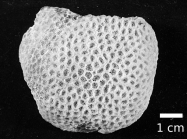
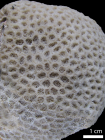
Description This species is widespread, and reasonably common. It can often be recognised in situ by its daytime expanded tentacles. Corallites are usually strongly plocoid, and about 3.5 to 4.5 mm diameter. Many examples showed a few "giant" corallites. Budding is predominantly extratentacular but with examples of intratentacular budding on many coralla. On cleaned specimens, a clear ring of large pali distinguishes the species. Reef slopes of clear to moderately turbid water are the usual habitat, in shallow to mid-depths. Tentacles are extended during daytime which make the living coral distinct from other small faviids underwater. (Sheppard, 1998 <308>)
Colonies are flat and are frequently lobed. Corallites are monocentric and plocoid. Daughter corallites are produced by extratentacular budding. Corallites have calices approximately 2.5 mm in diameter. Paliform lobes form a neat circle around small columellae. Polyps are usually extended only at night. Tentacles are short and are of two alternating sizes. Colour: yellow, cream, green or brown, usually pale-coloured in the tropics and brightly coloured (green or brown ) in high latitude areas. Abundance: in high latitudes it occurs in a wide range of non-reefal environments protected from strong wave action, and colonies may attain 3 m in diameter. Occurs in most reef environments but large colonies usually occur only in shaded places, such as under overhangs, and are seldom common. (Veron, 1986 <57>) [details]
Colonies are flat and are frequently lobed. Corallites are monocentric and plocoid. Daughter corallites are produced by extratentacular budding. Corallites have calices approximately 2.5 mm in diameter. Paliform lobes form a neat circle around small columellae. Polyps are usually extended only at night. Tentacles are short and are of two alternating sizes. Colour: yellow, cream, green or brown, usually pale-coloured in the tropics and brightly coloured (green or brown ) in high latitude areas. Abundance: in high latitudes it occurs in a wide range of non-reefal environments protected from strong wave action, and colonies may attain 3 m in diameter. Occurs in most reef environments but large colonies usually occur only in shaded places, such as under overhangs, and are seldom common. (Veron, 1986 <57>) [details]
Hoeksema, B. W.; Cairns, S. (2024). World List of Scleractinia. Plesiastrea versipora (Lamarck, 1816). Accessed through: World Register of Marine Species at: https://www.marinespecies.org/aphia.php?p=taxdetails&id=207494 on 2024-04-26
Date
action
by
 The webpage text is licensed under a Creative Commons Attribution 4.0 License
original description
(of Astrea versipora Lamarck, 1816) Lamarck, J.-B. M. de. (1816). Histoire naturelle des animaux sans vertèbres. Tome second. <em>Paris. Verdière.</em> Vol. 2 pp. 1-568., available online at http://www.biodiversitylibrary.org/item/47698 [details]
original description (of Plesiastrea proximans Dennant, 1904) Dennant, J. (1904). Recent corals from the South Australian and Victorian coasts. <em>Transactions and Proceedings of the Royal Society of South Australia.</em> 28: 1-11, pls. 1-2. [details]
original description (of Plesiastrea quatrefagiana Milne Edwards & Haime, 1849) Milne Edwards H, Haime J. (1849). Recherches sur les polypiers. Mémoire 4. Monographie des Astréides (1) (suite). <em>Annales des Sciences Naturelles, Zoologie, Series 3.</em> 12, 3, 95-197. [details]
original description (of Astraea versipora Lamarck, 1816) Lamarck, J.-B. M. de. (1816). Histoire naturelle des animaux sans vertèbres. Tome second. <em>Paris. Verdière.</em> Vol. 2 pp. 1-568., available online at http://www.biodiversitylibrary.org/item/47698 [details]
original description (of Plesiastrea urvillii Milne Edwards & Haime, 1848) Milne Edwards, H.; Haime, J. (1848). Recherches sur les polypiers. Mémoire 4. Monographie des Astréides (1). <em>Annales des Sciences Naturelles, Zoologie, Series 3.</em> 10: 209-320, pls. 5-9. [details]
context source (HKRMS) AFCD. (2004). Ecological Status and Revised Species Records of Hong Kong's Scleractinian Corals. Agriculture, Fisheries and Conservation Department,The Hong Kong SAR Government. [details]
context source (Hexacorallia) Fautin, Daphne G. (2013). Hexacorallians of the World. (look up in IMIS) [details]
basis of record Veron JEN. (1986). Corals of Australia and the Indo-Pacific. <em>Angus & Robertson Publishers.</em> [details]
additional source Veron JEN, Pichon M, Wijsman-Best M. (1977). Scleractinia of Eastern Australia – Part II. Families Faviidae, Trachyphylliidae. <em>Australian Institute of Marine Science Monograph series.</em> 3: 1-233. [details]
additional source Cairns, S.D., B.W. Hoeksema & J. van der Land. (1999). Appendix: List of extant stony corals. <em>Atoll Research Bulletin.</em> 459: 13-46.
page(s): 30 [details]
additional source Randall RH. (2003). An annotated checklist of hydrozoan and scleractinian corals collected from Guam and other Mariana Islands. <em>Micronesica.</em> 35-36: 121-137.
page(s): 133 [details]
additional source Cairns, S.D., B.W. Hoeksema & J. van der Land. (2007). as a contribution to UNESCO-IOC Register of Marine Organisms. (look up in IMIS) [details]
additional source Liu, J.Y. [Ruiyu] (ed.). (2008). Checklist of marine biota of China seas. <em>China Science Press.</em> 1267 pp. (look up in IMIS) [details] Available for editors [request]
additional source Veron JEN. (2000). Corals of the World. Vol. 1–3. <em>Australian Institute of Marine Science and CRR, Queensland, Australia.</em> [details]
additional source Veron JEN. (2002). New species described in Corals of the World. <em>Australian Institute of Marine Science Monograph Series.</em> 11: 1-209.
page(s): 162, 167 [details]
additional source Wells JW. (1955). Recent and subfossil corals of Moreton Bay, Queensland. <em>Queensland. University of Queensland Papers, Department of Geology.</em> 4 (10): 1-18, pls. 1-3.
page(s): 5, 14 [details]
additional source Scheer G, Pillai CSG. (1974). Report on Scleractinia from the Nicobar Islands. <em>Zoologica, Stuttgart.</em> 42(122): 1-75.
page(s): 9, 44, 75 [details]
additional source Cairns, S.D., L. Gershwin, F.J. Brook, P. Pugh, E.W. Dawson, O.V.; Ocaña, W. Vervoort, G. Williams, J.E. Watson, D.M. Opresko, P. Schuchert, P.M. Hine, D.P. Gordon, H.I. Campbell, A.J. Wright, J.A.Sánchez & D.G. Fautin. (2009). Phylum Cnidaria: corals, medusae, hydroids, myxozoans. <em>in: Gordon, D.P. (Ed.) (2009). New Zealand inventory of biodiversity: 1. Kingdom Animalia: Radiata, Lophotrochozoa, Deuterostomia.</em> pp. 59-101., available online at https://repository.si.edu/handle/10088/8431 [details] Available for editors [request]
additional source Pillai CSG, Scheer G (1976) Report on the stony corals from the Maldive Archipelago. Results of the Xarifa Expedition 1957/58. Zoologica, Stuttgart 43 (126): 1-83, pls. 1-32. [details]
additional source Milne Edwards H, Haime J. (1849). Recherches sur les polypiers. Mémoire 4. Monographie des Astréides (1) (suite). <em>Annales des Sciences Naturelles, Zoologie, Series 3.</em> 12, 3, 95-197.
page(s): 118-119 [details]
additional source Nemenzo F, CJ Ferraris (1982) Some scleractinian corals from the reefs of Cebu and Mactan Islands. Kalikasan: The Philippine Journal of Biology 11: 111-135.
page(s): 124 [details]
additional source Pichon, M.; Benzoni, F. (2007). Taxonomic re-appraisal of zooxanthellate Scleractinian Corals in the Maldive Archipelago. <em>Zootaxa.</em> 1441: 21–33.
page(s): 32 [details]
additional source Veron JEN, Marsh LM. (1988). Hermatypic corals of Western Australia : records and annotated species list. <em>Records Western Australian Museum Supplement.</em> 29: 1-136., available online at https://doi.org/10.5962/bhl.title.60555
page(s): 33, 111 [details]
additional source Pillai CSG. (1972). Stony corals of the seas around India. <em>Proceedings of the First International Symposium on Corals and Coral Reefs, 1969. Marine Biological Association of India Symposium.</em> 5: 191-216.
page(s): 205 [details]
additional source Randall RH, Myers RF. (1983). The corals. Guide to the Coastal Resources of Guam: Vol. 2. <em>University of Guam Press, Guam, pp. 128.</em> [details]
additional source Goulet, T. L.; Cook, C. B.; Goulet, D. (2005). Effect of short-term exposure to elevated temperatures and light levels on photosynthesis of different host-symbiont combinations in the Aiptasia pallidal Symbiodinium symbiosis. Limnol. Oceanogr., 50(5): 1490-1498
page(s): 1494 [details]
additional source Veron, J. E. N. (2000). Corals of the World, Volume III: Families Mussidae, Faviidae, Trachyphylliidae, Poritidae. Australian Institute of Marine Science. Townsville., volume 3, pp. 490.
page(s): 226-227 [details]
additional source Maragos, J. E.; Molina, M.; Kenyon, J. (2004). Palmyra Atoll coral data compiled from Townsend Cromwell 2000-2002, U.S. Fish and Wildlife Service 2000-2001, and Sette 2004 surveys [Table 8]. UNPUBLISHED, UNPUBLISHED [details]
additional source Wells JW. (1954). Recent corals of the Marshall Islands: Bikini and nearby atolls, part 2, oceanography (biologic). <em>U.S. Geological Survey Professional Paper.</em> 260(I): 385-486.
page(s): 394, 396, 397, 459, 460 [details]
additional source Pillai CSG. (1983). Structure and generic diversity of recent Scleractinia of India. <em>Journal of the Marine Biological Association of India.</em> 25, 1-2, 78-90.
page(s): 86 [details]
additional source Sheppard, C. R. C. (1985). Fringing reefs in the southern region, Jeddah to Jizan. Fauna of Saudi Arabia, 7, 37-58
page(s): 45 [details]
additional source Reimer, J. D.; Takishita, K.; Maruyama, T. (2006). Molecular identification of symbiotic dinoflagellates (Symbiodinium spp.) from Palythoa spp. (Anthozoa: Hexacorallia) in Japan. Coral Reefs, 25, 521-527
page(s): 524 [details]
additional source Reimer, J. D.; Takishita, K.; Ono, S.; Maruyama, T.; Tsukahara, J. (2006). Latitudinal and intracolony ITS-rDNA sequence variation in the symbiotic dinoflagellate genus Symbiodinium (Dinophyceae) in Zoanthus sansibaricus (Anthozoa:Hexacorallia). Phycological Research, 54, 122-132
page(s): 123, 125 [details]
additional source Reimer, J. D.; Ono, S.; Tsukahara, J.; Takishita, K.; Maruyama, T. (2007). Non-seasonal clade-specificity and subclade microvariation in symbiotic dinoflagellates (Symbiodinium spp.) in Zoanthus sansibaricus (Anthozoa: Hexacorallia) at Kagoshima Bay, Japan. Phycological Research, 55, 58-65
page(s): 62 [details]
additional source Severance, E. G.; Karl, S. A. (2006). Contrasting population genetic structures of sympatric, mass-spawning Caribbean corals. Marine Biology, 150, 57-68
page(s): 58 [details]
additional source Rodolfo-Metalpa, R.; Richard, C.; Allemand, D.; Bianchi, C. N.; Morri, C.; Ferrier-Pagès, C. (2006). Response of zooxanthellae in symbiosis with the Mediterranean corals Cladocora caespitosa and Oculina patagonica to elevated temperatures. Marine Biology, 150, 45-55
page(s): 46, 51, 52, 53 [details]
additional source Wallace, C. C.; Fellegara, I.; Muir, P. R.; Harrison, P. L. (2009). The scleractinian corals of Moreton Bay, eastern Australia: high latitude, marginal assemblages with increasing species richness. Memoirs of the Queensland Museum, 54, 2
page(s): 3, 10, 14, 21, 80, 82 [details]
additional source Muller Parker, G.; Pierce-Cravens, J.; Bingham, B. L. (2007). Broad thermal tolerance of the symbiotic dinoflagellate Symbiodinium muscatinei (Dinophyta) in the sea anemone Anthopleura elegantissima (Cnidaria) from northern latitudes. Journal of Phycology, 43, 1, 25-31
page(s): 30 [details]
additional source Juszkiewicz DJ, White NE, Stolarski J, Benzoni F, Arrigoni R, Hoeksema BW, Wilson NG, Bunce M, Richards ZT. (2022). Phylogeography of recent Plesiastrea (Scleractinia: Plesiastreidae) based on an integrated taxonomic approach. <em>Molecular Phylogenetics and Evolution.</em> 172: 107469., available online at https://doi.org/10.1016/j.ympev.2022.107469 [details]
new combination reference Wijsman-Best M (1977) Indo-Pacific coral species belonging to the subfamily Montastreinae Vaughan and Wells, 1943 (Scleractinia-Coelenterata) Part I. The genera Montastrea and Plesiastrea. Zoologische Mededelingen, Leiden 52: 81-97. [details]
original description (of Plesiastrea proximans Dennant, 1904) Dennant, J. (1904). Recent corals from the South Australian and Victorian coasts. <em>Transactions and Proceedings of the Royal Society of South Australia.</em> 28: 1-11, pls. 1-2. [details]
original description (of Plesiastrea quatrefagiana Milne Edwards & Haime, 1849) Milne Edwards H, Haime J. (1849). Recherches sur les polypiers. Mémoire 4. Monographie des Astréides (1) (suite). <em>Annales des Sciences Naturelles, Zoologie, Series 3.</em> 12, 3, 95-197. [details]
original description (of Astraea versipora Lamarck, 1816) Lamarck, J.-B. M. de. (1816). Histoire naturelle des animaux sans vertèbres. Tome second. <em>Paris. Verdière.</em> Vol. 2 pp. 1-568., available online at http://www.biodiversitylibrary.org/item/47698 [details]
original description (of Plesiastrea urvillii Milne Edwards & Haime, 1848) Milne Edwards, H.; Haime, J. (1848). Recherches sur les polypiers. Mémoire 4. Monographie des Astréides (1). <em>Annales des Sciences Naturelles, Zoologie, Series 3.</em> 10: 209-320, pls. 5-9. [details]
context source (HKRMS) AFCD. (2004). Ecological Status and Revised Species Records of Hong Kong's Scleractinian Corals. Agriculture, Fisheries and Conservation Department,The Hong Kong SAR Government. [details]
context source (Hexacorallia) Fautin, Daphne G. (2013). Hexacorallians of the World. (look up in IMIS) [details]
basis of record Veron JEN. (1986). Corals of Australia and the Indo-Pacific. <em>Angus & Robertson Publishers.</em> [details]
additional source Veron JEN, Pichon M, Wijsman-Best M. (1977). Scleractinia of Eastern Australia – Part II. Families Faviidae, Trachyphylliidae. <em>Australian Institute of Marine Science Monograph series.</em> 3: 1-233. [details]
additional source Cairns, S.D., B.W. Hoeksema & J. van der Land. (1999). Appendix: List of extant stony corals. <em>Atoll Research Bulletin.</em> 459: 13-46.
page(s): 30 [details]
additional source Randall RH. (2003). An annotated checklist of hydrozoan and scleractinian corals collected from Guam and other Mariana Islands. <em>Micronesica.</em> 35-36: 121-137.
page(s): 133 [details]
additional source Cairns, S.D., B.W. Hoeksema & J. van der Land. (2007). as a contribution to UNESCO-IOC Register of Marine Organisms. (look up in IMIS) [details]
additional source Liu, J.Y. [Ruiyu] (ed.). (2008). Checklist of marine biota of China seas. <em>China Science Press.</em> 1267 pp. (look up in IMIS) [details] Available for editors
[request] additional source Veron JEN. (2000). Corals of the World. Vol. 1–3. <em>Australian Institute of Marine Science and CRR, Queensland, Australia.</em> [details]
additional source Veron JEN. (2002). New species described in Corals of the World. <em>Australian Institute of Marine Science Monograph Series.</em> 11: 1-209.
page(s): 162, 167 [details]
additional source Wells JW. (1955). Recent and subfossil corals of Moreton Bay, Queensland. <em>Queensland. University of Queensland Papers, Department of Geology.</em> 4 (10): 1-18, pls. 1-3.
page(s): 5, 14 [details]
additional source Scheer G, Pillai CSG. (1974). Report on Scleractinia from the Nicobar Islands. <em>Zoologica, Stuttgart.</em> 42(122): 1-75.
page(s): 9, 44, 75 [details]
additional source Cairns, S.D., L. Gershwin, F.J. Brook, P. Pugh, E.W. Dawson, O.V.; Ocaña, W. Vervoort, G. Williams, J.E. Watson, D.M. Opresko, P. Schuchert, P.M. Hine, D.P. Gordon, H.I. Campbell, A.J. Wright, J.A.Sánchez & D.G. Fautin. (2009). Phylum Cnidaria: corals, medusae, hydroids, myxozoans. <em>in: Gordon, D.P. (Ed.) (2009). New Zealand inventory of biodiversity: 1. Kingdom Animalia: Radiata, Lophotrochozoa, Deuterostomia.</em> pp. 59-101., available online at https://repository.si.edu/handle/10088/8431 [details] Available for editors
[request] additional source Pillai CSG, Scheer G (1976) Report on the stony corals from the Maldive Archipelago. Results of the Xarifa Expedition 1957/58. Zoologica, Stuttgart 43 (126): 1-83, pls. 1-32. [details]
additional source Milne Edwards H, Haime J. (1849). Recherches sur les polypiers. Mémoire 4. Monographie des Astréides (1) (suite). <em>Annales des Sciences Naturelles, Zoologie, Series 3.</em> 12, 3, 95-197.
page(s): 118-119 [details]
additional source Nemenzo F, CJ Ferraris (1982) Some scleractinian corals from the reefs of Cebu and Mactan Islands. Kalikasan: The Philippine Journal of Biology 11: 111-135.
page(s): 124 [details]
additional source Pichon, M.; Benzoni, F. (2007). Taxonomic re-appraisal of zooxanthellate Scleractinian Corals in the Maldive Archipelago. <em>Zootaxa.</em> 1441: 21–33.
page(s): 32 [details]
additional source Veron JEN, Marsh LM. (1988). Hermatypic corals of Western Australia : records and annotated species list. <em>Records Western Australian Museum Supplement.</em> 29: 1-136., available online at https://doi.org/10.5962/bhl.title.60555
page(s): 33, 111 [details]
additional source Pillai CSG. (1972). Stony corals of the seas around India. <em>Proceedings of the First International Symposium on Corals and Coral Reefs, 1969. Marine Biological Association of India Symposium.</em> 5: 191-216.
page(s): 205 [details]
additional source Randall RH, Myers RF. (1983). The corals. Guide to the Coastal Resources of Guam: Vol. 2. <em>University of Guam Press, Guam, pp. 128.</em> [details]
additional source Goulet, T. L.; Cook, C. B.; Goulet, D. (2005). Effect of short-term exposure to elevated temperatures and light levels on photosynthesis of different host-symbiont combinations in the Aiptasia pallidal Symbiodinium symbiosis. Limnol. Oceanogr., 50(5): 1490-1498
page(s): 1494 [details]
additional source Veron, J. E. N. (2000). Corals of the World, Volume III: Families Mussidae, Faviidae, Trachyphylliidae, Poritidae. Australian Institute of Marine Science. Townsville., volume 3, pp. 490.
page(s): 226-227 [details]
additional source Maragos, J. E.; Molina, M.; Kenyon, J. (2004). Palmyra Atoll coral data compiled from Townsend Cromwell 2000-2002, U.S. Fish and Wildlife Service 2000-2001, and Sette 2004 surveys [Table 8]. UNPUBLISHED, UNPUBLISHED [details]
additional source Wells JW. (1954). Recent corals of the Marshall Islands: Bikini and nearby atolls, part 2, oceanography (biologic). <em>U.S. Geological Survey Professional Paper.</em> 260(I): 385-486.
page(s): 394, 396, 397, 459, 460 [details]
additional source Pillai CSG. (1983). Structure and generic diversity of recent Scleractinia of India. <em>Journal of the Marine Biological Association of India.</em> 25, 1-2, 78-90.
page(s): 86 [details]
additional source Sheppard, C. R. C. (1985). Fringing reefs in the southern region, Jeddah to Jizan. Fauna of Saudi Arabia, 7, 37-58
page(s): 45 [details]
additional source Reimer, J. D.; Takishita, K.; Maruyama, T. (2006). Molecular identification of symbiotic dinoflagellates (Symbiodinium spp.) from Palythoa spp. (Anthozoa: Hexacorallia) in Japan. Coral Reefs, 25, 521-527
page(s): 524 [details]
additional source Reimer, J. D.; Takishita, K.; Ono, S.; Maruyama, T.; Tsukahara, J. (2006). Latitudinal and intracolony ITS-rDNA sequence variation in the symbiotic dinoflagellate genus Symbiodinium (Dinophyceae) in Zoanthus sansibaricus (Anthozoa:Hexacorallia). Phycological Research, 54, 122-132
page(s): 123, 125 [details]
additional source Reimer, J. D.; Ono, S.; Tsukahara, J.; Takishita, K.; Maruyama, T. (2007). Non-seasonal clade-specificity and subclade microvariation in symbiotic dinoflagellates (Symbiodinium spp.) in Zoanthus sansibaricus (Anthozoa: Hexacorallia) at Kagoshima Bay, Japan. Phycological Research, 55, 58-65
page(s): 62 [details]
additional source Severance, E. G.; Karl, S. A. (2006). Contrasting population genetic structures of sympatric, mass-spawning Caribbean corals. Marine Biology, 150, 57-68
page(s): 58 [details]
additional source Rodolfo-Metalpa, R.; Richard, C.; Allemand, D.; Bianchi, C. N.; Morri, C.; Ferrier-Pagès, C. (2006). Response of zooxanthellae in symbiosis with the Mediterranean corals Cladocora caespitosa and Oculina patagonica to elevated temperatures. Marine Biology, 150, 45-55
page(s): 46, 51, 52, 53 [details]
additional source Wallace, C. C.; Fellegara, I.; Muir, P. R.; Harrison, P. L. (2009). The scleractinian corals of Moreton Bay, eastern Australia: high latitude, marginal assemblages with increasing species richness. Memoirs of the Queensland Museum, 54, 2
page(s): 3, 10, 14, 21, 80, 82 [details]
additional source Muller Parker, G.; Pierce-Cravens, J.; Bingham, B. L. (2007). Broad thermal tolerance of the symbiotic dinoflagellate Symbiodinium muscatinei (Dinophyta) in the sea anemone Anthopleura elegantissima (Cnidaria) from northern latitudes. Journal of Phycology, 43, 1, 25-31
page(s): 30 [details]
additional source Juszkiewicz DJ, White NE, Stolarski J, Benzoni F, Arrigoni R, Hoeksema BW, Wilson NG, Bunce M, Richards ZT. (2022). Phylogeography of recent Plesiastrea (Scleractinia: Plesiastreidae) based on an integrated taxonomic approach. <em>Molecular Phylogenetics and Evolution.</em> 172: 107469., available online at https://doi.org/10.1016/j.ympev.2022.107469 [details]
new combination reference Wijsman-Best M (1977) Indo-Pacific coral species belonging to the subfamily Montastreinae Vaughan and Wells, 1943 (Scleractinia-Coelenterata) Part I. The genera Montastrea and Plesiastrea. Zoologische Mededelingen, Leiden 52: 81-97. [details]
 Present Present in aphia/obis/gbif/idigbio Inaccurate Introduced: alien Containing type locality
Holotype (of Astrea versipora Lamarck, 1816) MNHN scle36, verbatimGeounit Habite l'Ocean indie... [details]
Nontype (of Plesiastraea urvillei Milne Edwards & Haime, 1848) BMNH, geounit Vietnamese Exclusive Economic Zone [details]
Nontype (of Plesiastraea urvillei Milne Edwards & Haime, 1848) SMNH, geounit Australian Exclusive Economic Zone [details]
Nontype (of Plesiastraea urvillei Milne Edwards & Haime, 1848) SMNH, geounit Australian Exclusive Economic Zone [details]
Nontype (of Orbicella versipora (Lamarck, 1816)) IGPS 38522, geounit Japanese Exclusive Economic Zone [details]
Nontype (of Orbicella versipora (Lamarck, 1816)) IGPS 40341, geounit Japanese Exclusive Economic Zone [details]
Nontype (of Orbicella versipora (Lamarck, 1816)) IGPS 40342, geounit Japanese Exclusive Economic Zone [details]
Nontype (of Orbicella versipora (Lamarck, 1816)) IGPS 40344, geounit Japanese Exclusive Economic Zone [details]
Nontype (of Orbicella versipora (Lamarck, 1816)) IGPS 40345, geounit Japanese Exclusive Economic Zone [details]
Nontype (of Orbicella versipora (Lamarck, 1816)) IGPS 40346, geounit Japanese Exclusive Economic Zone [details]
Nontype (of Orbicella versipora (Lamarck, 1816)) IGPS 40392, geounit Japanese Exclusive Economic Zone [details]
Nontype (of Orbicella versipora (Lamarck, 1816)) IGPS 40464, geounit Japanese Exclusive Economic Zone [details]
Nontype (of Orbicella versipora (Lamarck, 1816)) IGPS 40536, geounit Japanese Exclusive Economic Zone [details]
Nontype (of Orbicella versipora (Lamarck, 1816)) IGPS 40774, geounit Japanese Exclusive Economic Zone [details]
Nontype (of Orbicella versipora (Lamarck, 1816)) IGPS 47877, geounit Japanese Exclusive Economic Zone [details]
Nontype (of Orbicella versipora (Lamarck, 1816)) IGPS 47878, geounit Japanese Exclusive Economic Zone [details]
Nontype (of Orbicella versipora (Lamarck, 1816)) IGPS 48680, geounit Marshall Islands Exclusive Economic Zone [details]
Nontype (of Orbicella versipora (Lamarck, 1816)) IGPS 48701, geounit Northern Mariana Exclusive Economic Zone [details]
Nontype (of Orbicella versipora (Lamarck, 1816)) IGPS 48791, geounit Marshall Islands Exclusive Economic Zone [details]
Nontype (of Orbicella versipora (Lamarck, 1816)) IGPS 48796, geounit Marshall Islands Exclusive Economic Zone [details]
Nontype (of Orbicella versipora (Lamarck, 1816)) IGPS 49609, geounit Northern Mariana Exclusive Economic Zone [details]
Nontype (of Orbicella versipora (Lamarck, 1816)) IGPS 50712, geounit Palau Exclusive Economic Zone [details]
Nontype (of Orbicella versipora (Lamarck, 1816)) IGPS 53034, geounit Palau Exclusive Economic Zone [details]
Nontype HLD X2: 151-17(a,b), geounit Indian Exclusive Economic Zone [details]
Nontype MSI 379-CC [details]
Nontype WAM 121-58, geounit Australian Exclusive Economic Zone [details]
Nontype WAM 122-58, geounit Australian Exclusive Economic Zone [details]
Nontype WAM 125-85, geounit Australian Exclusive Economic Zone [details]
Nontype WAM 130-74, geounit Australian Exclusive Economic Zone [details]
Nontype WAM 13-76, geounit Australian Exclusive Economic Zone [details]
Nontype WAM 144-58, geounit Australian Exclusive Economic Zone [details]
Nontype WAM 145-58, geounit Australian Exclusive Economic Zone [details]
Nontype WAM 146-58, geounit Australian Exclusive Economic Zone [details]
Nontype WAM 148-58, geounit Australian Exclusive Economic Zone [details]
Nontype WAM 160-81 [details]
Nontype WAM 161-81 [details]
Nontype WAM 162-77, geounit Australian Exclusive Economic Zone [details]
Nontype WAM 165-78, geounit Australian Exclusive Economic Zone [details]
Nontype WAM 166-77, geounit Australian Exclusive Economic Zone [details]
Nontype WAM 176-74, geounit Australian Exclusive Economic Zone [details]
Nontype WAM 182-78, geounit Australian Exclusive Economic Zone [details]
Nontype WAM 183-78, geounit Australian Exclusive Economic Zone [details]
Nontype WAM 1-87, geounit Australian Exclusive Economic Zone [details]
Nontype WAM 187-78, geounit Australian Exclusive Economic Zone [details]
Nontype WAM 212-84, geounit Australian Exclusive Economic Zone [details]
Nontype WAM 255-74, geounit Australian Exclusive Economic Zone [details]
Nontype WAM 263-74, geounit Australian Exclusive Economic Zone [details]
Nontype WAM 264-74, geounit Australian Exclusive Economic Zone [details]
Nontype WAM 266-78, geounit Australian Exclusive Economic Zone [details]
Nontype WAM 270-74, geounit Australian Exclusive Economic Zone [details]
Nontype WAM 271-74, geounit Australian Exclusive Economic Zone [details]
Nontype WAM 278-73, geounit Australian Exclusive Economic Zone [details]
Nontype WAM 300-78, geounit Australian Exclusive Economic Zone [details]
Nontype WAM 308-78, geounit Australian Exclusive Economic Zone [details]
Nontype WAM 332-85, geounit Australian Exclusive Economic Zone [details]
Nontype WAM 335-80, geounit Australian Exclusive Economic Zone [details]
Nontype WAM 34-72, geounit Australian Exclusive Economic Zone [details]
Nontype WAM 348-77, geounit Australian Exclusive Economic Zone [details]
Nontype WAM 352-79, geounit Australian Exclusive Economic Zone [details]
Nontype WAM 35-72, geounit Australian Exclusive Economic Zone [details]
Nontype WAM 365-80, geounit Australian Exclusive Economic Zone [details]
Nontype WAM 372-85, geounit Australian Exclusive Economic Zone [details]
Nontype WAM 373-77, geounit Australian Exclusive Economic Zone [details]
Nontype WAM 374-77, geounit Australian Exclusive Economic Zone [details]
Nontype WAM 375-77, geounit Australian Exclusive Economic Zone [details]
Nontype WAM 376-77, geounit Australian Exclusive Economic Zone [details]
Nontype WAM 400-86, geounit Australian Exclusive Economic Zone [details]
Nontype WAM 410-86, geounit Australian Exclusive Economic Zone [details]
Nontype WAM 412-86, geounit Australian Exclusive Economic Zone [details]
Nontype WAM 413-86, geounit Australian Exclusive Economic Zone [details]
Nontype WAM 440-77, geounit Australian Exclusive Economic Zone [details]
Nontype WAM 451-79, geounit Australian Exclusive Economic Zone [details]
Nontype WAM 4-59, geounit Australian Exclusive Economic Zone [details]
Nontype WAM 468-78, geounit Australian Exclusive Economic Zone [details]
Nontype WAM 48-88, geounit Australian Exclusive Economic Zone [details]
Nontype WAM 492-79, geounit Australian Exclusive Economic Zone [details]
Nontype WAM 493-79, geounit Australian Exclusive Economic Zone [details]
Nontype WAM 493-83, geounit Australian Exclusive Economic Zone [details]
Nontype WAM 495-79, geounit Australian Exclusive Economic Zone [details]
Nontype WAM 508-84, geounit Australian Exclusive Economic Zone [details]
Nontype WAM 511-84, geounit Australian Exclusive Economic Zone [details]
Nontype WAM 55-59, geounit Australian Exclusive Economic Zone [details]
Nontype WAM 56-72, geounit Australian Exclusive Economic Zone [details]
Nontype WAM 58-59, geounit Australian Exclusive Economic Zone [details]
Nontype WAM 595-84, geounit Australian Exclusive Economic Zone [details]
Nontype WAM 59-85, geounit Australian Exclusive Economic Zone [details]
Nontype WAM 66-88, geounit Australian Exclusive Economic Zone [details]
Nontype WAM 67-88, geounit Australian Exclusive Economic Zone [details]
Nontype WAM 701-81, geounit Australian Exclusive Economic Zone [details]
Nontype WAM 702-81, geounit Australian Exclusive Economic Zone [details]
Nontype WAM 71-85, geounit Australian Exclusive Economic Zone [details]
Nontype WAM 74-85, geounit Australian Exclusive Economic Zone [details]
Nontype WAM 758-84, geounit Australian Exclusive Economic Zone [details]
Nontype WAM 762-81, geounit Australian Exclusive Economic Zone [details]
Nontype WAM 766-85, geounit Ashmore-Cartier Is. [details]
Nontype WAM 827-81, geounit Australian Exclusive Economic Zone [details]
Nontype WAM 831-81, geounit Australian Exclusive Economic Zone [details]
Nontype WAM 833-81, geounit Australian Exclusive Economic Zone [details]
Nontype WAM 858-81, geounit Australian Exclusive Economic Zone [details]
Nontype WAM 90-28, geounit Australian Exclusive Economic Zone [details]
Nontype WAM 918-85, geounit Australian Exclusive Economic Zone [details]
Nontype WAM 941-81, geounit Australian Exclusive Economic Zone [details]
Nontype WAM 999-81, geounit Australian Exclusive Economic Zone [details]
Unknown type (of Favia versipora (Lamarck, 1816)) IMC, geounit Myanmar Exclusive Economic Zone [details]
Unknown type AM 13103, 14347, geounit Australian Exclusive Economic Zone [details]
Unknown type AM 14345, geounit Australian Exclusive Economic Zone [details]
Unknown type IESS 218, 240, 293, 309, 458, geounit Réunion Exclusive Economic Zone [details]
Unknown type IESS 256, 315, geounit Mauritian Exclusive Economic Zone [details]
Unknown type IESS 297, geounit Mauritian Exclusive Economic Zone [details]
Unknown type QM 1204, 1524, geounit Australian Exclusive Economic Zone [details]
Unknown type QM 7262, geounit Australian Exclusive Economic Zone [details]
Unknown type RMCA, geounit Mozambican Exclusive Economic Zone [details]
Unknown type RMNH 10719, geounit Australian Exclusive Economic Zone [details]
Unknown type RMNH 10722, geounit Australian Exclusive Economic Zone [details]
Unknown type RMNH 9996, geounit Indonesian Exclusive Economic Zone [details]
Unknown type SME 80, geounit Madagascan Exclusive Economic Zone [details]
Unknown type ZMAN 6407, 6410, 6411 [details]
Unknown type ZMAN 6408, 6414 [details]
Unknown type ZMAN 6409, geounit New Caledonian Exclusive Economic Zone [details]
Unknown type ZMAN 6412, geounit New Caledonian Exclusive Economic Zone [details]
Unknown type ZMAN 6413 [details]
Unknown type ZMAN 6685, geounit Indonesian Exclusive Economic Zone [details]
Unknown type ZMAN 6686, geounit Indonesian Exclusive Economic Zone [details]
Unknown type ZMAN 6687 [details]
Unknown type ZMAN 6688, geounit Indonesian Exclusive Economic Zone [details]
From editor or global species database
Biology zooxanthellate [details]From other sources
Description This species is widespread, and reasonably common. It can often be recognised in situ by its daytime expanded tentacles. Corallites are usually strongly plocoid, and about 3.5 to 4.5 mm diameter. Many examples showed a few "giant" corallites. Budding is predominantly extratentacular but with examples of intratentacular budding on many coralla. On cleaned specimens, a clear ring of large pali distinguishes the species. Reef slopes of clear to moderately turbid water are the usual habitat, in shallow to mid-depths. Tentacles are extended during daytime which make the living coral distinct from other small faviids underwater. (Sheppard, 1998 <308>)Colonies are flat and are frequently lobed. Corallites are monocentric and plocoid. Daughter corallites are produced by extratentacular budding. Corallites have calices approximately 2.5 mm in diameter. Paliform lobes form a neat circle around small columellae. Polyps are usually extended only at night. Tentacles are short and are of two alternating sizes. Colour: yellow, cream, green or brown, usually pale-coloured in the tropics and brightly coloured (green or brown ) in high latitude areas. Abundance: in high latitudes it occurs in a wide range of non-reefal environments protected from strong wave action, and colonies may attain 3 m in diameter. Occurs in most reef environments but large colonies usually occur only in shaded places, such as under overhangs, and are seldom common. (Veron, 1986 <57>) [details]
Type locality Red Sea (Veron, 1986). [details]
To Barcode of Life (13 barcodes)
To Biodiversity Heritage Library (18 publications) (from synonym Favia versipora (Lamarck, 1816))
To Biodiversity Heritage Library (24 publications)
To Biodiversity Heritage Library (27 publications) (from synonym Astrea versipora Lamarck, 1816)
To Biodiversity Heritage Library (9 publications) (from synonym Orbicella versipora (Lamarck, 1816))
To Biological Information System for Marine Life (BISMaL)
To European Nucleotide Archive (ENA)
To GenBank (203 nucleotides; 190 proteins)
To GenBank (203 nucleotides; 190 proteins) (from synonym Astrea versipora Lamarck, 1816)
To IUCN Red List (Least Concern)
To MNHN Type collection (IK 2012-10624) (from synonym Astrea versipora Lamarck, 1816)
To USNM Invertebrate Zoology Cnidaria Collection (1 record) (from synonym Plesiastraea urvillei Milne Edwards & Haime, 1848)
To USNM Invertebrate Zoology Cnidaria Collection (103 records)
To ITIS
To Biodiversity Heritage Library (18 publications) (from synonym Favia versipora (Lamarck, 1816))
To Biodiversity Heritage Library (24 publications)
To Biodiversity Heritage Library (27 publications) (from synonym Astrea versipora Lamarck, 1816)
To Biodiversity Heritage Library (9 publications) (from synonym Orbicella versipora (Lamarck, 1816))
To Biological Information System for Marine Life (BISMaL)
To European Nucleotide Archive (ENA)
To GenBank (203 nucleotides; 190 proteins)
To GenBank (203 nucleotides; 190 proteins) (from synonym Astrea versipora Lamarck, 1816)
To IUCN Red List (Least Concern)
To MNHN Type collection (IK 2012-10624) (from synonym Astrea versipora Lamarck, 1816)
To USNM Invertebrate Zoology Cnidaria Collection (1 record) (from synonym Plesiastraea urvillei Milne Edwards & Haime, 1848)
To USNM Invertebrate Zoology Cnidaria Collection (103 records)
To ITIS