Foraminifera taxon details
Tuberendothyra Skipp, 1969 †
721720 (urn:lsid:marinespecies.org:taxname:721720)
accepted
Genus
Endothyra tuberculata Lipina, 1948 † accepted as Tuberendothyra tuberculata (Lipina, 1948) † (type by original designation)
Endothyra (Tuberendothyra) Skipp, 1969 † · unaccepted (Opinion of Loeblich & Tappan,...)
Opinion of Loeblich & Tappan, 1987 Nomen translatum
marine, brackish, fresh, terrestrial
fossil only
feminine
(of Endothyra (Tuberendothyra) Skipp, 1969 †) Skipp, B. (1969). Foraminifera, in History of the Redwall Limestone of Northern Arizona (McKee, E. D. and Gutschick, R. C., Eds.). <em>Geological Society of America Memoirs.</em> 114: 173-255., available online at https://doi.org/10.1130/MEM114-p1
page(s): p. 210 [details] Available for editors [request]
page(s): p. 210 [details] Available for editors
[request]
Hayward, B.W.; Le Coze, F.; Vachard, D.; Gross, O. (2024). World Foraminifera Database. Tuberendothyra Skipp, 1969 †. Accessed at: https://www.marinespecies.org/foraminifera/aphia.php?p=taxdetails&id=721720 on 2024-09-23
Date
action
by
original description
(of Endothyra (Tuberendothyra) Skipp, 1969 †) Skipp, B. (1969). Foraminifera, in History of the Redwall Limestone of Northern Arizona (McKee, E. D. and Gutschick, R. C., Eds.). <em>Geological Society of America Memoirs.</em> 114: 173-255., available online at https://doi.org/10.1130/MEM114-p1
page(s): p. 210 [details] Available for editors [request]
basis of record Loeblich, A. R.; Tappan, H. (1987). Foraminiferal Genera and their Classification. Van Nostrand Reinhold Company, New York. 970pp., available online at https://books.google.pt/books?id=n_BqCQAAQBAJ [details] Available for editors [request]
page(s): p. 210 [details] Available for editors
[request] basis of record Loeblich, A. R.; Tappan, H. (1987). Foraminiferal Genera and their Classification. Van Nostrand Reinhold Company, New York. 970pp., available online at https://books.google.pt/books?id=n_BqCQAAQBAJ [details] Available for editors
[request] From editor or global species database
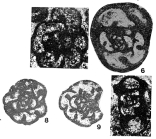
Diagnosis Test discoidal to subglobular, biumbilicate, periphery rounded, early stage streptospiral, later planispiral, septa long, directed slightly forward and following the curvature of the outer wall; wall dark to gray, two layers, secondary deposits on the floor of all chambers form prominent unconnected mounds or tubercles that are equidimensional to elongate and may appear in section as nodes or spines, inner tips of the septa may be thickened; basal aperture low to moderate in size. L. Carboniferous (U. Toumaisian to L. Visean); USSR: Siberia, Ural Mountains, Russian Platform; USA: Arizona, Colorado, New Mexico, Alaska; Canada: Alberta. (Loeblich & Tappan, 1987, Foraminiferal Genera and Their Classification) [details]
