WoRMS taxon details
Thrypticotrochus Cairns, 1989
267910 (urn:lsid:marinespecies.org:taxname:267910)
accepted
Genus
Thrypticotrochus multilobatus Cairns, 1989 accepted as Thrypticotrochus petterdi (Dennant, 1906) (type by original designation)
- Species Thrypticotrochus odonthercus Kitahara & Cairns, 2021
- Species Thrypticotrochus petterdi (Dennant, 1906)
- Species Thrypticotrochus multilobatus Cairns, 1989 accepted as Thrypticotrochus petterdi (Dennant, 1906) (unaccepted > junior subjective synonym)
marine, fresh, terrestrial
Cairns, S.D. (1989). A revision of the ahermatypic Scleractinia of the Philippine Islands and adjacent waters, Part 1: Fungiacyathidae, Micrabaciidae, Turbinoliinae, Guyniidae, and Flabellidae. <em>Smithsonian Contributions to Zoology.</em> 486: 1-136. [details] Available for editors  [request]
[request]
Depth range 95-925 m
Depth range 95-925 m [details]
Hoeksema, B. W.; Cairns, S. (2024). World List of Scleractinia. Thrypticotrochus Cairns, 1989. Accessed through: World Register of Marine Species at: https://www.marinespecies.org/aphia.php?p=taxdetails&id=267910 on 2024-09-20
Date
action
by
 The webpage text is licensed under a Creative Commons Attribution 4.0 License
original description
Cairns, S.D. (1989). A revision of the ahermatypic Scleractinia of the Philippine Islands and adjacent waters, Part 1: Fungiacyathidae, Micrabaciidae, Turbinoliinae, Guyniidae, and Flabellidae. <em>Smithsonian Contributions to Zoology.</em> 486: 1-136. [details] Available for editors [request]
context source (Hexacorallia) Fautin, Daphne G. (2013). Hexacorallians of the World. (look up in IMIS) [details]
basis of record van der Land, J. (ed). (2008). UNESCO-IOC Register of Marine Organisms (URMO). , available online at http://www.marinespecies.org/urmo/ [details]
additional source Cairns, S.D., R. Baron-Szabo, A.F. Budd, B. Lathuilière, E. Roniewicz, J. Stolarski & K.G. Johnson. (2010). Corallosphere. , available online at http://www.corallosphere.org [details]
redescription Cairns, S.D. (1995). The marine fauna of New Zealand: Scleractinia (Cnidaria: Anthozoa. <em>New Zealand Oceanographic Memoir.</em> 103: 1-210. [details] Available for editors [request]
redescription Cairns, S.D. (1997). A generic revision and phylogenetic analysis of the Turbinoliidae (Cnidaria: Scleractinia). <em>Smithsonian Contributions to Zoology.</em> 591: 1-55. [details] Available for editors [request]
[request] context source (Hexacorallia) Fautin, Daphne G. (2013). Hexacorallians of the World. (look up in IMIS) [details]
basis of record van der Land, J. (ed). (2008). UNESCO-IOC Register of Marine Organisms (URMO). , available online at http://www.marinespecies.org/urmo/ [details]
additional source Cairns, S.D., R. Baron-Szabo, A.F. Budd, B. Lathuilière, E. Roniewicz, J. Stolarski & K.G. Johnson. (2010). Corallosphere. , available online at http://www.corallosphere.org [details]
redescription Cairns, S.D. (1995). The marine fauna of New Zealand: Scleractinia (Cnidaria: Anthozoa. <em>New Zealand Oceanographic Memoir.</em> 103: 1-210. [details] Available for editors
[request] redescription Cairns, S.D. (1997). A generic revision and phylogenetic analysis of the Turbinoliidae (Cnidaria: Scleractinia). <em>Smithsonian Contributions to Zoology.</em> 591: 1-55. [details] Available for editors
[request]  Present Inaccurate Introduced: alien Containing type locality
From editor or global species database
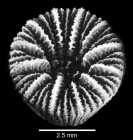
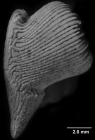
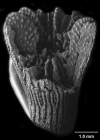
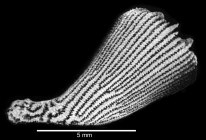
Comparison See account of Levicyathus [details]Diagnosis Corallum ceratoid, circular in cross section, and with a pointed base, base often irregularly shaped due to asexual fragmentation; up to 6 mm in GCD; theca imperforate; costae serrate, originating by trifurcation; septa hexamerally arranged in 4 or more cycles (up to 72 septa); multiple paliform lobes on all but last cycle of septa; columella papillose. [details]
Remark This genus and family was monographed by Cairns (1997), which included a phylogenetic analysis based on morphology. Monotypic (Cairns, 2004). The genus appears to be unique in the family in its predominant form of asexual reproduction. [details]
From other sources
Biology azooxanthellate [details]Depth range 95-925 m [details]