WoRMS taxon details
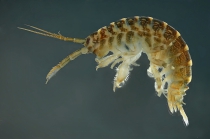
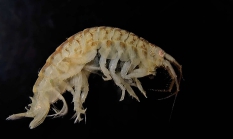
Dikerogammarus villosus (Sowinsky, 1894)
148586 (urn:lsid:marinespecies.org:taxname:148586)
accepted
Species
Gammarus marinus var. villosa Sowinsky, 1894 · unaccepted
brackish, fresh, terrestrial
recent only
(of Gammarus marinus var. villosa Sowinsky, 1894) Sovinsky, V.K. (1894). Sur les crustacés de la Mer d'Azov = Ракообраанын Ааовскаго мори. <em>Zapiski Kievskago obshchestva estestvoispytatele = Mémoires de la Société des Naturalistes de Kieff.</em> 13: 289-406. (look up in IMIS)
page(s): 380-383 [details]
page(s): 380-383 [details]
Distribution Dikerogammarus villosus is an invader from the Black Sea. This species is expected to occur in all fresh and weakly...
Distribution Dikerogammarus villosus is an invader from the Black Sea. This species is expected to occur in all fresh and weakly brackish water. [details]
Horton, T.; Lowry, J.; De Broyer, C.; Bellan-Santini, D.; Copilas-Ciocianu, D.; Corbari, L.; Costello, M.J.; Daneliya, M.; Dauvin, J.-C.; Fišer, C.; Gasca, R.; Grabowski, M.; Guerra-García, J.M.; Hendrycks, E.; Hughes, L.; Jaume, D.; Jazdzewski, K.; Kim, Y.-H.; King, R.; Krapp-Schickel, T.; LeCroy, S.; Lörz, A.-N.; Mamos, T.; Senna, A.R.; Serejo, C.; Souza-Filho, J.F.; Tandberg, A.H.; Thomas, J.D.; Thurston, M.; Vader, W.; Väinölä, R.; Valls Domedel, G.; Vonk, R.; White, K.; Zeidler, W. (2024). World Amphipoda Database. Dikerogammarus villosus (Sowinsky, 1894). Accessed through: World Register of Marine Species at: https://www.marinespecies.org/aphia.php?p=taxdetails&id=148586 on 2024-04-27
Date
action
by
 The webpage text is licensed under a Creative Commons Attribution 4.0 License
original description
(of Gammarus marinus var. villosa Sowinsky, 1894) Sovinsky, V.K. (1894). Sur les crustacés de la Mer d'Azov = Ракообраанын Ааовскаго мори. <em>Zapiski Kievskago obshchestva estestvoispytatele = Mémoires de la Société des Naturalistes de Kieff.</em> 13: 289-406. (look up in IMIS)
page(s): 380-383 [details]
context source (Introduced species) Rewicz, T.; Grabowski, M.; MacNeil, C.; Bącela-Spychalska, K. (2014). The profile of a ‘perfect' invader – the case of killer shrimp, Dikerogammarus villosus. <em>Aquatic Invasions.</em> 9(3): 267-288., available online at https://doi.org/10.3391/ai.2014.9.3.04 [details] Available for editors [request]
context source (Schelde) Maris, T.; Beauchard, O.; Van Damme, S.; Van den Bergh, E.; Wijnhoven, S.; Meire, P. (2013). Referentiematrices en Ecotoopoppervlaktes Annex bij de Evaluatiemethodiek Schelde-estuarium Studie naar “Ecotoopoppervlaktes en intactness index”. <em>Monitor Taskforce Publication Series, 2013-01. NIOZ: Yerseke.</em> 35 pp. (look up in IMIS) [details]
additional source Faasse, M.; Van Moorsel, G. (2000). Nieuwe en minder bekende vlokreeftjes van sublitorale harde bodems in het Deltagebied (Crustacea: Amphipoda: Gammaridea) [New and lesser-known amphipods of hard substrates in the Delta area of the Netherlands (Crustacea: Amphipoda: Gammaridea)]. <i>Ned. Faunist. Meded. 11</i>: 19-44 (look up in IMIS) [details]
ecology source Rewicz, T.; Grabowski, M.; MacNeil, C.; Bącela-Spychalska, K. (2014). The profile of a ‘perfect' invader – the case of killer shrimp, Dikerogammarus villosus. <em>Aquatic Invasions.</em> 9(3): 267-288., available online at https://doi.org/10.3391/ai.2014.9.3.04 [details] Available for editors [request]
ecology source Rewicz, T.; Wattier, R.; Grabowski, M.; Rigaud, T.; Bącela-Spychalska, K. (2015). Out of the Black Sea: Phylogeography of the Invasive Killer Shrimp Dikerogammarus villosus across Europe. <em>PLOS ONE.</em> 10(2): e0118121., available online at https://doi.org/10.1371/journal.pone.0118121 [details] Available for editors [request]
ecology source Bącela, K.; Grabowski, M.; Konopacka, A. (2008). Dikerogammarus villosus (Sowinsky, 1894) (Crustacea, Amphipoda) enters Vistula – the biggest river in the Baltic basin. <em>Aquatic Invasions.</em> 3(1): 95-98., available online at https://doi.org/10.3391/ai.2008.3.1.16 [details] Available for editors [request]
page(s): 380-383 [details]
context source (Introduced species) Rewicz, T.; Grabowski, M.; MacNeil, C.; Bącela-Spychalska, K. (2014). The profile of a ‘perfect' invader – the case of killer shrimp, Dikerogammarus villosus. <em>Aquatic Invasions.</em> 9(3): 267-288., available online at https://doi.org/10.3391/ai.2014.9.3.04 [details] Available for editors
[request] context source (Schelde) Maris, T.; Beauchard, O.; Van Damme, S.; Van den Bergh, E.; Wijnhoven, S.; Meire, P. (2013). Referentiematrices en Ecotoopoppervlaktes Annex bij de Evaluatiemethodiek Schelde-estuarium Studie naar “Ecotoopoppervlaktes en intactness index”. <em>Monitor Taskforce Publication Series, 2013-01. NIOZ: Yerseke.</em> 35 pp. (look up in IMIS) [details]
additional source Faasse, M.; Van Moorsel, G. (2000). Nieuwe en minder bekende vlokreeftjes van sublitorale harde bodems in het Deltagebied (Crustacea: Amphipoda: Gammaridea) [New and lesser-known amphipods of hard substrates in the Delta area of the Netherlands (Crustacea: Amphipoda: Gammaridea)]. <i>Ned. Faunist. Meded. 11</i>: 19-44 (look up in IMIS) [details]
ecology source Rewicz, T.; Grabowski, M.; MacNeil, C.; Bącela-Spychalska, K. (2014). The profile of a ‘perfect' invader – the case of killer shrimp, Dikerogammarus villosus. <em>Aquatic Invasions.</em> 9(3): 267-288., available online at https://doi.org/10.3391/ai.2014.9.3.04 [details] Available for editors
[request] ecology source Rewicz, T.; Wattier, R.; Grabowski, M.; Rigaud, T.; Bącela-Spychalska, K. (2015). Out of the Black Sea: Phylogeography of the Invasive Killer Shrimp Dikerogammarus villosus across Europe. <em>PLOS ONE.</em> 10(2): e0118121., available online at https://doi.org/10.1371/journal.pone.0118121 [details] Available for editors
[request] ecology source Bącela, K.; Grabowski, M.; Konopacka, A. (2008). Dikerogammarus villosus (Sowinsky, 1894) (Crustacea, Amphipoda) enters Vistula – the biggest river in the Baltic basin. <em>Aquatic Invasions.</em> 3(1): 95-98., available online at https://doi.org/10.3391/ai.2008.3.1.16 [details] Available for editors
[request]  Present Present in aphia/obis/gbif/idigbio Inaccurate Introduced: alien Containing type locality
From editor or global species database
Distribution Dikerogammarus villosus is an invader from the Black Sea. This species is expected to occur in all fresh and weakly brackish water. [details]Habitat Epigean [details]
Introduced species vector dispersal Belgian part of the North Sea (Marine Region) Canals: natural range expansion through man-made canals [details]
From regional or thematic species database
Introduced species abundance in Czech Republic (Nation) : Common to dominant [details]Introduced species abundance in Czech Republic (Nation) : Common [details]
Introduced species impact in Czech Republic (Nation) : Outcompetes native species for resources and/or space [details]
Introduced species population trend in Czech Republic (Nation) : Increasing [details]
Introduced species remark in Czech Republic (Nation) : Species recorded here as "established" as most specimens in the population sampled at this location were mature females which (along with the greater than 20% proportion of juveniles) which indicates successful reproduction. [details]
Introduced species remark in Czech Republic (Nation) : The lagoon is geographically divided into a smaller part to the west, belonging to Germany and a larger eastern part belonging to Poland. [details]
Introduced species vector dispersal in Belgian part of the North Sea: Ships: accidental with ballast water, sea water systems, live wells or other deck basins [details]
Introduced species vector dispersal in Belgian part of the North Sea: Ships: accidental with ballast water, sea water systems, live wells or other deck basins [details]
Introduced species vector dispersal in Czech Republic (Nation) : Natural dispersal [details]
Introduced species vector dispersal in Czech Republic (Nation) : Secondary natural dispersal from alien source population. "Using the canals joining the different river systems, the species has reached the River Odra. There it quickly spread [natural dispersal] both up- and downstream, reaching for the first time the B [details]
Introduced species vector dispersal in Belgian part of the North Sea: Ships: accidental as attached or free-living fouling organisms [details]
Introduced species vector dispersal in Belgian part of the North Sea: Ships: accidental as attached or free-living fouling organisms [details]
From other sources
Alien species The killer shrimp Dikerogrammarus villosus original distribution was in the Ponto-Caspian region. After the opening of the canal between Danube and the Rhine in 1992 the species found its way to Western Europe. This killer shrimp distributed itself both actively and passively - via ships - through the European water-network and in 1997 the shrimp was found in the Belgian Albert canal. Since then, the species has advanced to brackish and freshwater in both East and West Flanders. Quickly the species became notorious as an aggressive omnivore that feeds on other shrimps. Together with its high adaptability and short generation time, this causes the killer shrimp to exclude other shrimps, affecting local food webs and biodiversity. These characteristics make of the killer shrimp a successful exotic invasive species. [details]
| Language | Name | |
|---|---|---|
| Dutch | reuzenvlokreeft | [details] |
| English | killer shrimp | [details] |
| German | Großer Höckerflohkrebs | [details] |
| Ukrainian | Бокоплав опушений | [details] |
To Barcode of Life (912 barcodes)
To Biodiversity Heritage Library (2 publications)
To European Nucleotide Archive (ENA)
To GenBank (169 nucleotides; 102 proteins)
To Information system on Aquatic Non-Indigenous and Cryptogenic Species (AquaNIS)
To Niet-inheemse soorten Belgisch deel Noordzee en aanpalende estuaria (in Dutch)
To PESI
To Biodiversity Heritage Library (2 publications)
To European Nucleotide Archive (ENA)
To GenBank (169 nucleotides; 102 proteins)
To Information system on Aquatic Non-Indigenous and Cryptogenic Species (AquaNIS)
To Niet-inheemse soorten Belgisch deel Noordzee en aanpalende estuaria (in Dutch)
To PESI