Ten remarkable new marine species from 2025
- The Dragon Nematode, Dracograllus miguelitus
- The Sponge Ambusher Worm, Eunice siphoninsidiator
- The Golden Glow Zoantharian, Corallizoanthus aureus
- Iskra’s Glitter Worm, Photinopolynoe iskrae
- The Good Luck Flatworm, Acanthobothrium goleketen
- The Darth Vader Supergiant Isopod, Bathynomus vaderi
- The Nodule Crown Coral, Deltocyathus zoemetallicus
- The Atlantic Manta Ray, Mobula yarae
- Poseidon's Squid, Mobydickia poseidonii
- The Elven Abyss Tunicate, Kaikoja undume
Release date: March 19th 2026
Press release available at https://www.marinespecies.org/worms-top-ten/2025/press-release
High-resolution images of Top-Ten species available at https://www.marinespecies.org/photogallery.php?album=5645
The Dragon Nematode
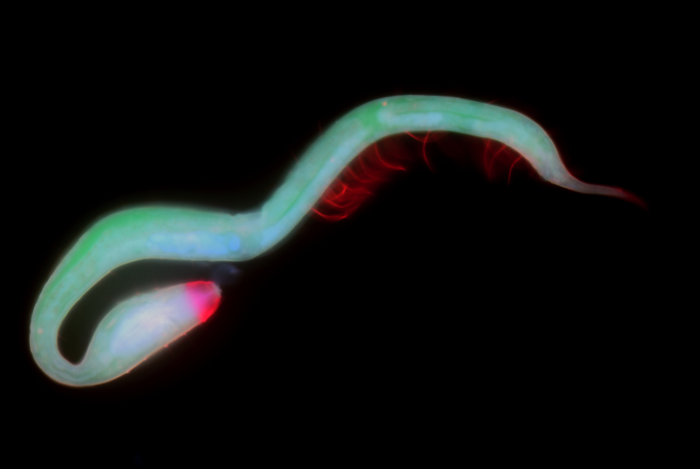
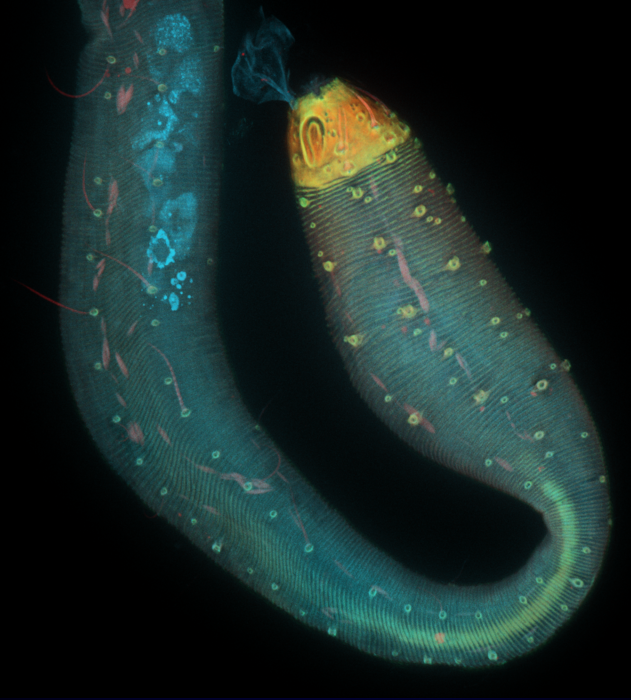
Image credit: V. Foulon
Dracograllus miguelitus Johnson da Silva, Zeppilli, Foulon, Dessandier, Matabos & Sarrazin, 2025
https://www.marinespecies.org/aphia.php?p=taxdetails&id=1828220
“If all the matter in the universe except the nematodes were swept away, our world would still be dimly recognizable, with its mountains, hills, valleys, rivers, lakes, and oceans traced by a film of nematodes.”
This century-old statement by nematode expert Nathan Augustus Cobb captures a stark reality: nematode worms are among the most abundant and diverse animals on Earth. More than 60% of the multicellular animals known from the deep ocean belong to this group, and their total species diversity has been estimated at several millions.
Most nematodes conform to a simple, tubular body plan and live inside sediments or other organisms. The newly discovered “dragon nematode” Dracograllus miguelitus belongs to a group whose members have the ability to grip hard substrates and actively move across surfaces. The species name miguelitus was chosen in honor of Pedro Miguel, the nephew of the lead author, a child fascinated by dragons, making this tiny “dragon nematode” a fitting tribute. The hard substrate on which this tiny dragon was found was inactive hydrothermal vents at the Mid-Atlantic Ridge "Lucky Strike" vent field, at a depth of 1,649 m. It is the first of its kind to be described from chemosynthetic environments, and different from other members of the group in the number, shape, and arrangement of the tube-like structures that it uses to move.
Dracograllus miguelitus was discovered as part of a multi-national effort to characterize the biota of hydrothermal communities. The discovery of a new species endemic to inactive vents highlights how much of the ecology and biology of these habitats remains unknown. Inactive hydrothermal vents, particularly along slow-spreading ridges such as the Mid-Atlantic Ridge, are associated with large seafloor massive sulfide deposits and have attracted growing interest as potential targets for deep-sea mining. Finding a previously unknown nematode species in this environment underscores both the hidden diversity of deep-sea meiofauna and the importance of improving our understanding of these poorly explored ecosystems in the face of emerging human pressures.
Original source
- Johnson da Silva, W.; Zeppilli, D.; Foulon, V.; Dessandier, P.-A.; Matabos, M.; Sarrazin, J. (2025). On Dracograllus miguelitus sp. nov. (Nematoda: Draconematidae) from an inactive structure: insights into its taxonomy, biodiversity and ecology at hydrothermal vents. PeerJ. 13: e19585., available online at https://doi.org/10.7717/peerj.19585
- William Johnson da Silva (wjohnson.ecologia@gmail.com) (co-author)
- https://www.marinespecies.org/aphia.php?p=image&pic=205957&tid=1828220
- https://www.marinespecies.org/aphia.php?p=image&pic=205956&tid=1828220
The Sponge Ambusher Worm
Eunice siphoninsidiator Zhou, Zhang, Shen & Zhang in Zhou et al., 2025
https://www.marinespecies.org/aphia.php?p=taxdetails&id=1802245
The Sponge Ambusher Worm is a large deep sea polychaete worm discovered from the slopes of underwater mountains in the northwest Pacific Ocean. This species was collected by the Human Operated Vehicle (HOV) Jiaolong about 1,000 meters (over 2/3 of a mile) below the surface. It belongs to the genus Eunice, making it a close relative of one of the most infamous polychaetes in the world: the 3-meter long Bobbit Worm! While the Sponge Ambusher Worm only reaches about 18 cm in length, much like the Bobbit Worm, it is an ambush predator with an impressive set of jaws.
Interestingly, the Sponge Ambusher Worm sets its trap in a rather peculiar location: the central cavity of a glass sponge. Glass sponges are fascinating marine creatures in their own right, covered with sharp spicules made of silica, which means living inside of one would be like making your home inside of a thorn bush made of glass! The combination of this unusual lair and their predatory lifestyle is what gives the Sponge Ambusher Worm its name, siphoninsidiator translates to “tube or pipe ambusher” in Latin.
The relationship between the Sponge Ambusher Worm and its glass sponge host may be an example of a mutualism (a partnership between two species in which both partners benefit). The glass sponge, with its spiky surfaces, provides its worm tenant with both protection from potential predators and concealment from potential prey. To repay this hospitality, the Sponge Ambusher Worm will eat other animals that try to live on its host, such as brittle stars and barnacles, which keeps the glass sponge clean and allows it to keep feeding (filtering organic particles) at peak efficiency. Researchers think this may be an obligate relationship, as every glass sponge they examined had at least one Sponge Ambusher Worm inside.
Original source
- Zhou, Y.; Zhang, R.; Shen, C.; Mao, Q.; Zhang, M.; Zhang, D. (2025). Ambusher in sponge: a new species of Eunice (Annelida, Eunicidae) commensal within deep-sea Farreidae (Porifera, Hexactinellida) on northwest Pacific seamounts. ZooKeys. 1230: 25-36., available online at https://zookeys.pensoft.net/article/140329/list/9/
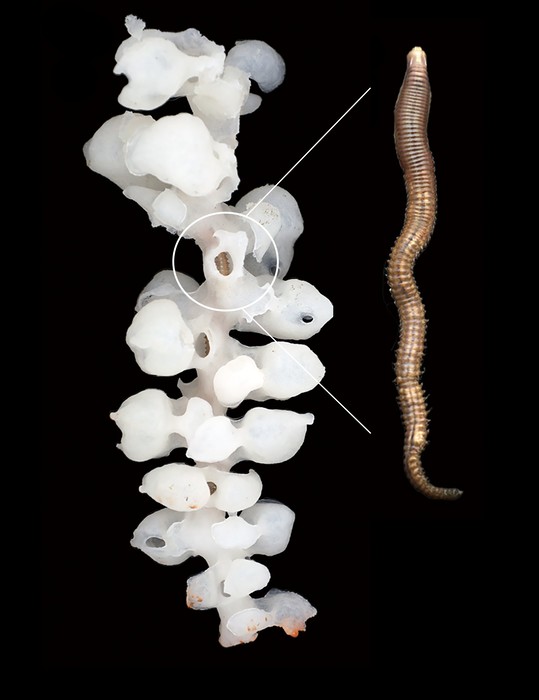
Image credit: Yadong Zhou
The Golden Glow Zoantharian
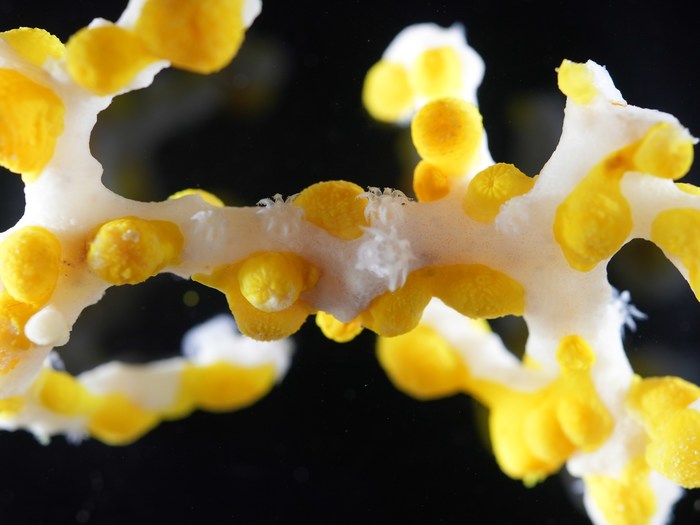
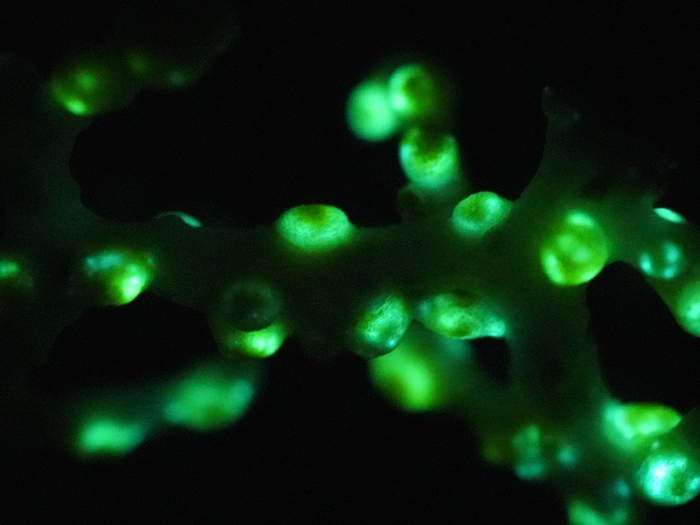
Images credit: Manabu Bessho-Uehara
Corallizoanthus aureus Kise, Bessho-Uehara, Kondo, Shimoji, Ito, Tsuchida, Fujiwara & Reimer, 2025
https://www.marinespecies.org/aphia.php?p=taxdetails&id=1873585
Though it may look like a rave in a cave, these epibiotic zoantharians living on precious corals don’t turn on their flashing lights to party. Representing the first documented deep-sea cave species to bioluminesce, the new species Corallizoanthus aureus flashed a 515-nanometer green light in response to chemical or mechanical disturbance. As light is one of the best ways to deter predation in caves at 400 m below the surface, this species is thought to light up as a sort of ‘burglar alarm’ hypothesized to attract the attention of larger predators to potential threats of the polyps with the deep-sea equivalent of a tornado siren.
Collected using a remote operated vehicle (ROV) near Minamidaito Island in southern Japan, researchers with the Japan Agency for Marine-Earth Science and Technology (JAMSTEC) leading the Deep-sea Archaic Refugia in Karst (D-ARK) project first spotted the bioluminescence of this new species on their Pleurocorallium inutile host coral colonies near the entrances of steep karst caves. This region, roughly 360 kilometers west of Okinawa-jima Island, is characterized by its dramatic underwater topography and underwater caverns that have historically limited biological sampling. Living directly attached to their coral hosts, the bright yellow polyps of C. aureus form colonies (when not glowing) that are easy to miss until the lights go out.
Because bioluminescence in hexacorallian lineages is not common and remains poorly understood, this species adds a missing piece to the story of the evolution of bioluminescence in a group where this ability is rarely documented. The discovery of this species suggests that luminescence is more widespread among deep-sea, epibiotic organisms than previously recognized, shedding light on the breadth of biodiversity still awaiting description in the deep.
Original Source
- Kise, H.; Bessho-Uehara, M.; Kondo, K. C. F.; Shimoji, K.; Ito, S.; Tsuchida, S.; Fujiwara, Y.; Reimer, J. D. (2025). Glow in the D-ARK: a new bioluminescent species of Corallizoanthus (Anthozoa: Zoantharia: Parazoanthidae) from southern Japan. Royal Society Open Science. 12(11): 250890., available online at https://doi.org/10.1098/rsos.250890
- Hiroki Kise (h.kise@aist.go.jp) (co-author)
- James Davis Reimer (jreimer@cs.u-ryukyu.ac.jp) (co-author)
- https://www.marinespecies.org/aphia.php?p=image&pic=205987&tid=1873585
- https://www.marinespecies.org/aphia.php?p=image&pic=205988&tid=1873585
Iskra’s Glitter Worm
Photinopolynoe iskrae Hiley, Green & Rouse, 2025
https://www.marinespecies.org/aphia.php?p=taxdetails&id=1849371
Far below the Pacific Ocean, in a world without sunlight, something glitters. Scientists exploring the seafloor off the coast of California have discovered a new species of shimmering, scale-covered worm aptly named Iskra’s Glitter Worm (Photinopolynoe iskrae).
The name Iskra, meaning “spark”, was chosen not by a marine biologist, but by a high school student. Maja Young from the American School in Warsaw had the opportunity to name this new species after winning the ‘Inspired by the Deep’ competition, which challenged participants to find ways in which elements of the deep sea could solve environmental issues on land. She named the species after her childhood dog — a fitting tribute for a creature that glitters so brightly.
To study these animals, researchers used remotely operated vehicles (ROVs) to collect specimens from the bottom of the Pacific. Iskra’s Glitter Worm has been found in several unusual habitats: whale falls (where the bodies of sunken whales become entire ecosystems), wood falls (formed by drifting trees that sink to the seafloor), and methane seeps (patches of seafloor where gas leaks out from deep in the Earth’s crust). These habitats look very different but share one remarkable feature. In the darkness of the deep ocean, these ecosystems rely on energy produced by chemosynthetic bacteria that feed on methane or other chemicals such as those found in bone or wood. Life here is not built on sunlight, but on chemicals. Most relatives of Iskra’s Glitter Worm specialize on a single one of these chemosynthetic ecosystems, but this worm seems to be less picky. These worms have a lot to teach us about life in some of Earth’s most unusual habitats.
Original Source
- Hiley, A. S.; Green, K. R.; Rouse, G. W. (2025). Seven new species of scaleworms (Lepidonotopodini, Polynoidae, Polychaeta, Annelida) from deep-sea chemosynthetic-based ecosystems. Marine Biodiversity. 55(6)., available online at https://link.springer.com/article/10.1007/s12526-025-01580-7
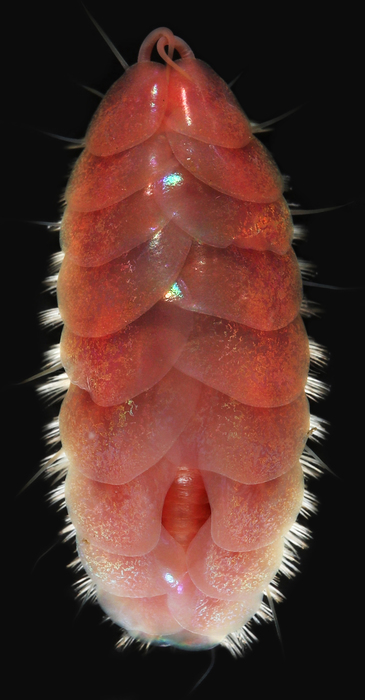
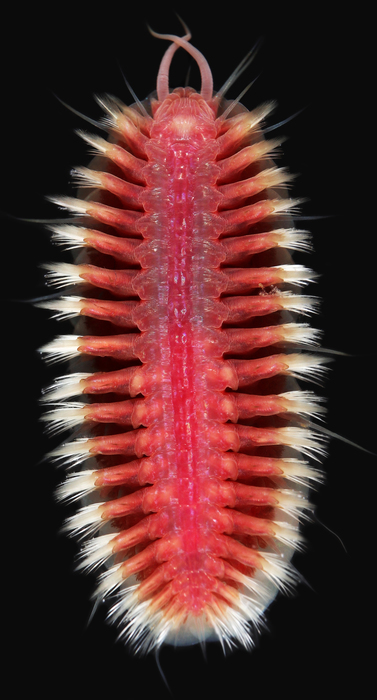
Image credit: P.C. Dr. Greg W. Rouse and edited by Dr. Avery S. Hiley
- Avery Hiley (ahiley@ucsd.edu) (co-author)
- https://www.marinespecies.org/aphia.php?p=image&pic=205949&tid=1849371
- https://www.marinespecies.org/aphia.php?p=image&pic=205950&tid=1849371
The Good Luck Flatworm
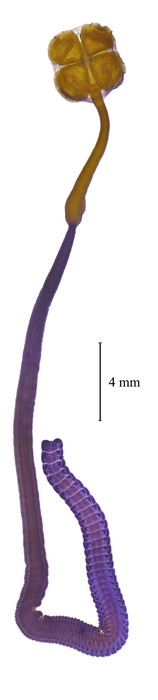
Image credit: Manuel Irigoitia
Acanthobothrium goleketen Irigoitia, Franzese & Alarcos in Irigoitia, Franzese, Alarcos, Arredondo & Timi, 2025
https://www.marinespecies.org/aphia.php?p=taxdetails&id=1831387
Acanthobothrium goleketen Irigoitia, Franzese & Alarcos is a new species of parasitic flatworm known only from a single, critically endangered host species, the guitarfish, Pseudobatos horkelii. By virtue of its inferred reliance on this critically endangered host, A. goleketen itself has also been catalogued as critically endangered. This worm attaches to its host via a scolex that resembles a four-leafed clover, suggestive of its specific epithet, which translates to "Good Luck" in the Tehuelche language endemic to the region from which the worm was discovered. The Tehuelche language (Aonek'o 'a'ien) is functionally extinct, as its last native speaker passed away in 2019, but it is undergoing an active revitalization process by descendants and communities in Patagonia. Conservation efforts for Tehuelche language and culture offer a striking parallel to the status of this species and its host. Efforts to conserve these endangered species also depend on long-term funding for the scientific system in Argentina.
Original Source
- Irigoitia, M. M.; Franzese, S.; Alarcos, A. J.; Arredondo, N. J.; Timi, J. T. (2025). An unusual new species at risk, parasite of a critically endangered guitarfish, Pseudobatos horkelii (Elasmobranchi: Rhinobatidae): insights into the phylogeny of Acanthobothrium (Cestoda: Onchoproteocephalidea). Zoologischer Anzeiger. 318: 120-131., available online at https://doi.org/10.1016/j.jcz.2025.07.008
- Manuel Irigoitia (manuelirigoitia@gmail.com) (co-author)
- Sebastián Franzese (sefranze20@gmail.com) (co-author)
- Ana Julia Alarcos (jalarcos@mdp.edu.ar) (co-author)
The Darth Vader Supergiant Isopod
Bathynomus vaderi Ng, Sidabalok & Nguyen, 2025
https://www.marinespecies.org/aphia.php?p=taxdetails&id=1791043
"Luke... am I your dinner?!?" This stern looking creature is Bathynomus vaderi, the first member of the deep-sea isopod genus Bathynomus described from Vietnam. Named after the Sith Lord Darth Vader because of the resemblance of its head with the helmet of that Star Wars character, this giant isopod was discovered in the seafood markets of Quy Nhơn City, very very far away from the Star Wars Galaxy. That such a large animal was hiding in plain sight, unknown to science but part of a growing culinary trend for deep sea crustaceans, highlights the critical need for the study of marine biodiversity. Despite ongoing economic pressure for fisheries for Bathynomus, the biology of Bathynomus vaderi, its distribution in the deep Indo-West Pacific, and the size and health of wild populations remain unknown.
Furthermore, the discovery of B. vaderi is a result of collaborative work among three scientists from different nations in Southeast Asia, i.e. Singapore, Indonesia and Vietnam. Both the discovery and the recognition of the Darth Vader Supergiant Isopod as one of WoRMS Top Ten Marine Species 2025 have pointed out a successful research collaboration among Southeast Asian scientists in exploring the region marine biodiversity.
Original Source
- Ng, P.K.L., Sidabalok, C.M. & Nguyen, T.S. (2025). A new species of supergiant Bathynomus A. Milne-Edwards, 1879 (Crustacea, Isopoda, Cirolanidae) from Vietnam, with notes on the taxonomy of Bathynomus jamesi Kou, Chen & Li, 2017. Zookeys. 1223: 289–310., available online at https://doi.org/10.3897/zookeys.1223.139335
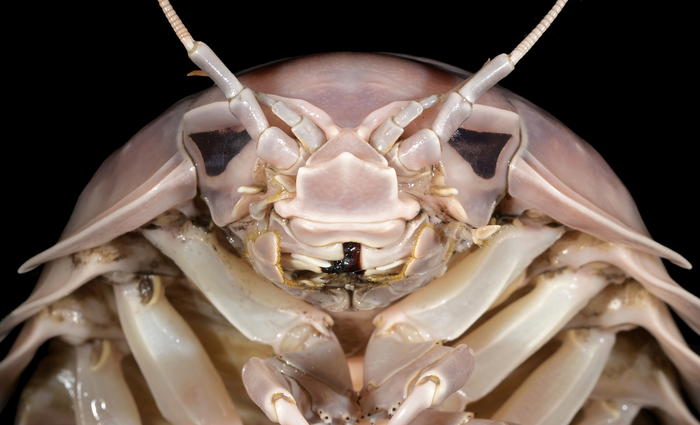
Image credit: Nguyen Thanh Son
- Conni M. Sidabalok (sidabalok_conni@yahoo.com) (co-author)
- Peter K. L. Ng (peterng@nus.edu.sg) (co-author)
- Thanh Son Nguyen (sonnt@hus.edu.vn) (co-author)
The Nodule Crown Coral
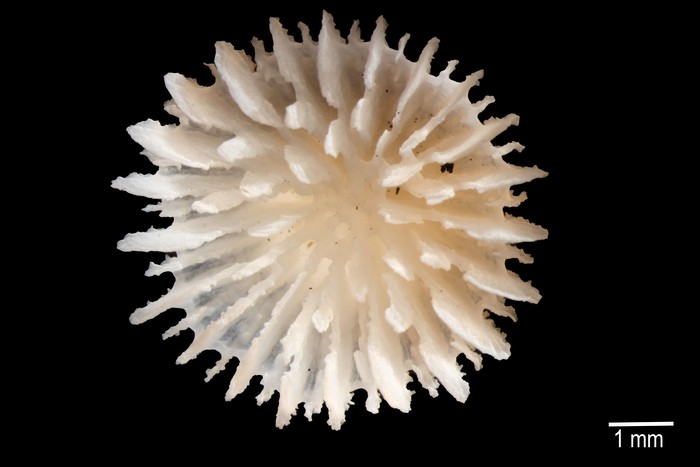
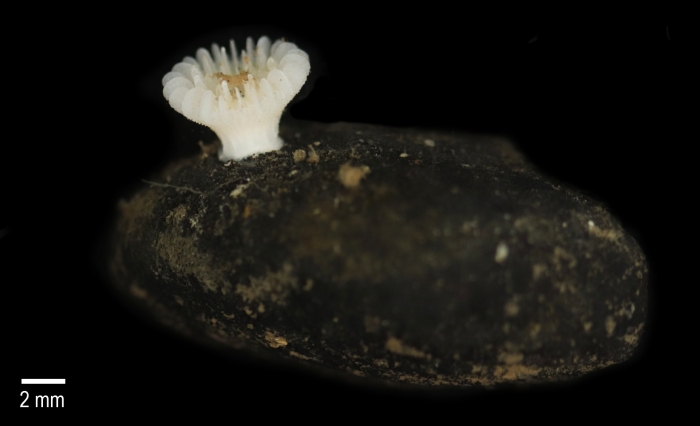
Image credit: The Natural History Museum and University of Gothenberg
Deltocyathus zoemetallicus Santodomingo, Bribiesca-Contreras & Kitahara in Bribiesca-Contreras et al., 2025
https://www.marinespecies.org/aphia.php?p=taxdetails&id=1848605
Polymetallic nodules are the original rolling stones: aggregations of minerals that tumble across the abyssal plains of the deep Indian and Pacific oceans. Unlike their proverbial kin, which gather no moss, polymetallic nodules do serve as a substrate for biodiversity, attracting sessile animals like sponges, sea anemones, and octocorals. New to this cohort of rock enthusiasts is Deltocyathus zoemetallicus, the first and only known stony coral that lives attached to polymetallic nodules. Both the extreme depth at which Deltocyathus zoemetallicus lives and its association with the polymetallic nodules are rare and special attributes of this species.
Few stony corals can live at 4,000 meters, as the chemistry of seawater at depth makes maintaining a stony skeleton very difficult, and most members of the genus Deltocyathus live directly on the seafloor sediment, rather than atop rocks or nodules. Seabed imagery shows that these corals are more abundant when there are more nodules. This raises concerns about the species’ long term survival: these mineral accretions have been targeted for deep-sea mining, and without the hard substrate provided by the nodules, Deltocyathus zoemetallicus and other sessile nodule specialists will lack the habitat needed for their survival and success.
Original Source
- Bribiesca-Contreras, G.; Santodomingo, N.; Kitahara, M. V.; Simon-Lledó, E.; Fleming, B. F. M.; Dahlgren, T. G.; Jones, D. O. B.; Wiklund, H.; Glover, A. G. (2025). Hidden gems of the abyss: first species of azooxanthellate scleractinian coral (Scleractinia: Deltocyathidae) attached to polymetallic nodules in the eastern Pacific Ocean. Zoological Journal of the Linnean Society. 205(3): zlaf146., available online at https://doi.org/10.1093/zoolinnean/zlaf146
- Nadia Santodomingo (nadia.santodomingo@senckenberg.de) (co-author)
- Guadalupe Bribiesca-Contreras (guadalupe.bribiesca.contreras@noc.ac.uk) (co-author)
- Marcelo V. Kitahara (kitahara@usp.br) (co-author)
- https://www.marinespecies.org/aphia.php?p=image&pic=205954&tid=1848605
- https://www.marinespecies.org/aphia.php?p=image&pic=205955&tid=1848605
- Hidden gems of the abyss: New Deep-Sea Coral Found Living on Nodules Targeted for Mining (NOC News)
- Newly Identified Coral Species Survives On Mineral Nodules Of The Deep Pacific (Forbes)
- New Deep-Sea Coral Found on Nodules Targeted for Mining (Marine Technology News)
- New Stony Coral Described In The Deep Ocean (DeeperBlue)
- Deep-Sea Mining Test in the Pacific Drastically Reduced Biodiversity and Animal Populations (Smithsonian Magazine)
The Atlantic Manta Ray
Mobula yarae Bucair & Marshall, 2025
https://www.marinespecies.org/aphia.php?p=taxdetails&id=1830940
For centuries, humans have been fascinated by the ocean’s largest rays: the manta rays. Until this year, only two species of manta ray were known. The existence of a third manta species in the Atlantic had been hypothesized for nearly 15 years, but there was disagreement among scientists. Confirming that manta rays in the Atlantic Ocean represent a distinct species required in-depth detective work. By studying manta rays from around the world, researchers from Brazil, Mexico, and the USA carefully compared color patterns, teeth, skin, and DNA to definitively establish the Atlantic Manta Ray as a new species.
The description of this species is particularly relevant to society. Like other manta rays, the Atlantic Manta Ray faces growing threats. Accidental capture in fishing gear, collisions with boats, pollution, and habitat loss all threaten this gentle giant. Officially recognizing the Atlantic Manta Ray as its own species gives conservationists the legal and scientific tools needed to track and protect it across the many countries that share Atlantic waters. Several conservation and research institutions have already framed the description as a conservation-relevant milestone. The species name yarae honors Yara, a powerful water spirit from Indigenous Brazilian mythology. The name reflects both the ray’s majestic nature and the deep cultural connections between people, the sea, and this amazing animal. Even now, there is still so much to learn about the sea around us. If a new species of one of the ocean’s largest inhabitants was hiding in plain sight, what other mysteries wait to be discovered?
Original Source
- Bucair, N.; Hinojosa-Alvarez, S.; Marshall, A. D.; Pate, J.; Francini, C. L. B.; Garrido, A. G.; Capel, K. C. C.; Loboda, T. S.; Monteiro, J. S.; Bruno, C. E. M.; Vaga, C. F.; Dove, A. D. M.; Hoopes, L. A.; Perry, C.; Kitahara, M. V. (2025). An integrative taxonomy investigation unravels a cryptic species of Mobula Rafinesque, 1810 (Mobulidae, Myliobatiformes), from the Atlantic Ocean. Environmental Biology of Fishes. 108(11): 1801-1835., available online at https://doi.org/10.1007/s10641-025-01727-2
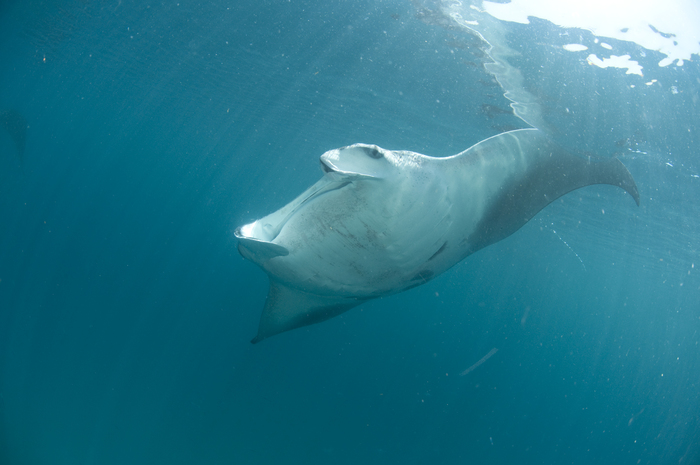
Image credit: Louise Murray
- Naya Bucair (nayarabucair@usp.br) (co-author)
- Marcelo V. Kitahara (kitahara@usp.br) (co-author)
- Silvia Hinojosa-Alvarez (shinojosa@tec.mx) (co-author)
Poseidon's Squid
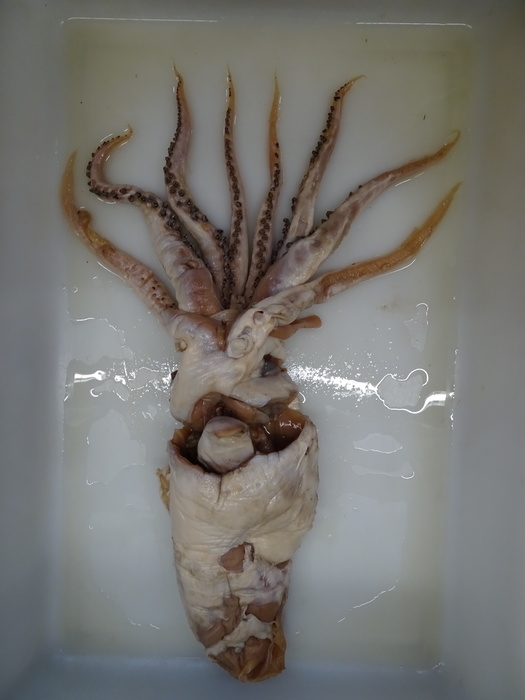
Image credit: Sam Arnold & FÁ Fernández-Álvarez
Mobydickia poseidonii Sa. Arnold & Fernández-Álvarez, 2025
https://www.marinespecies.org/aphia.php?p=taxdetails&id=1821955
Poseidon’s Squid, Mobydickia poseidonii, is one of the most remarkable deep-sea discoveries of 2025. While revising a group of deep-sea squids, scientists discovered that a single specimen collected in the 1950s did not belong to any known squid family. One particularly unusual element of this squid’s discovery is that it came not from a freshly collected animal or even a beached or net-entangled individual — this one-of-a-kind squid specimen was found in the stomach of a sperm whale! It is so distinctive that the researchers established not only a new species and genus, but an entirely new family called Mobydickidae to accommodate it. Known from just this one individual taken in Antarctic waters, Poseidon’s Squid represents a separate branch of the squid family tree, one that had gone unnoticed for decades inside a museum collection. The discovery of an entirely new squid family from a single preserved specimen highlights how much of the deep ocean still remains unknown and how important museums and biological collections are as a repository of Earth’s biodiversity.
Its name reflects both its dramatic discovery and its striking anatomy. The genus Mobydickia honors Moby-Dick, the fictional colossal white sperm whale from Herman Melville’s classic novel, acknowledging the real sperm whale that revealed this new discovery. The specific epithet poseidonii refers to Poseidon, the Greek god of the sea. According to myth, Poseidon wielded a powerful trident capable of unleashing storms and shipwrecks. The squid’s arm hooks resemble that trident: central hooks on most of the arms have one large central cusp with a smaller accessory claw on either side. Unlike many deep-sea squids, Poseidon’s Squid lacks glowing light organs and has a pale, gelatinous body. These unusual features made it clear that this animal did not belong in any existing squid family. Sperm whales can dive thousands of meters in search of squid prey, and in this case, one whale unknowingly delivered to science an entirely unknown branch of ocean life.
Original Source
- Arnold, S.; Nos, D.; Sáez-Liante, R.; Fernández-Álvarez, F. Á. (2025). Diversity in the squid family Ancistrocheiridae and description of a new family of the order Oegopsida (Cephalopoda). Zoological Journal of the Linnean Society. 204(3): zlaf074., available online at https://doi.org/10.1093/zoolinnean/zlaf074
- Sam Arnold (sam.arnold.work@gmail.com) (co-author)
- Fernando Á. Fernández-Álvarez (f.a.fernandez.alvarez@gmail.com) or (fafernandez@ieo.csic.es) (co-author)
The Elven Abyss Tunicate
Kaikoja undume Mandre & Rouse, 2025
https://www.marinespecies.org/aphia.php?p=taxdetails&id=1864678
Close your eyes and picture the closest living relatives of vertebrates. Most people would not picture a gelatinous filter feeder, permanently glued to the sea floor, shaped like Shrek’s head, with two siphons resembling his ears, sucking water in through one and expelling it through the other. Yet this is how our closest invertebrate cousins make their living. They are ascidians, also known as sea squirts or tunicates, and, like us, they are members of the phylum Chordata.
Of the approximately 2,300 species of sea squirts, members of the deep sea family Octacnemidae are some of the strangest. They live 3,000 meters (about 2 miles) below the surface, and while their shallow water cousins happily filter feed on plankton, plankton is hard to come by in the deep sea. Instead, these tunicates specialize on larger prey. Rather than looking like one of Shrek’s ears, their oral siphon has transformed into a large Venus flytrap-like structure to trap unsuspecting prey like copepods and other small animals. This is how the new species, Kaikoja undume, the Elven Abyss Tunicate, survives in the deep sea. The species name undume comes from the Elven language of Middle-earth. Decades before The Lord of the Rings was published, Tolkien wrote a poem in Elvish, known as “The Markirya Poem.” This poem includes the phrase “undumë hácala,” which translates to “abyss yawning”—a great description for the new species, which is typically found with its oral siphon open, yawning in the dark depths of the abyss waiting for food. Copepods and small animals drifting in the deep “shall not pass” the Elven Abyss Tunicate easily. Kaikoja undume is a prime example of how the organisms inhabiting Earth’s oceans can be as strange and alien as anything imagined in Tolkien’s Middle-earth.
Original Source
- Mandre, P.; Rouse, G. W. (2025). Molecular Phylogeny of the Deep-Sea Predatory Octacnemidae (Ascidiacea, Tunicata, Chordata), with Seven New Species. Diversity. 17(12): 859., available online at https://doi.org/10.3390/d17120859
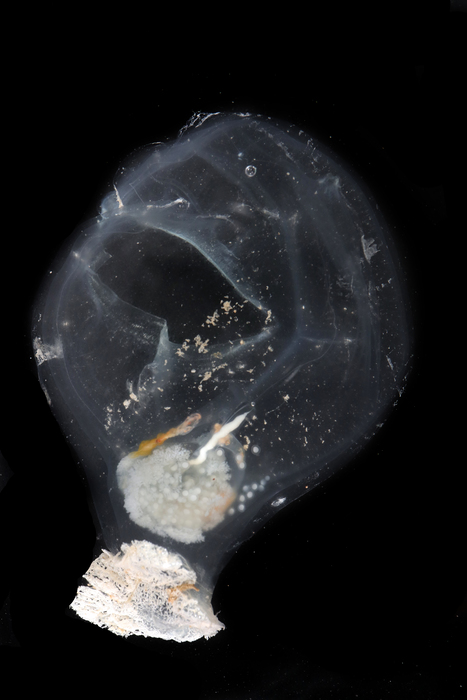
Image credit: Dr. Greg Rouse
- Peter Mandre (pmandre@ucsd.edu) (co-author)
- Greg Rouse (grouse@ucsd.edu) (co-author)
Acknowledgements
The WoRMS Top Ten Marine Species 2025 would not have been possible without the collaboration between the WoRMS Data Management Team (DMT), the WoRMS Top Ten Decision Committee, the WoRMS Steering Committee (SC) and voluntary contributions by many of the WoRMS editors.
The work of the DMT and many WoRMS-DMT-related activities are supported by LifeWatch Belgium, part of the E-Science European LifeWatch Infrastructure for Biodiversity and Ecosystem Research. LifeWatch is a distributed virtual laboratory, which is used for different aspects of biodiversity research. The Species Information Backbone of LifeWatch aims at bringing together taxonomic and species-related data and at filling the gaps in our knowledge. In addition, it gives support to taxonomic experts by providing them logistic and financial support for the organization of meetings and workshops related to expanding the content and enhancing the quality of taxonomic databases.
WoRMS – as ABC WoRMS – is an endorsed action under the UN Ocean Decade.
WoRMS and Ocean Census have a partnership to enhance rapid discovery and identification of marine life.
WoRMS is listed as an affilitated project with Marine Life 2030, which is endorsed as an UN Ocean Decade Programme.
The Flanders Marine Institute (VLIZ) is the permanent host institute of WoRMS.