WoRMS taxon details
Abra alba (W. Wood, 1802)
141433 (urn:lsid:marinespecies.org:taxname:141433)
accepted
Species
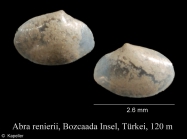
Abra renieri (Bronn, 1831) · unaccepted
Amphidesma boysiana Leach, 1852 · unaccepted > unjustified emendation (Unjustified emendation of Mactra...)
Unjustified emendation of Mactra boysi Montagu, 1803
Erycina renierii Bronn, 1831 · unaccepted
Erycina tumida Brusina, 1865 · unaccepted
Mactra alba W. Wood, 1802 · unaccepted
Mactra boysii Montagu, 1803 · unaccepted
Scrobicularia alba (W. Wood, 1802) · unaccepted
Scrobicularia alba var. oblonga J. T. Marshall, 1893 · unaccepted
Syndesmya alba (W. Wood, 1802) · unaccepted > superseded combination
Syndesmya alba var. apesa De Gregorio, 1884 · unaccepted (synonym)
Syndesmya alba var. curta Jeffreys, 1864 · unaccepted (synonym)
Syndesmya renieri (Bronn, 1831) · unaccepted > junior objective synonym (and superseded combination)
Syndosmya alba (W. Wood, 1802) · unaccepted
Syndosmya alba var. major Recluz, 1843 · unaccepted (synonym)
Syndosmya apelina Récluz, 1843 · unaccepted
Syndosmya occitanica Récluz, 1844 · unaccepted
Tellina apelina Gmelin, 1791, sensu Renier, 1804 · unaccepted (misapplication)
Tellina pellucida Brocchi, 1814 · unaccepted (preoccupied by Tellina pellucida...)
preoccupied by Tellina pellucida Spengler, 1798
Tellina semidentata Scacchi, 1833 · unaccepted
marine
(of Mactra alba W. Wood, 1802) Wood W. 1802. Observations on the hinges of British Bivalve shells. <i>Transactions of the Linnean Society of London</i>, 6: 154-176, pl. 14-18. , available online at http://biodiversitylibrary.org/page/758287
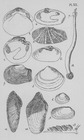
page(s): p. 165, pl. 16 fig. 9-12 [details] Available for editors [request]
page(s): p. 165, pl. 16 fig. 9-12 [details] Available for editors
[request]
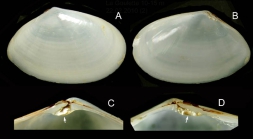
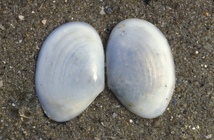
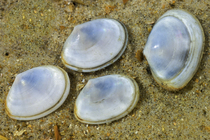
Description Small (up to 25mm long), thin and fragile shell. Oval shape, rather flat with thin concentric growth
lines. The shells are...
Distribution In the investigated area A. alba is very abundant in the south-eastern part of the Oyster Ground and the Frisian Front...
Distribution During both periods Abra alba is a common species in the near-coastal zone. The species is only rarely found further than...
lines. The shells are...
Description Small (up to 25mm long), thin and fragile shell. Oval shape, rather flat with thin concentric growth
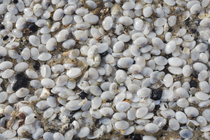
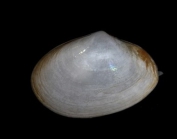
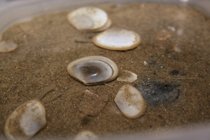
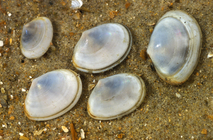
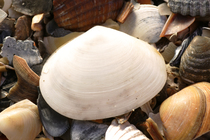
lines. The shells are shiny white and somehow transparent. Abra alba lives rather deep in the bottom and feeds on sediment by means of long, individually separated stretchable siphons. [details]
lines. The shells are shiny white and somehow transparent. Abra alba lives rather deep in the bottom and feeds on sediment by means of long, individually separated stretchable siphons. [details]
Distribution In the investigated area A. alba is very abundant in the south-eastern part of the Oyster Ground and the Frisian Front...
Distribution In the investigated area A. alba is very abundant in the south-eastern part of the Oyster Ground and the Frisian Front area. The bivalve is also present near the Dutch coast and in the Voordelta area, where its distribution extends into the Westerschelde and the Grevelingenmeer. The highest densities in the Delta area are found in the Oosterschelde. In the western part of the Wadden Sea and at the Balgzand the species is present in low densities. Highest biomass is found along the Dutch coast and in the central part of the Frisian Front area. Other investigations found the species to be confined to a more or less narrow strip of sea bottom near the shore (Eisma, 1966; Tebble, 1966; Wolff, 1973; Hayward & Ryland, 1990;< Rees & Dare, 1993). [details]
Distribution During both periods Abra alba is a common species in the near-coastal zone. The species is only rarely found further than...
Distribution During both periods Abra alba is a common species in the near-coastal zone. The species is only rarely found further than 30 km off the coast. Abra alba locally reaches very high densities: up to about 14,000 ind./m2 in the 1976-1986 period and appr. 5,000 ind./m2 in the 1994-2001 period. The highest densities are observed near the western coastal zone in both periods. [details]
MolluscaBase eds. (2024). MolluscaBase. Abra alba (W. Wood, 1802). Accessed through: World Register of Marine Species at: https://www.marinespecies.org/aphia.php?p=taxdetails&id=141433 on 2024-09-19
 The webpage text is licensed under a Creative Commons Attribution 4.0 License
original description
(of Amphidesma boysiana Leach, 1852) Leach, W. E. (1852). Molluscorum Britanniae Synopsis. A synopsis of the Mollusca of Great Britain arranged according to their natural affinities and anatomical structure. Van Voorst, London, viii + 376 pp. (edited posthumously by J. E. Gray). , available online at https://www.biodiversitylibrary.org/page/13107076
page(s): 279; note: unjustified emendation and new combination of Mactra boysi Montagu, 1803 [details]
original description (of Erycina renierii Bronn, 1831) Bronn, H. G. (1831). Italiens Tertiär-Gebilde und deren organische Einschlüsse. Karl Groos, Heidelberg, xii + 176 pp., 1 pl., available online at https://www.biodiversitylibrary.org/page/39170083
page(s): 90; note: as Erycina (?) renierii; based in part on Tellina apelina Gmelin, 1791 sensu Renier, 1804 [details]
original description (of Mactra alba W. Wood, 1802) Wood W. 1802. Observations on the hinges of British Bivalve shells. <i>Transactions of the Linnean Society of London</i>, 6: 154-176, pl. 14-18. , available online at http://biodiversitylibrary.org/page/758287
page(s): p. 165, pl. 16 fig. 9-12 [details] Available for editors [request]
original description (of Mactra boysii Montagu, 1803) Montagu, G. (1803). Testacea Britannica or natural history of British shells, marine, land, and fresh-water, including the most minute: Systematically arranged and embellished with figures. J. White, London, Vol. 1, xxxvii + 291 pp;; Vol. 2, pp. 293–606, pl. 1-16., available online at http://www.biodiversitylibrary.org/item/78694
page(s): 98-99, pl. 3 fig. 7 [details]
original description (of Erycina tumida Brusina, 1865) Brusina, S. (1865). Conchiglie dalmate inedite. <em>Verhandlungen der Kaiserlich-königlichen Zoologisch-botanisch Gesellschaft in Wien.</em> 15: 3-42., available online at https://www.biodiversitylibrary.org/page/16400444 [details]
original description (of Syndosmya apelina Récluz, 1843) Récluz, C. A. (1843). Monographie du genre <i>Syndosmya</i>. <em>Revue zoologique, par la Société Cuvierienne.</em> 6: 359-369., available online at http://biodiversitylibrary.org/page/2271434
page(s): 364 [details]
original description (of Syndosmya occitanica Récluz, 1844) Récluz, C. A. (1843). Monographie du genre <i>Syndosmya</i>. <em>Revue zoologique, par la Société Cuvierienne.</em> 6: 359-369., available online at http://biodiversitylibrary.org/page/2271434
page(s): 365 [details]
original description (of Tellina pellucida Brocchi, 1814) Brocchi, G. B. (1814). <i>Conchiologia fossile subapennina con osservazioni geologiche sugli Apennini e sul suolo adiacente. Tomo primo</i>. pp. 1-56, I-LXXV, 1-240. Milano, Stamperia Reale., available online at https://www.biodiversitylibrary.org/page/12001697
page(s): 514, pl. 12, fig. 8 [details]
original description (of Tellina semidentata Scacchi, 1833) Scacchi, A. (1833). <i>Osservazioni Zoologiche</i>. Napoli, Tipi della Società Tipografica. 1: 1-12 [February]; 2: 13-27 [May]. , available online at http://biodiversitylibrary.org/page/35752103
page(s): 13 [details]
original description (of Syndesmya alba var. curta Jeffreys, 1864) Jeffreys, J. G. (1862-1869). <i>British conchology</i>. Vol. 1: pp. cxiv + 341 [1862]. Vol. 2: pp. 479 [1864]. Vol. 3: pp. 394 [1865]. Vol. 4: pp. 487 [1867]. Vol. 5: pp. 259 [1869]. London, van Voorst. , available online at http://www.biodiversitylibrary.org/item/55187
page(s): 439 [details]
original description (of Syndosmya alba var. major Recluz, 1843) Récluz, C. A. (1843). Monographie du genre <i>Syndosmya</i>. <em>Revue zoologique, par la Société Cuvierienne.</em> 6: 359-369., available online at http://biodiversitylibrary.org/page/2271434
page(s): 362 [details]
original description (of Scrobicularia alba var. oblonga J. T. Marshall, 1893) Marshall, J. T. (1893-1894). Additions to 'British Conchology' [Part 1]. <em>Journal of Conchology.</em> 7: 241-265 [October 1893], 379-385 [April 1894]., available online at http://biodiversitylibrary.org/page/31573735
page(s): 247 [details]
context source (Schelde) Maris, T.; Beauchard, O.; Van Damme, S.; Van den Bergh, E.; Wijnhoven, S.; Meire, P. (2013). Referentiematrices en Ecotoopoppervlaktes Annex bij de Evaluatiemethodiek Schelde-estuarium Studie naar “Ecotoopoppervlaktes en intactness index”. <em>Monitor Taskforce Publication Series, 2013-01. NIOZ: Yerseke.</em> 35 pp. (look up in IMIS) [details]
context source (BeRMS 2020) Marine Biology Section, Ugent. Belgium. INRAM. Benthic fauna monitoring- SSD - Belgian Science Policy., available online at http://www.vliz.be/projects/inram/imers.php. [details]
basis of record Gofas, S.; Le Renard, J.; Bouchet, P. (2001). Mollusca. in: Costello, M.J. et al. (eds), European Register of Marine Species: a check-list of the marine species in Europe and a bibliography of guides to their identification. <em>Patrimoines Naturels.</em> 50: 180-213., available online at http://www.vliz.be/imisdocs/publications/ocrd/254404.pdf [details]
additional source Dewarumez, J. M., Quisthoudt, C. and Richard, A. 1986. Suivi pluriannuel du peuplement a Abra alba dans la partie meridionale de la Mer du Nord (region du Dunkerque-France). Hydrobiologia 142: 1870-1197., available online at https://doi.org/10.1007/bf00026758 [details]
additional source Huber, M. (2010). <i>Compendium of bivalves. A full-color guide to 3,300 of the world's marine bivalves. A status on Bivalvia after 250 years of research</i>. Hackenheim: ConchBooks. 901 pp., 1 CD-ROM. (look up in IMIS) [details]
additional source Zamouri-Langar, N.; Chouba, L.; Ajjabi Chebil, L.; Mrabet, R.; El Abed, A. (2011). Les coquillages bivalves des côtes tunisiennes. Institut National des Sciences et Technologies de la Mer: Salammbô. ISBN 978-9938-9512-0-2. 128 pp. (look up in IMIS) [details]
additional source Webb C.M. (1986). Post-larval development of the tellinacean bivalves <i>Abra alba</i>, <i>Tellina fabula</i> and <i>Donax vittatus</i> (Mollusca, Bivalvia), with reference to the late larva. <em>Journal of the Marine Biological Association of the United Kingdom.</em> 66: 749-762. [details] Available for editors [request]
redescription Wood W. 1802. Observations on the hinges of British Bivalve shells. <i>Transactions of the Linnean Society of London</i>, 6: 154-176, pl. 14-18. , available online at http://biodiversitylibrary.org/page/758287
page(s): 165 [details] Available for editors [request]
identification resource Cosel, R. von; Gofas, S. (2019). <i>Marine bivalves of tropical West Africa: from Rio de Oro to southern Angola</i>. Publications Scientifiques du Muséum, Paris, IRD Éditions, Marseille (Faune et Flore tropicales, volume 48): 1-1104.
page(s): 679 [details]
page(s): 279; note: unjustified emendation and new combination of Mactra boysi Montagu, 1803 [details]
original description (of Erycina renierii Bronn, 1831) Bronn, H. G. (1831). Italiens Tertiär-Gebilde und deren organische Einschlüsse. Karl Groos, Heidelberg, xii + 176 pp., 1 pl., available online at https://www.biodiversitylibrary.org/page/39170083
page(s): 90; note: as Erycina (?) renierii; based in part on Tellina apelina Gmelin, 1791 sensu Renier, 1804 [details]
original description (of Mactra alba W. Wood, 1802) Wood W. 1802. Observations on the hinges of British Bivalve shells. <i>Transactions of the Linnean Society of London</i>, 6: 154-176, pl. 14-18. , available online at http://biodiversitylibrary.org/page/758287
page(s): p. 165, pl. 16 fig. 9-12 [details] Available for editors
[request] original description (of Mactra boysii Montagu, 1803) Montagu, G. (1803). Testacea Britannica or natural history of British shells, marine, land, and fresh-water, including the most minute: Systematically arranged and embellished with figures. J. White, London, Vol. 1, xxxvii + 291 pp;; Vol. 2, pp. 293–606, pl. 1-16., available online at http://www.biodiversitylibrary.org/item/78694
page(s): 98-99, pl. 3 fig. 7 [details]
original description (of Erycina tumida Brusina, 1865) Brusina, S. (1865). Conchiglie dalmate inedite. <em>Verhandlungen der Kaiserlich-königlichen Zoologisch-botanisch Gesellschaft in Wien.</em> 15: 3-42., available online at https://www.biodiversitylibrary.org/page/16400444 [details]
original description (of Syndosmya apelina Récluz, 1843) Récluz, C. A. (1843). Monographie du genre <i>Syndosmya</i>. <em>Revue zoologique, par la Société Cuvierienne.</em> 6: 359-369., available online at http://biodiversitylibrary.org/page/2271434
page(s): 364 [details]
original description (of Syndosmya occitanica Récluz, 1844) Récluz, C. A. (1843). Monographie du genre <i>Syndosmya</i>. <em>Revue zoologique, par la Société Cuvierienne.</em> 6: 359-369., available online at http://biodiversitylibrary.org/page/2271434
page(s): 365 [details]
original description (of Tellina pellucida Brocchi, 1814) Brocchi, G. B. (1814). <i>Conchiologia fossile subapennina con osservazioni geologiche sugli Apennini e sul suolo adiacente. Tomo primo</i>. pp. 1-56, I-LXXV, 1-240. Milano, Stamperia Reale., available online at https://www.biodiversitylibrary.org/page/12001697
page(s): 514, pl. 12, fig. 8 [details]
original description (of Tellina semidentata Scacchi, 1833) Scacchi, A. (1833). <i>Osservazioni Zoologiche</i>. Napoli, Tipi della Società Tipografica. 1: 1-12 [February]; 2: 13-27 [May]. , available online at http://biodiversitylibrary.org/page/35752103
page(s): 13 [details]
original description (of Syndesmya alba var. curta Jeffreys, 1864) Jeffreys, J. G. (1862-1869). <i>British conchology</i>. Vol. 1: pp. cxiv + 341 [1862]. Vol. 2: pp. 479 [1864]. Vol. 3: pp. 394 [1865]. Vol. 4: pp. 487 [1867]. Vol. 5: pp. 259 [1869]. London, van Voorst. , available online at http://www.biodiversitylibrary.org/item/55187
page(s): 439 [details]
original description (of Syndosmya alba var. major Recluz, 1843) Récluz, C. A. (1843). Monographie du genre <i>Syndosmya</i>. <em>Revue zoologique, par la Société Cuvierienne.</em> 6: 359-369., available online at http://biodiversitylibrary.org/page/2271434
page(s): 362 [details]
original description (of Scrobicularia alba var. oblonga J. T. Marshall, 1893) Marshall, J. T. (1893-1894). Additions to 'British Conchology' [Part 1]. <em>Journal of Conchology.</em> 7: 241-265 [October 1893], 379-385 [April 1894]., available online at http://biodiversitylibrary.org/page/31573735
page(s): 247 [details]
context source (Schelde) Maris, T.; Beauchard, O.; Van Damme, S.; Van den Bergh, E.; Wijnhoven, S.; Meire, P. (2013). Referentiematrices en Ecotoopoppervlaktes Annex bij de Evaluatiemethodiek Schelde-estuarium Studie naar “Ecotoopoppervlaktes en intactness index”. <em>Monitor Taskforce Publication Series, 2013-01. NIOZ: Yerseke.</em> 35 pp. (look up in IMIS) [details]
context source (BeRMS 2020) Marine Biology Section, Ugent. Belgium. INRAM. Benthic fauna monitoring- SSD - Belgian Science Policy., available online at http://www.vliz.be/projects/inram/imers.php. [details]
basis of record Gofas, S.; Le Renard, J.; Bouchet, P. (2001). Mollusca. in: Costello, M.J. et al. (eds), European Register of Marine Species: a check-list of the marine species in Europe and a bibliography of guides to their identification. <em>Patrimoines Naturels.</em> 50: 180-213., available online at http://www.vliz.be/imisdocs/publications/ocrd/254404.pdf [details]
additional source Dewarumez, J. M., Quisthoudt, C. and Richard, A. 1986. Suivi pluriannuel du peuplement a Abra alba dans la partie meridionale de la Mer du Nord (region du Dunkerque-France). Hydrobiologia 142: 1870-1197., available online at https://doi.org/10.1007/bf00026758 [details]
additional source Huber, M. (2010). <i>Compendium of bivalves. A full-color guide to 3,300 of the world's marine bivalves. A status on Bivalvia after 250 years of research</i>. Hackenheim: ConchBooks. 901 pp., 1 CD-ROM. (look up in IMIS) [details]
additional source Zamouri-Langar, N.; Chouba, L.; Ajjabi Chebil, L.; Mrabet, R.; El Abed, A. (2011). Les coquillages bivalves des côtes tunisiennes. Institut National des Sciences et Technologies de la Mer: Salammbô. ISBN 978-9938-9512-0-2. 128 pp. (look up in IMIS) [details]
additional source Webb C.M. (1986). Post-larval development of the tellinacean bivalves <i>Abra alba</i>, <i>Tellina fabula</i> and <i>Donax vittatus</i> (Mollusca, Bivalvia), with reference to the late larva. <em>Journal of the Marine Biological Association of the United Kingdom.</em> 66: 749-762. [details] Available for editors
[request] redescription Wood W. 1802. Observations on the hinges of British Bivalve shells. <i>Transactions of the Linnean Society of London</i>, 6: 154-176, pl. 14-18. , available online at http://biodiversitylibrary.org/page/758287
page(s): 165 [details] Available for editors
[request] identification resource Cosel, R. von; Gofas, S. (2019). <i>Marine bivalves of tropical West Africa: from Rio de Oro to southern Angola</i>. Publications Scientifiques du Muséum, Paris, IRD Éditions, Marseille (Faune et Flore tropicales, volume 48): 1-1104.
page(s): 679 [details]
 Present Present in aphia/obis/gbif/idigbio Inaccurate Introduced: alien Containing type locality
From editor or global species database
Biology A. alba and Tellina fabula are two species occupying the same feeding niche since both can feed on deposit as well as on suspended material. Competition between the two species may result in the slow growth of the later-settling T. fabula. [details]From other sources
Biology The production of a large number of small-sized eggs suggests that A. alba has a larval development with a long pelagic life. The optimal spawning period of the bivalve lies between May and August. The first postlarvae have a shell length of btween 200 and 300 µm. Specimens that settle in early summer grow rapidly, while another spatfall in late summer or autumn apparently does not grow until the following spring. Most specimens of A. alba live only one year, reaching modal lengths of 12-14 mm. Specimens that live for two years grow to 13-16 mm and the maximum length reached is 20-25 mm. The abundance of A. alba typically fluctuates widely from year to year due to variation in recruitment success or adult mortality. A. alba is capable of rapidly exploiting any new disturbed substratum suitable for colonisation, either through larval recruitment, secondary settlement or post-metamorphosis juveniles or re-distribution of adults following storms. A thin-shelled selective deposit [details]Description Small (up to 25mm long), thin and fragile shell. Oval shape, rather flat with thin concentric growth
lines. The shells are shiny white and somehow transparent. Abra alba lives rather deep in the bottom and feeds on sediment by means of long, individually separated stretchable siphons. [details]
Distribution In the investigated area A. alba is very abundant in the south-eastern part of the Oyster Ground and the Frisian Front area. The bivalve is also present near the Dutch coast and in the Voordelta area, where its distribution extends into the Westerschelde and the Grevelingenmeer. The highest densities in the Delta area are found in the Oosterschelde. In the western part of the Wadden Sea and at the Balgzand the species is present in low densities. Highest biomass is found along the Dutch coast and in the central part of the Frisian Front area. Other investigations found the species to be confined to a more or less narrow strip of sea bottom near the shore (Eisma, 1966; Tebble, 1966; Wolff, 1973; Hayward & Ryland, 1990;< Rees & Dare, 1993). [details]
Distribution During both periods Abra alba is a common species in the near-coastal zone. The species is only rarely found further than 30 km off the coast. Abra alba locally reaches very high densities: up to about 14,000 ind./m2 in the 1976-1986 period and appr. 5,000 ind./m2 in the 1994-2001 period. The highest densities are observed near the western coastal zone in both periods. [details]
Habitat Abra alba can be found in all sediment types. However, the species does tend to prefer (> 50% of the samples) fine-grained sediments with a median grain size between 50 and 250 μm and a mud content of 10-50%. In coarse sediments (median grain size > 300 μm) with a low mud content (< 10%) the A. alba is rather rare. [details]
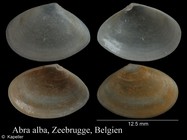
Morphology The shell is thin and brittle, broadly oval in outline. It is up to 25 mm long and has a sculpture of fine concentric lines. The growth stages are clear. The shell is white in colour, covered with a light brown periostracum. The interior of the shell is white. [details]

| Language | Name | |
|---|---|---|
| Danish | hvid pebermusling | [details] |
| Dutch | witte dunschaal | [details] |
| English | white furrow-shellwhite furrow shellwhite abra | [details] |
| French | telline blanchesyndesmye blanche | [details] |
| German | weiße Pfeffermuschelkleine Pfeffermuschel | [details] |
BIOTIC
Encyclopedia of Marine Life of Britain and Ireland
Marine Life Information Network - UK
To Barcode of Life (14 barcodes)
To Biodiversity Heritage Library (146 publications) (from synonym Syndosmya alba (W. Wood, 1802))
To Biodiversity Heritage Library (54 publications) (from synonym Syndesmya alba (W. Wood, 1802))
To Biodiversity Heritage Library (74 publications)
To Dyntaxa
To European Nucleotide Archive, ENA (Abra alba)
To GB Mollusca Types (Mactra boysii Montagu, 1803; Syntype(s); EXEMS Moll4287) (from synonym Mactra boysii Montagu, 1803)
To GenBank (18 nucleotides; 7 proteins)
To Global Biotic Interactions (GloBI)
To Malacopics (Abra alba (W. Wood, 182) Netherlands, Zuid-Holland, Hoek van Holland, beached after...
To Malacopics (Abra alba (W. Wood, 182))
To Malacopics (Abra alba)
To Marine Bivalves of the British Isles webpage at National Museum of Wales
To MNHN Fossil collection (Abra alba (WOOD, 1802); Figuré; F.R11565)
To PESI (from synonym Syndesmya alba (W. Wood, 1802))
To PESI (from synonym Syndosmya alba (W. Wood, 1802))
To PESI (from synonym Syndesmya alba var. apesa De Gregorio, 1884)
To PESI (from synonym Syndesmya alba var. curta Jeffreys, 1864)
To PESI (from synonym Syndosmya alba var. major Recluz, 1843)
To PESI
To PESI (from synonym Erycina tumida Brusina, 1865)
To PESI (from synonym Mactra alba W. Wood, 1802)
To PESI (from synonym Syndosmya occitanica Récluz, 1844)
To PESI (from synonym Tellina pellucida Brocchi, 1814)
To PESI (from synonym Tellina semidentata Scacchi, 1833)
To ITIS
Encyclopedia of Marine Life of Britain and Ireland
Marine Life Information Network - UK
To Barcode of Life (14 barcodes)
To Biodiversity Heritage Library (146 publications) (from synonym Syndosmya alba (W. Wood, 1802))
To Biodiversity Heritage Library (54 publications) (from synonym Syndesmya alba (W. Wood, 1802))
To Biodiversity Heritage Library (74 publications)
To Dyntaxa
To European Nucleotide Archive, ENA (Abra alba)
To GB Mollusca Types (Mactra boysii Montagu, 1803; Syntype(s); EXEMS Moll4287) (from synonym Mactra boysii Montagu, 1803)
To GenBank (18 nucleotides; 7 proteins)
To Global Biotic Interactions (GloBI)
To Malacopics (Abra alba (W. Wood, 182) Netherlands, Zuid-Holland, Hoek van Holland, beached after...
To Malacopics (Abra alba (W. Wood, 182))
To Malacopics (Abra alba)
To Marine Bivalves of the British Isles webpage at National Museum of Wales
To MNHN Fossil collection (Abra alba (WOOD, 1802); Figuré; F.R11565)
To PESI (from synonym Syndesmya alba (W. Wood, 1802))
To PESI (from synonym Syndosmya alba (W. Wood, 1802))
To PESI (from synonym Syndesmya alba var. apesa De Gregorio, 1884)
To PESI (from synonym Syndesmya alba var. curta Jeffreys, 1864)
To PESI (from synonym Syndosmya alba var. major Recluz, 1843)
To PESI
To PESI (from synonym Erycina tumida Brusina, 1865)
To PESI (from synonym Mactra alba W. Wood, 1802)
To PESI (from synonym Syndosmya occitanica Récluz, 1844)
To PESI (from synonym Tellina pellucida Brocchi, 1814)
To PESI (from synonym Tellina semidentata Scacchi, 1833)
To ITIS
From editor or global species database


From other sources


 renieri.jpg "To Malacopics (Abra alba)")
