WoRMS taxon details
Spisula solida (Linnaeus, 1758)

140301 (urn:lsid:marinespecies.org:taxname:140301)
accepted
Species
Cardium solidum Linnaeus, 1758 · unaccepted (original combination)
Cardium triste Linnaeus, 1758 · unaccepted
Corbicula panormitana (Bivona, 1839) † · unaccepted
Cyrena panormitana Bivona, 1839 † · unaccepted
Mactra castanea Lamarck, 1818 · unaccepted
Mactra crassatella Lamarck, 1818 · unaccepted
Mactra gallina Spengler, 1802 · unaccepted
Mactra ovalis J. Sowerby, 1817 † · unaccepted
Mactra sachalinensis var. conjunctiva Jeffreys, 1864 · unaccepted
Mactra solida (Linnaeus, 1758) · unaccepted > superseded combination
Mactra solida var. conjunctiva Jeffreys, 1864 · unaccepted (synonym)
Mactra striata Nyst, 1845 · unaccepted
Mactra truncata Montagu, 1808 · unaccepted
Spisula (Spisula) ovalis (J. Sowerby, 1817) · alternative representation
Spisula ovalis (J. Sowerby, 1817) · unaccepted
Trigonella gallina da Costa, 1778 · unaccepted
Trigonella zonaria da Costa, 1778 · unaccepted
marine
(of Cardium solidum Linnaeus, 1758) Linnaeus, C. (1758). Systema Naturae per regna tria naturae, secundum classes, ordines, genera, species, cum characteribus, differentiis, synonymis, locis. <em>Editio decima, reformata [10th revised edition], vol. 1: 824 pp. Laurentius Salvius: Holmiae.</em> , available online at https://biodiversitylibrary.org/page/726886
page(s): 681 [details] Available for editors [request]
page(s): 681 [details] Available for editors
[request]
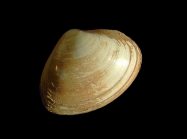
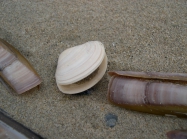
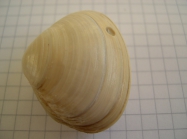
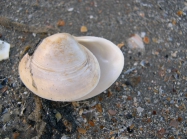
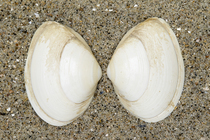
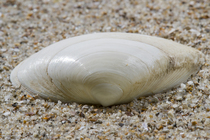
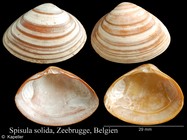
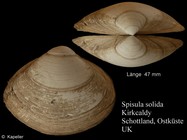
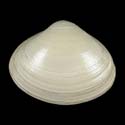
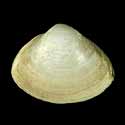
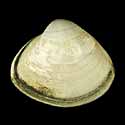
Description A thick oval shell, mostly coloured dirty white and measuring up to 50 mm long. Concentric lines at
the front and back are...
Distribution With observations in the coastal zone up to in the open sea the distribution of Spisula solida covers the entire Belgian...
the front and back are...
Description A thick oval shell, mostly coloured dirty white and measuring up to 50 mm long. Concentric lines at
the front and back are reasonably coarse, growth lines are clear. A shallow burrowing suspension
feeder. [details]
the front and back are reasonably coarse, growth lines are clear. A shallow burrowing suspension
feeder. [details]
Distribution With observations in the coastal zone up to in the open sea the distribution of Spisula solida covers the entire Belgian...
Distribution With observations in the coastal zone up to in the open sea the distribution of Spisula solida covers the entire Belgian part of the North Sea. The species is mainly found on the tops of the sandbanks. During the 1976-1986 period S. solida was found in a relatively high number of locations. In the 1994-2001 period, however, the distribution frequency decreased considerably. In both periods S. solida reached a maximum density of 40 ind./m2. [details]
MolluscaBase eds. (2024). MolluscaBase. Spisula solida (Linnaeus, 1758). Accessed through: World Register of Marine Species at: https://www.marinespecies.org/aphia.php?p=taxdetails&id=140301 on 2024-09-23
Date
action
by
 The webpage text is licensed under a Creative Commons Attribution 4.0 License
original description
(of Cyrena panormitana Bivona, 1839 †) Bivona And. 1839. Descrizione di due nuove specie di conchiglie fossili de dintorni di Palermo. <i>Effemeridi scientifiche e letterarie per la Sicilia</i>
24: 21-23, available online at http://books.google.com/books?id=DJswAAAAYAAJ&pg=RA3-PA39
page(s): 21-22 [details]
original description (of Mactra castanea Lamarck, 1818) Lamarck, J.B. (1818). [volume 5 of] Histoire naturelle des Animaux sans Vertèbres, préséntant les caractères généraux et particuliers de ces animaux, leur distribution, leurs classes, leurs familles, leurs genres, et la citation des principales espèces qui s'y rapportent; precedes d'une Introduction offrant la determination des caracteres essentiels de l'Animal, sa distinction du vegetal et desautres corps naturels, enfin, l'Exposition des Principes fondamentaux de la Zoologie. <em>Paris, Deterville.</em> vol 5: 612 pp., available online at http://biodiversitylibrary.org/page/12886879 [details]
original description (of Mactra crassatella Lamarck, 1818) Lamarck, J.B. (1818). [volume 5 of] Histoire naturelle des Animaux sans Vertèbres, préséntant les caractères généraux et particuliers de ces animaux, leur distribution, leurs classes, leurs familles, leurs genres, et la citation des principales espèces qui s'y rapportent; precedes d'une Introduction offrant la determination des caracteres essentiels de l'Animal, sa distinction du vegetal et desautres corps naturels, enfin, l'Exposition des Principes fondamentaux de la Zoologie. <em>Paris, Deterville.</em> vol 5: 612 pp., available online at http://biodiversitylibrary.org/page/12886879 [details]
original description (of Mactra gallina Spengler, 1802) Spengler, L. (1802). Beskrivelse over det toskallede Conchylie-Slægt <i>Mactra</i>. <em>Skrivter af Naturhistorie-Selskabet, Kiøbenhavn.</em> 5(2): 92-128, pl. 3., available online at https://babel.hathitrust.org/cgi/pt?id=hvd.32044106425135;view=1up;seq=358 [details]
original description (of Mactra ovalis J. Sowerby, 1817 †) Sowerby, J. (1815-1818). The mineral conchology of Great Britain; or coloured figures and descriptions of those remains of testaceous animals or shells, which have been preserved at various times and depths in the earth [Vol. II]. London, privately published, pp. 1-235 + index, errata and addenda [3 pp.] + supplementary index to vol. II, pp. 240-251; pl. 103-233. , available online at http://www.biodiversitylibrary.org/item/210427
page(s): 136, pl. 160, fig. 5 [details]
original description (of Mactra striata Nyst, 1845) Nyst, P.-H. J. (1845). Description des coquilles et des polypiers fossiles des terrains tertiaires de la Belgique. <em>Mémoires Couronnés et Mémoires des Savants Etrangers, publiés par l'Académie Royale des Sciences et Belles-Lettres de Bruxelles.</em> 17: 1-697, 15 pls., available online at https://www.biodiversitylibrary.org/page/2668665 [details]
original description (of Mactra truncata Montagu, 1808) Montagu, G. (1808). Supplement to Testacea Britannica with Additional Plates. Woolmer, Exeter. v + 183 pp., pl. 17-30. , available online at https://www.biodiversitylibrary.org/page/61685744 [details]
original description (of Trigonella gallina da Costa, 1778) Da Costa, E. M. (1778). <i>Historia naturalis testaceorum Britanniæ, or, the British conchology</i>; containing the descriptions and other particulars of natural history of the shells of Great Britain and Ireland: illustrated with figures. In English and French. - Historia naturalis testaceorum Britanniæ, ou, la conchologie Britannique; contenant les descriptions & autres particularités d'histoire naturelle des coquilles de la Grande Bretagne & de l'Irlande: avec figures en taille douce. En anglois & françois. i-xii, 1-254, i-vii, [1], Pl. I-XVII. London. (Millan, White, Emsley & Robson). , available online at https://www.biodiversitylibrary.org/page/13116783
page(s): 199-200; pl. 14 fig. 6 [details]
original description (of Trigonella zonaria da Costa, 1778) Da Costa, E. M. (1778). <i>Historia naturalis testaceorum Britanniæ, or, the British conchology</i>; containing the descriptions and other particulars of natural history of the shells of Great Britain and Ireland: illustrated with figures. In English and French. - Historia naturalis testaceorum Britanniæ, ou, la conchologie Britannique; contenant les descriptions & autres particularités d'histoire naturelle des coquilles de la Grande Bretagne & de l'Irlande: avec figures en taille douce. En anglois & françois. i-xii, 1-254, i-vii, [1], Pl. I-XVII. London. (Millan, White, Emsley & Robson). , available online at https://www.biodiversitylibrary.org/page/13116783
page(s): 197-198; pl. 15 fig. 1 [details]
original description (of Mactra sachalinensis var. conjunctiva Jeffreys, 1864) Jeffreys, J. G. (1862-1869). <i>British conchology</i>. Vol. 1: pp. cxiv + 341 [1862]. Vol. 2: pp. 479 [1864]. Vol. 3: pp. 394 [1865]. Vol. 4: pp. 487 [1867]. Vol. 5: pp. 259 [1869]. London, van Voorst. , available online at http://www.biodiversitylibrary.org/item/55187
page(s): 2: 417 [details]
original description (of Cardium solidum Linnaeus, 1758) Linnaeus, C. (1758). Systema Naturae per regna tria naturae, secundum classes, ordines, genera, species, cum characteribus, differentiis, synonymis, locis. <em>Editio decima, reformata [10th revised edition], vol. 1: 824 pp. Laurentius Salvius: Holmiae.</em> , available online at https://biodiversitylibrary.org/page/726886
page(s): 681 [details] Available for editors [request]
original description (of Cardium triste Linnaeus, 1758) Linnaeus, C. (1758). Systema Naturae per regna tria naturae, secundum classes, ordines, genera, species, cum characteribus, differentiis, synonymis, locis. <em>Editio decima, reformata [10th revised edition], vol. 1: 824 pp. Laurentius Salvius: Holmiae.</em> , available online at https://biodiversitylibrary.org/page/726886 [details] Available for editors [request]
original description (of Mactra solida var. conjunctiva Jeffreys, 1864) Jeffreys, J. G. (1862-1869). <i>British conchology</i>. Vol. 1: pp. cxiv + 341 [1862]. Vol. 2: pp. 479 [1864]. Vol. 3: pp. 394 [1865]. Vol. 4: pp. 487 [1867]. Vol. 5: pp. 259 [1869]. London, van Voorst. , available online at http://www.biodiversitylibrary.org/item/55187
page(s): 2: 417 [details]
context source (Schelde) Vanosmael, C. (1977). Studie van het macrobenthos ter hoogte van de monding van de Westerschelde en de Belgische kust. <em>MSc Thesis. Rijksuniversiteit Gent, Faculteit der Wetenschappen: Gent.</em> 70 pp. (look up in IMIS) [details]
context source (BeRMS 2020) Bio-environmental research group; Institute of Agricultural and Fisheries research (ILVO), Belgium; (2015): Epibenthos and demersal fish monitoring data in function of wind energy development in the Belgian part of the North Sea. [details]
basis of record Gofas, S.; Le Renard, J.; Bouchet, P. (2001). Mollusca. in: Costello, M.J. et al. (eds), European Register of Marine Species: a check-list of the marine species in Europe and a bibliography of guides to their identification. <em>Patrimoines Naturels.</em> 50: 180-213., available online at http://www.vliz.be/imisdocs/publications/ocrd/254404.pdf [details]
additional source Huber, M. (2010). <i>Compendium of bivalves. A full-color guide to 3,300 of the world's marine bivalves. A status on Bivalvia after 250 years of research</i>. Hackenheim: ConchBooks. 901 pp., 1 CD-ROM. (look up in IMIS) [details]
page(s): 21-22 [details]
original description (of Mactra castanea Lamarck, 1818) Lamarck, J.B. (1818). [volume 5 of] Histoire naturelle des Animaux sans Vertèbres, préséntant les caractères généraux et particuliers de ces animaux, leur distribution, leurs classes, leurs familles, leurs genres, et la citation des principales espèces qui s'y rapportent; precedes d'une Introduction offrant la determination des caracteres essentiels de l'Animal, sa distinction du vegetal et desautres corps naturels, enfin, l'Exposition des Principes fondamentaux de la Zoologie. <em>Paris, Deterville.</em> vol 5: 612 pp., available online at http://biodiversitylibrary.org/page/12886879 [details]
original description (of Mactra crassatella Lamarck, 1818) Lamarck, J.B. (1818). [volume 5 of] Histoire naturelle des Animaux sans Vertèbres, préséntant les caractères généraux et particuliers de ces animaux, leur distribution, leurs classes, leurs familles, leurs genres, et la citation des principales espèces qui s'y rapportent; precedes d'une Introduction offrant la determination des caracteres essentiels de l'Animal, sa distinction du vegetal et desautres corps naturels, enfin, l'Exposition des Principes fondamentaux de la Zoologie. <em>Paris, Deterville.</em> vol 5: 612 pp., available online at http://biodiversitylibrary.org/page/12886879 [details]
original description (of Mactra gallina Spengler, 1802) Spengler, L. (1802). Beskrivelse over det toskallede Conchylie-Slægt <i>Mactra</i>. <em>Skrivter af Naturhistorie-Selskabet, Kiøbenhavn.</em> 5(2): 92-128, pl. 3., available online at https://babel.hathitrust.org/cgi/pt?id=hvd.32044106425135;view=1up;seq=358 [details]
original description (of Mactra ovalis J. Sowerby, 1817 †) Sowerby, J. (1815-1818). The mineral conchology of Great Britain; or coloured figures and descriptions of those remains of testaceous animals or shells, which have been preserved at various times and depths in the earth [Vol. II]. London, privately published, pp. 1-235 + index, errata and addenda [3 pp.] + supplementary index to vol. II, pp. 240-251; pl. 103-233. , available online at http://www.biodiversitylibrary.org/item/210427
page(s): 136, pl. 160, fig. 5 [details]
original description (of Mactra striata Nyst, 1845) Nyst, P.-H. J. (1845). Description des coquilles et des polypiers fossiles des terrains tertiaires de la Belgique. <em>Mémoires Couronnés et Mémoires des Savants Etrangers, publiés par l'Académie Royale des Sciences et Belles-Lettres de Bruxelles.</em> 17: 1-697, 15 pls., available online at https://www.biodiversitylibrary.org/page/2668665 [details]
original description (of Mactra truncata Montagu, 1808) Montagu, G. (1808). Supplement to Testacea Britannica with Additional Plates. Woolmer, Exeter. v + 183 pp., pl. 17-30. , available online at https://www.biodiversitylibrary.org/page/61685744 [details]
original description (of Trigonella gallina da Costa, 1778) Da Costa, E. M. (1778). <i>Historia naturalis testaceorum Britanniæ, or, the British conchology</i>; containing the descriptions and other particulars of natural history of the shells of Great Britain and Ireland: illustrated with figures. In English and French. - Historia naturalis testaceorum Britanniæ, ou, la conchologie Britannique; contenant les descriptions & autres particularités d'histoire naturelle des coquilles de la Grande Bretagne & de l'Irlande: avec figures en taille douce. En anglois & françois. i-xii, 1-254, i-vii, [1], Pl. I-XVII. London. (Millan, White, Emsley & Robson). , available online at https://www.biodiversitylibrary.org/page/13116783
page(s): 199-200; pl. 14 fig. 6 [details]
original description (of Trigonella zonaria da Costa, 1778) Da Costa, E. M. (1778). <i>Historia naturalis testaceorum Britanniæ, or, the British conchology</i>; containing the descriptions and other particulars of natural history of the shells of Great Britain and Ireland: illustrated with figures. In English and French. - Historia naturalis testaceorum Britanniæ, ou, la conchologie Britannique; contenant les descriptions & autres particularités d'histoire naturelle des coquilles de la Grande Bretagne & de l'Irlande: avec figures en taille douce. En anglois & françois. i-xii, 1-254, i-vii, [1], Pl. I-XVII. London. (Millan, White, Emsley & Robson). , available online at https://www.biodiversitylibrary.org/page/13116783
page(s): 197-198; pl. 15 fig. 1 [details]
original description (of Mactra sachalinensis var. conjunctiva Jeffreys, 1864) Jeffreys, J. G. (1862-1869). <i>British conchology</i>. Vol. 1: pp. cxiv + 341 [1862]. Vol. 2: pp. 479 [1864]. Vol. 3: pp. 394 [1865]. Vol. 4: pp. 487 [1867]. Vol. 5: pp. 259 [1869]. London, van Voorst. , available online at http://www.biodiversitylibrary.org/item/55187
page(s): 2: 417 [details]
original description (of Cardium solidum Linnaeus, 1758) Linnaeus, C. (1758). Systema Naturae per regna tria naturae, secundum classes, ordines, genera, species, cum characteribus, differentiis, synonymis, locis. <em>Editio decima, reformata [10th revised edition], vol. 1: 824 pp. Laurentius Salvius: Holmiae.</em> , available online at https://biodiversitylibrary.org/page/726886
page(s): 681 [details] Available for editors
[request] original description (of Cardium triste Linnaeus, 1758) Linnaeus, C. (1758). Systema Naturae per regna tria naturae, secundum classes, ordines, genera, species, cum characteribus, differentiis, synonymis, locis. <em>Editio decima, reformata [10th revised edition], vol. 1: 824 pp. Laurentius Salvius: Holmiae.</em> , available online at https://biodiversitylibrary.org/page/726886 [details] Available for editors
[request] original description (of Mactra solida var. conjunctiva Jeffreys, 1864) Jeffreys, J. G. (1862-1869). <i>British conchology</i>. Vol. 1: pp. cxiv + 341 [1862]. Vol. 2: pp. 479 [1864]. Vol. 3: pp. 394 [1865]. Vol. 4: pp. 487 [1867]. Vol. 5: pp. 259 [1869]. London, van Voorst. , available online at http://www.biodiversitylibrary.org/item/55187
page(s): 2: 417 [details]
context source (Schelde) Vanosmael, C. (1977). Studie van het macrobenthos ter hoogte van de monding van de Westerschelde en de Belgische kust. <em>MSc Thesis. Rijksuniversiteit Gent, Faculteit der Wetenschappen: Gent.</em> 70 pp. (look up in IMIS) [details]
context source (BeRMS 2020) Bio-environmental research group; Institute of Agricultural and Fisheries research (ILVO), Belgium; (2015): Epibenthos and demersal fish monitoring data in function of wind energy development in the Belgian part of the North Sea. [details]
basis of record Gofas, S.; Le Renard, J.; Bouchet, P. (2001). Mollusca. in: Costello, M.J. et al. (eds), European Register of Marine Species: a check-list of the marine species in Europe and a bibliography of guides to their identification. <em>Patrimoines Naturels.</em> 50: 180-213., available online at http://www.vliz.be/imisdocs/publications/ocrd/254404.pdf [details]
additional source Huber, M. (2010). <i>Compendium of bivalves. A full-color guide to 3,300 of the world's marine bivalves. A status on Bivalvia after 250 years of research</i>. Hackenheim: ConchBooks. 901 pp., 1 CD-ROM. (look up in IMIS) [details]
 Present Present in aphia/obis/gbif/idigbio Inaccurate Introduced: alien Containing type locality
From other sources
Description A thick oval shell, mostly coloured dirty white and measuring up to 50 mm long. Concentric lines atthe front and back are reasonably coarse, growth lines are clear. A shallow burrowing suspension
feeder. [details]
Distribution With observations in the coastal zone up to in the open sea the distribution of Spisula solida covers the entire Belgian part of the North Sea. The species is mainly found on the tops of the sandbanks. During the 1976-1986 period S. solida was found in a relatively high number of locations. In the 1994-2001 period, however, the distribution frequency decreased considerably. In both periods S. solida reached a maximum density of 40 ind./m2. [details]
Habitat Spisula solida mainly prefers coarse-grained sediments: the higher the median grain size, the higher the relative occurrence (up to 20%). The species furthermore also tends to prefer the presence of a low mud content (0-20%). The species does not occur in sediments with a mud content exceeding 20%.The high relative occurrence (20%) in sediments with a median grain size of 50-100 μm is considered unreliable (outlier). [details]
Validity Valid as Spisula (Spisula) solida (Linnaeus, 1758) [details]

| Language | Name | |
|---|---|---|
| Basque | txirla zuria | [details] |
| Catalan | ou blanccloïssa blanca | [details] |
| Danish | tykskallet trugmusling | [details] |
| Dutch | stevige strandschelp | [details] |
| English | thick trough shellthick surfclamsurf clamsolid surf clambar clam | [details] |
| Finnish | vinohammassimpukka | [details] |
| French | spisule solidespisule épaissemactre solide | [details] |
| Galician | cornichaameixa branca | [details] |
| German | Ovale Trogmuschelfeste TrogmuschelDickwandige Trogmuscheldickschalige Trogmuschel | [details] |
| Portuguese | amêijoa branca | [details] |
| Spanish | clicaalmeja blanca | [details] |
BIOTIC
Encyclopedia of Marine Life of Britain and Ireland
Marine Life Information Network - UK
To Barcode of Life (16 barcodes)
To Biodiversity Heritage Library (338 publications) (from synonym Mactra solida (Linnaeus, 1758))
To Biodiversity Heritage Library (37 publications)
To Biodiversity Heritage Library (98 publications) (from synonym Mactra truncata Montagu, 1808)
To Conchology (Spisula solida)
To Conchology (Spisula solida)
To Conchology (Spisula solida)
To European Nucleotide Archive, ENA (Spisula solida)
To GB Mollusca Types (Mactra truncata Montagu, 1808; Syntype(s); EXEMS Moll3776) (from synonym Mactra truncata Montagu, 1808)
To GenBank (1869 nucleotides; 12 proteins) (from synonym Cardium solidum Linnaeus, 1758)
To GenBank (1869 nucleotides; 12 proteins) (from synonym Spisula ovalis (J. Sowerby, 1817))
To GenBank (1869 nucleotides; 12 proteins)
To Global Biotic Interactions (GloBI)
To Malacopics (Spisula solida (Linnaeus, 1758) Netherlands, Zuid-Holland, Hoek van Holland, beache...
To Malacopics (Spisula solida (Linnaeus, 1758))
To Marine Bivalves of the British Isles webpage at National Museum of Wales
To PESI
To PESI (from synonym Spisula (Spisula) ovalis (J. Sowerby, 1817))
To PESI (from synonym Cyrena panormitana Bivona, 1839 †)
To PESI (from synonym Mactra castanea Lamarck, 1818)
To PESI (from synonym Mactra crassatella Lamarck, 1818)
To PESI (from synonym Mactra ovalis J. Sowerby, 1817 †)
To PESI (from synonym Mactra striata Nyst, 1845)
To PESI (from synonym Mactra truncata Montagu, 1808)
To PESI (from synonym Trigonella gallina da Costa, 1778)
To PESI (from synonym Trigonella zonaria da Costa, 1778)
To PESI (from synonym Cardium solidum Linnaeus, 1758)
To PESI (from synonym Mactra solida (Linnaeus, 1758))
To PESI (from synonym Mactra solida var. conjunctiva Jeffreys, 1864)
To ITIS
Encyclopedia of Marine Life of Britain and Ireland
Marine Life Information Network - UK
To Barcode of Life (16 barcodes)
To Biodiversity Heritage Library (338 publications) (from synonym Mactra solida (Linnaeus, 1758))
To Biodiversity Heritage Library (37 publications)
To Biodiversity Heritage Library (98 publications) (from synonym Mactra truncata Montagu, 1808)
To Conchology (Spisula solida)
To Conchology (Spisula solida)
To Conchology (Spisula solida)
To European Nucleotide Archive, ENA (Spisula solida)
To GB Mollusca Types (Mactra truncata Montagu, 1808; Syntype(s); EXEMS Moll3776) (from synonym Mactra truncata Montagu, 1808)
To GenBank (1869 nucleotides; 12 proteins) (from synonym Cardium solidum Linnaeus, 1758)
To GenBank (1869 nucleotides; 12 proteins) (from synonym Spisula ovalis (J. Sowerby, 1817))
To GenBank (1869 nucleotides; 12 proteins)
To Global Biotic Interactions (GloBI)
To Malacopics (Spisula solida (Linnaeus, 1758) Netherlands, Zuid-Holland, Hoek van Holland, beache...
To Malacopics (Spisula solida (Linnaeus, 1758))
To Marine Bivalves of the British Isles webpage at National Museum of Wales
To PESI
To PESI (from synonym Spisula (Spisula) ovalis (J. Sowerby, 1817))
To PESI (from synonym Cyrena panormitana Bivona, 1839 †)
To PESI (from synonym Mactra castanea Lamarck, 1818)
To PESI (from synonym Mactra crassatella Lamarck, 1818)
To PESI (from synonym Mactra ovalis J. Sowerby, 1817 †)
To PESI (from synonym Mactra striata Nyst, 1845)
To PESI (from synonym Mactra truncata Montagu, 1808)
To PESI (from synonym Trigonella gallina da Costa, 1778)
To PESI (from synonym Trigonella zonaria da Costa, 1778)
To PESI (from synonym Cardium solidum Linnaeus, 1758)
To PESI (from synonym Mactra solida (Linnaeus, 1758))
To PESI (from synonym Mactra solida var. conjunctiva Jeffreys, 1864)
To ITIS