WoRMS taxon details
Scolelepis bonnieri (Mesnil, 1896)
131171 (urn:lsid:marinespecies.org:taxname:131171)
accepted
Species
Nerine bonnieri Mesnil, 1896 · unaccepted (superseded original combination)
marine
(of Nerine bonnieri Mesnil, 1896) Mesnil, F. (1896). Études de morphologie externe chez les Annélides. I. Les Spionidiens des côtes de la Manche. <em>Bulletin Scientifique de la France et de la Belgique.</em> 29: 110-287, plates VII-XV., available online at https://biodiversitylibrary.org/page/10726590
page(s): 168-170, 172, pl. X figs. 1-12 [details]
page(s): 168-170, 172, pl. X figs. 1-12 [details]
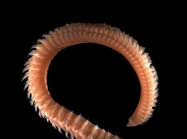
Description A bristle worm with a cylindrical body measuring up to 60 mm long. The head is acuminate and bears
two long palps. The...
Distribution A widespread species occurring in the subtidal zone of the western Wadden Sea, the Southern Bight, part of the Oyster...
Distribution In the 1976-1986 period Scolelepis bonnieri was mainly found in the area of the Flemish and Zeeland Banks whereas the...
two long palps. The...
Description A bristle worm with a cylindrical body measuring up to 60 mm long. The head is acuminate and bears
two long palps. The parapodial flaps are prominently present and are dorsally fused with the gills of
each segment. The worm is coloured pink. [details]
two long palps. The parapodial flaps are prominently present and are dorsally fused with the gills of
each segment. The worm is coloured pink. [details]
Distribution A widespread species occurring in the subtidal zone of the western Wadden Sea, the Southern Bight, part of the Oyster...
Distribution A widespread species occurring in the subtidal zone of the western Wadden Sea, the Southern Bight, part of the Oyster Ground and at the Dogger Bank. Highest densities are found near the coast. lt is absent from the Delta area and the central Oyster Ground. [details]
Distribution In the 1976-1986 period Scolelepis bonnieri was mainly found in the area of the Flemish and Zeeland Banks whereas the...
Distribution In the 1976-1986 period Scolelepis bonnieri was mainly found in the area of the Flemish and Zeeland Banks whereas the species had a broader distribution in the 1994-2001 period (all sandbank systems except the Coastal Banks). However, the species never reached high densities (maximum 150 ind./m2). [details]
Read, G.; Fauchald, K. (Ed.) (2024). World Polychaeta Database. Scolelepis bonnieri (Mesnil, 1896). Accessed through: World Register of Marine Species at: https://www.marinespecies.org/aphia.php?p=taxdetails&id=131171 on 2024-09-21
Date
action
by
 The webpage text is licensed under a Creative Commons Attribution 4.0 License
original description
(of Nerine bonnieri Mesnil, 1896) Mesnil, F. (1896). Études de morphologie externe chez les Annélides. I. Les Spionidiens des côtes de la Manche. <em>Bulletin Scientifique de la France et de la Belgique.</em> 29: 110-287, plates VII-XV., available online at https://biodiversitylibrary.org/page/10726590
page(s): 168-170, 172, pl. X figs. 1-12 [details]
context source (Schelde) Maris, T.; Beauchard, O.; Van Damme, S.; Van den Bergh, E.; Wijnhoven, S.; Meire, P. (2013). Referentiematrices en Ecotoopoppervlaktes Annex bij de Evaluatiemethodiek Schelde-estuarium Studie naar “Ecotoopoppervlaktes en intactness index”. <em>Monitor Taskforce Publication Series, 2013-01. NIOZ: Yerseke.</em> 35 pp. (look up in IMIS) [details]
context source (BeRMS 2020) Bio-environmental research group; Institute of Agricultural and Fisheries research (ILVO), Belgium; (2015): Macrobenthos monitoring in function of the Water Framework Directive in the period 2007-2009. [details]
basis of record Bellan, G. (2001). Polychaeta, <i>in</i>: Costello, M.J. <i>et al.</i> (Ed.) (2001). European register of marine species: a check-list of the marine species in Europe and a bibliography of guides to their identification. <em>Collection Patrimoines Naturels.</em> 50: 214-231. (look up in IMIS) [details]
additional source Muller, Y. (2004). Faune et flore du littoral du Nord, du Pas-de-Calais et de la Belgique: inventaire. [Coastal fauna and flora of the Nord, Pas-de-Calais and Belgium: inventory]. <em>Commission Régionale de Biologie Région Nord Pas-de-Calais: France.</em> 307 pp., available online at http://www.vliz.be/imisdocs/publications/145561.pdf [details]
additional source Fauchald, K.; Granados-Barba, A.; Solís-Weiss, V. (2009). Polychaeta (Annelida) of the Gulf of Mexico, Pp. 751–788 in D.L. Felder and D.K. Camp (eds.). <em>Gulf of Mexico. Origin, Waters, and Biota. Volume 1, Biodiversity.</em> Texas A&M University Press, College Station, Texas., available online at https://books.google.es/books?id=CphA8hiwaFIC&lpg=PR1&pg=PA751 [details]
additional source Dewarumez, Jean-Marie (look up in IMIS) [details]
page(s): 168-170, 172, pl. X figs. 1-12 [details]
context source (Schelde) Maris, T.; Beauchard, O.; Van Damme, S.; Van den Bergh, E.; Wijnhoven, S.; Meire, P. (2013). Referentiematrices en Ecotoopoppervlaktes Annex bij de Evaluatiemethodiek Schelde-estuarium Studie naar “Ecotoopoppervlaktes en intactness index”. <em>Monitor Taskforce Publication Series, 2013-01. NIOZ: Yerseke.</em> 35 pp. (look up in IMIS) [details]
context source (BeRMS 2020) Bio-environmental research group; Institute of Agricultural and Fisheries research (ILVO), Belgium; (2015): Macrobenthos monitoring in function of the Water Framework Directive in the period 2007-2009. [details]
basis of record Bellan, G. (2001). Polychaeta, <i>in</i>: Costello, M.J. <i>et al.</i> (Ed.) (2001). European register of marine species: a check-list of the marine species in Europe and a bibliography of guides to their identification. <em>Collection Patrimoines Naturels.</em> 50: 214-231. (look up in IMIS) [details]
additional source Muller, Y. (2004). Faune et flore du littoral du Nord, du Pas-de-Calais et de la Belgique: inventaire. [Coastal fauna and flora of the Nord, Pas-de-Calais and Belgium: inventory]. <em>Commission Régionale de Biologie Région Nord Pas-de-Calais: France.</em> 307 pp., available online at http://www.vliz.be/imisdocs/publications/145561.pdf [details]
additional source Fauchald, K.; Granados-Barba, A.; Solís-Weiss, V. (2009). Polychaeta (Annelida) of the Gulf of Mexico, Pp. 751–788 in D.L. Felder and D.K. Camp (eds.). <em>Gulf of Mexico. Origin, Waters, and Biota. Volume 1, Biodiversity.</em> Texas A&M University Press, College Station, Texas., available online at https://books.google.es/books?id=CphA8hiwaFIC&lpg=PR1&pg=PA751 [details]
additional source Dewarumez, Jean-Marie (look up in IMIS) [details]
 Present Present in aphia/obis/gbif/idigbio Inaccurate Introduced: alien Containing type locality
From other sources
Biology In spite of its common occurrence there is little information available on its life history or behaviour. S. bonnieri lives in mobile sands and builds loosely constructed burrows or is free-living.Members of the family Spionidae are generally considered surface deposit feeders, using their ciliated palps to select food particles (Fauchald & Jumars, 1979). [details]
Description A bristle worm with a cylindrical body measuring up to 60 mm long. The head is acuminate and bears
two long palps. The parapodial flaps are prominently present and are dorsally fused with the gills of
each segment. The worm is coloured pink. [details]
Distribution A widespread species occurring in the subtidal zone of the western Wadden Sea, the Southern Bight, part of the Oyster Ground and at the Dogger Bank. Highest densities are found near the coast. lt is absent from the Delta area and the central Oyster Ground. [details]
Distribution In the 1976-1986 period Scolelepis bonnieri was mainly found in the area of the Flemish and Zeeland Banks whereas the species had a broader distribution in the 1994-2001 period (all sandbank systems except the Coastal Banks). However, the species never reached high densities (maximum 150 ind./m2). [details]
Habitat S. bonnieri lives in a wide range of sediment types but seems to avoid substrates with a high mud content. [details]
Habitat The habitat preference of Scolelepis bonnieri is positively correlated with the median grain size: the coarser the sediment, the larger the chance of finding S. bonnieri. However, this chance never exceeds 30%. The species furthermore prefers sediments with low mud contents: the higher the mud content, the smaller the chance to find S. bonnieri (maximum 20%). [details]
Morphology Body cylindrical, with a maximum length of 40 mm and up to 90 segments. The head is pointed and bears two palps and a short median antenna of which the tip is free. The parapodia have distinct lobes on all segments and gills from one of the first segments onwards. The gills are fused with the upper lobe of the parapodia. The colour of the worm is pink (Hartmann-Schröder, 1971). [details]
Spelling In Müller (2004) as Scololepis bonnieri [details]

| Language | Name | |
|---|---|---|
| French | nérine | [details] |
To Barcode of Life (9 barcodes)
To Biodiversity Heritage Library (1 publication) (from synonym Nerine bonnieri Mesnil, 1896)
To European Nucleotide Archive, ENA (Scolelepis bonnieri)
To GenBank (1 nucleotides; 0 proteins)
To PESI
To USNM Invertebrate Zoology Annelida Collection (1 record)
To USNM Invertebrate Zoology Annelida Collection (1 record) (from synonym Nerine bonnieri Mesnil, 1896)
To ITIS
To Biodiversity Heritage Library (1 publication) (from synonym Nerine bonnieri Mesnil, 1896)
To European Nucleotide Archive, ENA (Scolelepis bonnieri)
To GenBank (1 nucleotides; 0 proteins)
To PESI
To USNM Invertebrate Zoology Annelida Collection (1 record)
To USNM Invertebrate Zoology Annelida Collection (1 record) (from synonym Nerine bonnieri Mesnil, 1896)
To ITIS