
WoRMS Photogallery
Hedraites plummerae Henbest, 1963
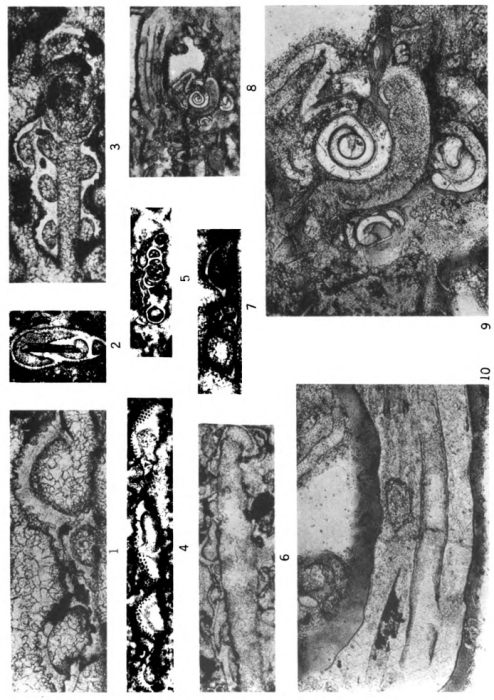
Description 1-10. Hedraites plummerae n . g., n. sp. Thin sections showing growth form, wall structure , and means of recognition in sectional views 1. Section, x 150, USGS collection f- 12218 (slide 18), (USNM 120580). Ibex Limestone of Cheney, Lower Permian, Shackelford County, Texas. 2. Specimen, x 40, attached to a spine or the axis of a plant (support not preserved). USGS collection f - 3729 (slide 5), (USNM 120581 ). Ibex Limestone of Cheney, Lower Permian, near Santa Anna, Texas. 3. Specimen, x 150, attached to axis or spine of unknown organism, USGS collection f-12218 (slide 41) (USNM 120582). 4. Specimen, x 40 , USGS collection f- 12219 ( slide 39) , (USNM 120583 ), encrusting a shell. Ibex Limestone of Cheney, Lower Permian, Shackelford County, Texas. 5. Cross section of specimen attached to an axis or spine, × 40, Ibex Limestone of Cheney, USGS collection f - 12219 (slide 38), (USNM 120584). 6. One or more individuals encrusting a shell, 40, same thin section as fig. 1. 7. Juvenarium, x 150, of either a microspheric individual H. plummerae or a related species. The form here is like those in Plate 2, figures 9 and 10. A slightly pitted surface is preserved on the innermost volution. USGS collection f - 12218 (slide 43) , (USNM 120585) . 8. Horizontal section through parts of several individuals, × 40, USGS collection f- 12763 ( slide 8) , (USNM 120586 ). Lower Permian, Archer County, Texas. 9-10. Parts of specimen in fig. 8, x 150, showing wall structure and canals of shell -perforating organisms Minytrypetes and Minylecytheca, which are illustrated in Plate 7, figures 1-4. General discussion of Plate 3. -The various appearances of the pitted surface of Hedraites as seen in thin section are displayed by all figures on this plate . The demonstration in figure 4,which is partly tangential , is unmistakable . The vertical sections of figures 1,4,and 6 and the horizontal sections of figures 8-10 show some tendency of the species for incrustation and massive growth form and illustrate characteristic attitudes on flat supports . Figures 2,3, and 5, illustrating specimens attached to axes of plants or animals , give striking examples of the protean growth form of Hedraites . The brownish , very finely granular structure of the porcellaneous walls of the Cornuspirinae is unusually well preserved in the thin sections in figures 8-10 , which is well core material . Nevertheless, the granularity seen here at 150 is probably coarser than originally existed . The shell material shows an obscure extinction pattern that is connected with calcite crystals in the matrix . The partial crystallization does not have a consistent relation to the shell form . These circumstances indicate a secondary origin for the incipient crystal structure . Figures 1 to 7 illustrate examples from the Ibex Limestone of Cheney in north central Texas , in which much of the original , structureless appearance of the porcellaneous wall is preserved , but the brownish color is generally missing . At magnifications no higher than 150 and in polarized light , the change from the porcellaneous structure to dark , finely granular , dolomitic (?) material that characterizes Ottonosia and Osagia is strikingly indicated (see discussion of Diagenesis and see also Plates 4 and 6). The decomposition and progress toward the dark replacement is particularly evident in figures 1,3,5,and 7. The exceptionally fine preservation of Hedraites in figures 8-10 affords a view of perforations of the shell of this foraminifer . The tubes ranging from 2 to 3 microns in diameter penetrate the walls at various and odd angles and positions . These are clearly the work of a parasitic , commensal , or saprophytic organism ( see plate 7,figures 1-4 ).
PNG file - 742.50 kB - 694 x 984 pixels
added on 2026-02-11583 viewsWoRMS taxa Hedraites plummerae Henbest, 1963 †checked Le Coze, François 2026-02-11

This work is licensed under a Creative Commons Attribution-NonCommercial-ShareAlike 4.0 International License
Click here to return to the thumbnails overview
Comment (0)
Click here to add a comment.* indicates a required field.
Disclaimer: WoRMS does not exercise any editorial control over the information displayed here. However, if you come across any misidentifications, spelling mistakes or low quality pictures, your comments would be very much appreciated. You can reach us by emailing info@marinespecies.org or adding a comment, we will correct the information or remove the image from the website when necessary or in case of doubt.
