Foraminifera taxon details
Socotraella Gallardo-García & Serra-Kiel, 2016 †
1047224 (urn:lsid:marinespecies.org:taxname:1047224)
accepted
Genus
Socotraella ashawqi Gallardo-García & Serra-Kiel, 2016 † (type by original designation)
marine, brackish, fresh, terrestrial
fossil only
feminine
Serra-Kiel, J.; Gallardo-García, A.; Razin, P.; Robinet, J.; Roger, J.; Grelaud, C.; Leroy, S.; Robin, C. (2016). Middle Eocene-Early Miocene larger foraminifera from Dhofar (Oman) and Socotra Island (Yemen). <em>Arabian Journal of Geosciences.</em> 9(5): 1-95., available online at https://doi.org/10.1007/s12517-015-2243-3
page(s): p. 53 [details] Available for editors [request]
page(s): p. 53 [details] Available for editors
[request]
Original description Diagnosis: Agglutinated test with an elongated-conical morphology. Wall composed of two layers: (a) an inner layer made of...
Original description Diagnosis: Agglutinated test with an elongated-conical morphology. Wall composed of two layers: (a) an inner layer made of heterogeneous grains and (b) an outer layer made of a fine material. Embryonic apparatus composed of a spherical proloculus in an apical location. Nepionic stage with a lowtrochospiral arrangement of the chambers. Later, in the neanic stage, the chambers show uniserial growth. No skeletal elements within the chamber lumen. The foramina in the nepionic stage are located in the bottom of the septum; later in the uniserial growth, the foramina show a cribrate distribution with peristomal lips. The apertural face is convex.
Distribution and age (from type species): This new species occurs in the uppermost beds of the Aydim Fm. and in isolated samples from the Ashawq Fm. from Socotra Island (Fig. 60) and in the Ashawq Fm. from western Dhofar (Fig. 58). Rupelian. [details]
Distribution and age (from type species): This new species occurs in the uppermost beds of the Aydim Fm. and in isolated samples from the Ashawq Fm. from Socotra Island (Fig. 60) and in the Ashawq Fm. from western Dhofar (Fig. 58). Rupelian. [details]
Hayward, B.W.; Le Coze, F.; Vachard, D.; Gross, O. (2025). World Foraminifera Database. Socotraella Gallardo-García & Serra-Kiel, 2016 †. Accessed at: https://www.marinespecies.org/Foraminifera/aphia.php?p=taxdetails&id=1047224 on 2026-09-21
Date
action
by
original description
Serra-Kiel, J.; Gallardo-García, A.; Razin, P.; Robinet, J.; Roger, J.; Grelaud, C.; Leroy, S.; Robin, C. (2016). Middle Eocene-Early Miocene larger foraminifera from Dhofar (Oman) and Socotra Island (Yemen). <em>Arabian Journal of Geosciences.</em> 9(5): 1-95., available online at https://doi.org/10.1007/s12517-015-2243-3
page(s): p. 53 [details] Available for editors [request]
page(s): p. 53 [details] Available for editors
[request]From editor or global species database
Original description Diagnosis: Agglutinated test with an elongated-conical morphology. Wall composed of two layers: (a) an inner layer made of heterogeneous grains and (b) an outer layer made of a fine material. Embryonic apparatus composed of a spherical proloculus in an apical location. Nepionic stage with a lowtrochospiral arrangement of the chambers. Later, in the neanic stage, the chambers show uniserial growth. No skeletal elements within the chamber lumen. The foramina in the nepionic stage are located in the bottom of the septum; later in the uniserial growth, the foramina show a cribrate distribution with peristomal lips. The apertural face is convex.Distribution and age (from type species): This new species occurs in the uppermost beds of the Aydim Fm. and in isolated samples from the Ashawq Fm. from Socotra Island (Fig. 60) and in the Ashawq Fm. from western Dhofar (Fig. 58). Rupelian. [details]

From editor or global species database
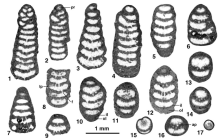
Image from typetaxon