
| Home | | Literature | | Log in |
| Diatoms | | Haptophytes | | Dinoflagellates | | Raphidophyceans | | Dictyochophyceans | | Pelagophyceans | | Cyanobacteria | | Greylist | | Harmful non-toxic |
WoRMS taxon detailsDinophysis tripos Gourret, 1883
 109662 (urn:lsid:marinespecies.org:taxname:109662)
accepted
Species
Dinophysis caudata var. tripos (Gourret) Gail, 1950 · unaccepted (synonym)
marine,
Gourret, P. (1883). Sur les Péridiniens du Golfe de Marseille. <em>Annales du Musée d'Histoire Naturelle de Marseille, Zoologie.</em> 1(8): 1-114. [details]

Type locality contained in Gulf of Marseille
type locality contained in Gulf of Marseille [details]
LSID urn:lsid:algaebase.org:taxname:47011
LSID urn:lsid:algaebase.org:taxname:47011 [details] Description Large cell with two posterior V-shaped processes, one extends almost the length of the main body and is midway between the...
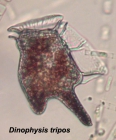
Description Large cell with two posterior V-shaped processes, one extends almost the length of the main body and is midway between the ventral and dorsal margins, while the other is short and dorsal. The left sulcal list is broader posteriorly and has a straight margin. Type E surface markings. [details] Distribution Widely distributed in tropical and temperate waters of both hemispheres. Also found occasionally in colder areas such as...
Distribution Widely distributed in tropical and temperate waters of both hemispheres. Also found occasionally in colder areas such as the northern Norwegian Sea (transported by warmer water masses, Johnsen and Lømsland, 2012) and subantarctic waters of the South Atlantic. [details]
Guiry, M.D. & Guiry, G.M. (2024). AlgaeBase. World-wide electronic publication, National University of Ireland, Galway (taxonomic information republished from AlgaeBase with permission of M.D. Guiry). Dinophysis tripos Gourret, 1883. Accessed through: World Register of Marine Species at: https://www.marinespecies.org/aphia.php?p=taxdetails&id=109662 on 2024-09-23
Date action by 2006-07-24 06:37:28Z changed Camba Reu, Cibran Copyright notice: the information originating from AlgaeBase may not be downloaded or replicated by any means, without the written permission of the copyright owner (generally AlgaeBase). Fair usage of data in scientific publications is permitted.
original description
Gourret, P. (1883). Sur les Péridiniens du Golfe de Marseille. <em>Annales du Musée d'Histoire Naturelle de Marseille, Zoologie.</em> 1(8): 1-114. [details]
basis of record Gómez, F. (2005). A list of free-living dinoflagellate species in the world's oceans. <em>Acta Bot. Croat.</em> 64(1): 129-212. [details] additional source Lee J.S., lgarashi T., Fraga S., Dahl E., Hovgaard P. & Yasumoto T. (1989). Determination of diarrhetic shellfish toxins in various dinoflagellate species. <em>J. Appl. Phycol.</em> 1, 147-152. [details] additional source Steidinger, K. A., M. A. Faust, and D. U. Hernández-Becerril. 2009. Dinoflagellates (Dinoflagellata) of the Gulf of Mexico, Pp. 131–154 in Felder, D.L. and D.K. Camp (eds.), Gulf of Mexico–Origins, Waters, and Biota. Biodiversity. Texas A&M Press, College [details] additional source Moestrup, Ø., Akselman, R., Cronberg, G., Elbraechter, M., Fraga, S., Halim, Y., Hansen, G., Hoppenrath, M., Larsen, J., Lundholm, N., Nguyen, L. N., Zingone, A. (Eds) (2009 onwards). IOC-UNESCO Taxonomic Reference List of Harmful Micro Algae., available online at http://www.marinespecies.org/HAB [details] additional source Lakkis, S. (2011). Le phytoplancton marin du Liban (Méditerranée orientale): biologie, biodiversité, biogéographie. Aracne: Roma. ISBN 978-88-548-4243-4. 293 pp. (look up in IMIS) [details] additional source Chang, F.H.; Charleston, W.A.G.; McKenna, P.B.; Clowes, C.D.; Wilson, G.J.; Broady, P.A. (2012). Phylum Myzozoa: dinoflagellates, perkinsids, ellobiopsids, sporozoans, in: Gordon, D.P. (Ed.) (2012). New Zealand inventory of biodiversity: 3. Kingdoms Bacteria, Protozoa, Chromista, Plantae, Fungi. pp. 175-216. [details] additional source Steidinger, K.A.; Tangen, K. (1997). Dinoflagellates. pp. 387-584. In: C.R. Tomas (ed.) (1997). Identifying Marine Phytoplankton. Academic Press: San Diego, CA [etc.] (USA). ISBN 0-12-693018-X. XV, 858 pp., available online at http://www.sciencedirect.com/science/article/pii/B9780126930184500057 [details] additional source Balech, E. (2002). Dinoflagelados tecados tóxicos en el Cono Sur Americano. <em>In: Sar, E.A., Ferrario, M.E. & Reguera, B. (Eds.). Floraciones Algales Nocivas en el Cono Sur Americano. Instituto Español de Oceanografía.</em> pp. 123-144. [details] Available for editors  [request] [request] additional source Guiry, M.D. & Guiry, G.M. (2024). AlgaeBase. <em>World-wide electronic publication, National University of Ireland, Galway.</em> searched on YYYY-MM-DD., available online at http://www.algaebase.org [details] additional source Integrated Taxonomic Information System (ITIS). , available online at http://www.itis.gov [details] additional source Tomas, C.R. (Ed.). (1997). Identifying marine phytoplankton. Academic Press: San Diego, CA [etc.] (USA). ISBN 0-12-693018-X. XV, 858 pp., available online at http://www.sciencedirect.com/science/book/9780126930184 [details] additional source Brandt, S. (2001). Dinoflagellates, <B><I>in</I></B>: Costello, M.J. <i>et al.</i> (Ed.) (2001). <i>European register of marine species: a check-list of the marine species in Europe and a bibliography of guides to their identification. Collection Patrimoines Naturels,</i> 50: pp. 47-53 (look up in IMIS) [details] additional source Boury-Esnault, N., G. Bellan, D. Bellan-Santini, C.F. Boudouresque, P.Chevaldonné, A. Dias, D. Faget, J.G. Harmelin, M. Harmelin-Vivien, C. Lejeusne, T. Pérez, J. Vacelet, M. Verlaque. (2023). The Station Marine d'Endoume, Marseille: 150 years of natural history. <em>Zootaxa.</em> 5249(2): 213-252. (look up in IMIS), available online at https://doi.org/10.11646/zootaxa.5249.2.3 [details] Available for editors [request] ecology source Mitra, A.; Caron, D. A.; Faure, E.; Flynn, K. J.; Leles, S. G.; Hansen, P. J.; McManus, G. B.; Not, F.; Do Rosario Gomes, H.; Santoferrara, L. F.; Stoecker, D. K.; Tillmann, U. (2023). The Mixoplankton Database (MDB): Diversity of photo‐phago‐trophic plankton in form, function, and distribution across the global ocean. <em>Journal of Eukaryotic Microbiology.</em> 70(4)., available online at https://doi.org/10.1111/jeu.12972 [details] ecology source Rial, P.; Garrido, J. L.; Jaén, D.; Rodríguez, F. (2012). Pigment composition in three Dinophysis species (Dinophyceae) and the associated cultures of Mesodinium rubrum and Teleaulax amphioxeia. <em>Journal of Plankton Research.</em> 35(2): 433-437., available online at https://doi.org/10.1093/plankt/fbs099 [details] ecology source Rodríguez, F.; Escalera, L.; Reguera, B.; Rial, P.; Riobó, P.; De Jesús da Silva, T. (2012). Morphological variability, toxinology and genetics of the dinoflagellate Dinophysis tripos (Dinophysiaceae, Dinophysiales). <em>Harmful Algae.</em> 13: 26-33., available online at https://doi.org/10.1016/j.hal.2011.09.012 [details]  Present Present in aphia/obis/gbif/idigbio Inaccurate Introduced: alien Containing type locality Present Present in aphia/obis/gbif/idigbio Inaccurate Introduced: alien Containing type locality
From editor or global species database
LSID urn:lsid:algaebase.org:taxname:47011 [details]From regional or thematic species database
Description Large cell with two posterior V-shaped processes, one extends almost the length of the main body and is midway between the ventral and dorsal margins, while the other is short and dorsal. The left sulcal list is broader posteriorly and has a straight margin. Type E surface markings. [details]Distribution Widely distributed in tropical and temperate waters of both hemispheres. Also found occasionally in colder areas such as the northern Norwegian Sea (transported by warmer water masses, Johnsen and Lømsland, 2012) and subantarctic waters of the South Atlantic. [details] Harmful effect 36 pg/cell of DTX1 in HPLC-FD analyses of picked cells according to Lee et al. (1989). No toxins found in picked cells from Hokkaido (Suzuki et al. 2009). High levels of PTX2 (179-232 pg/cell) in cultures of Galician strains analyzed by LC-MS (Rodríguez et al., 2012). When D. tripos was the only species in Dinophysis blooms (45-90 pg PTX2/cell), no toxins detected in shellfish. This could be explained because PTX2 is very quickly converted into non toxic PTX2 SA by mussels. [details] Identification The species can be distinquished from D. caudata by the shape of the left sulcal list and the presence of the two posterior processes. [details] Synonymy See Schiller 1933 page 159 for old synonyms. Dinophysis diegensis Kofoid 1907 and D. taylorii Hernandez-Becerril 1992 have been suggested as 'small cells' in the life cycle of D. caudata and D. tripos (Reguera & Gonzalez-Gil 2001, J. Phycol. 37: 318-333). However, small cells of D. tripos, observed in cultures of this species, are different from Dinophysis diegensis, the small cells of D. caudata. Therefore, D. diegensis should not be considered a synonym of D. tripos (Rodríguez et al. 2012) [details] From other sources
Diet general for group: both heterotrophic (eat other organisms) and autotrophic (photosynthetic) [details]Habitat pelagic [details] Importance General: known for producing dangerous toxins, particularly when in large numbers, called "red tides" because the cells are so abundant they make water change color. Also they can produce non-fatal or fatal amounts of toxins in predators (particularly shellfish) that may be eaten by humans. [details] Predators marine microorganisms and animal larvae [details] Reproduction general for group: both sexual and asexual [details]
Published in AlgaeBase
 Published in AlgaeBase (from synonym Dinophysis caudata var. tripos (Gourret) Gail, 1950)To Barcode of Life (7 barcodes) To Biodiversity Heritage Library (17 publications) To Dyntaxa To European Nucleotide Archive, ENA (Dinophysis tripos) To GenBank (40 nucleotides; 12 proteins) To PESI To ITIS |
