WoRMS taxon details
Oligobrachia haakonmosbiensis Smirnov, 2000
129110 (urn:lsid:marinespecies.org:taxname:129110)
accepted
Species
marine, brackish, fresh, terrestrial
recent only
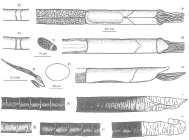
Smirnov, Roman V. (2000). Two new species of Pogonophora from the arctic mud volcano off northwestern Norway. <em>Sarsia.</em> 85(2), 141-150., available online at https://www.tandfonline.com/doi/abs/10.1080/00364827.2000.10414563
page(s): 147-149, figs. 6-7 [details] Available for editors [request]
page(s): 147-149, figs. 6-7 [details] Available for editors
[request]
Note Haakon Mosby mud volcano, RV Professor...
From editor or global species database
Type locality Haakon Mosby mud volcano, RV Professor Logachev, cruise 15, station 36, 72.0014 N, 14.7264 E [details]
Etymology Geographic adjective. Author's etymology is as follows: "The specific name haakonmosbiensis refers to the locality (Haakon...
Etymology Geographic adjective. Author's etymology is as follows: "The specific name haakonmosbiensis refers to the locality (Haakon Mosby Mud Volcano) [derived from] the research vessel Håkon Mosby which discovered it." [details]
Read, G.; Fauchald, K. (Ed.) (2026). World Polychaeta Database. Oligobrachia haakonmosbiensis Smirnov, 2000. Accessed through: World Register of Marine Species at: https://www.marinespecies.org/aphia.php?p=taxdetails&id=129110 on 2026-09-17
Date
action
by
 The webpage text is licensed under a Creative Commons
Attribution 4.0 License
The webpage text is licensed under a Creative Commons
Attribution 4.0 License
Nomenclature
original description
Smirnov, Roman V. (2000). Two new species of Pogonophora from the arctic mud volcano off northwestern Norway. <em>Sarsia.</em> 85(2), 141-150., available online at https://www.tandfonline.com/doi/abs/10.1080/00364827.2000.10414563
page(s): 147-149, figs. 6-7 [details] Available for editors [request]
page(s): 147-149, figs. 6-7 [details] Available for editors
[request]Taxonomy
redescription
Smirnov, R. V. (2014). A revision of the Oligobrachiidae (Annelida: Pogonophora), with notes on the morphology and distribution of Oligobrachia haakonmosbiensis Smirnov. <i>Marine Biology Research</i>. 10(10): 972-982., available online at https://doi.org/10.1080/17451000.2013.872799 [details]
Ecology
ecology source
Sen, Arunima; Didriksen, Alena; Hourdez, Stéphane; Svenning, Mette Marianne; Rasmussen, Tine L. (2020). Frenulate siboglinids at high Arctic methane seeps and insight into high latitude frenulate distribution. <em>Ecology and Evolution.</em> 10(3): 1339-1351., available online at https://onlinelibrary.wiley.com/doi/full/10.1002/ece3.5988 [details]
Other
additional source
van der Land, J. (ed). (2008). UNESCO-IOC Register of Marine Organisms (URMO). , available online at http://www.marinespecies.org/urmo/ [details]
additional source van der Land, J.; Southward, E. (2001). Pogonophora, <B><I>in</I></B>: Costello, M.J. <i>et al.</i> (Ed.) (2001). <i>European register of marine species: a check-list of the marine species in Europe and a bibliography of guides to their identification. Collection Patrimoines Naturels,</i> 50: pp. 235 (look up in IMIS) [details]
additional source van der Land, J.; Southward, E. (2001). Pogonophora, <B><I>in</I></B>: Costello, M.J. <i>et al.</i> (Ed.) (2001). <i>European register of marine species: a check-list of the marine species in Europe and a bibliography of guides to their identification. Collection Patrimoines Naturels,</i> 50: pp. 235 (look up in IMIS) [details]
 Present Present in aphia/obis/gbif/idigbio Inaccurate Introduced: alien Containing type locality
Syntype ZIRAS N65, geounit Norwegian part of the Norwegian Sea [details]
From editor or global species database
Etymology Geographic adjective. Author's etymology is as follows: "The specific name haakonmosbiensis refers to the locality (Haakon Mosby Mud Volcano) [derived from] the research vessel Håkon Mosby which discovered it." [details]Habitat mud volcano [details]
Type designation Smirnov's (2000:147) type material is five syntypes. He called the specimens syntypes and did not name a holotype. [details]
Type locality Haakon Mosby mud volcano, RV Professor Logachev, cruise 15, station 36, 72.0014 N, 14.7264 E [details]

To European Nucleotide Archive, ENA (Oligobrachia haakonmosbiensis)
To GenBank (27 nucleotides; 25 proteins)
To PESI
To GenBank (27 nucleotides; 25 proteins)
To PESI
From editor or global species database