WoRMS taxon details
Kaikoja undume Mandre & Rouse, 2025
1864678 (urn:lsid:marinespecies.org:taxname:1864678)
accepted
Species
marine, brackish, fresh, terrestrial
Mandre, P.; Rouse, G. W. (2025). Molecular Phylogeny of the Deep-Sea Predatory Octacnemidae (Ascidiacea, Tunicata, Chordata), with Seven New Species. <em>Diversity.</em> 17(12): 859., available online at https://doi.org/10.3390/d17120859 [details] Available for editors  [request]
[request]
Holotype WAM Z100624, geounit Indian Ocean
Holotype WAM Z100624, geounit Indian Ocean [details]
Etymology “Undumë” is Quenya (Tolkien’s elvish) for abyss. Tolkien’s Markiya poem includes the phrase “undumë hácala”...
Etymology “Undumë” is Quenya (Tolkien’s elvish) for abyss. Tolkien’s Markiya poem includes the phrase “undumë hácala” or abyss yawning, a great description for many group two octacnemids which are found yawning in the dark depths of the abyss. The name is used as a noun in apposition. [details]
Shenkar, N.; Gittenberger, A.; Lambert, G.; Rius, M.; Moreira da Rocha, R.; Swalla, B.J.; Turon, X. (2026). Ascidiacea World Database. Kaikoja undume Mandre & Rouse, 2025. Accessed through: World Register of Marine Species at: https://www.marinespecies.org/aphia.php?p=taxdetails&id=1864678 on 2026-09-28
 The webpage text is licensed under a Creative Commons
Attribution 4.0 License
The webpage text is licensed under a Creative Commons
Attribution 4.0 License
Nomenclature
original description
Mandre, P.; Rouse, G. W. (2025). Molecular Phylogeny of the Deep-Sea Predatory Octacnemidae (Ascidiacea, Tunicata, Chordata), with Seven New Species. <em>Diversity.</em> 17(12): 859., available online at https://doi.org/10.3390/d17120859 [details] Available for editors [request]
[request] Present Present in aphia/obis/gbif/idigbio Inaccurate Introduced: alien Containing type locality
Holotype WAM Z100624, geounit Indian Ocean [details]
From editor or global species database
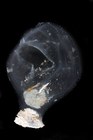
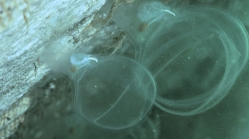
Diagnosis Small pedunculate Kaikoja. Tunic transparent, gelatinous, thin, smooth. Oral siphon bilobed, symmetric, circular muscles present, radial muscles absent, not anteriorly developed, transverse slit. Atrial siphon with four lobes, circular muscles present, radial muscles absent, reduced, dorsal. Peduncle short, muscles absent, gut–gonad complex within, rhizoids absent, ventral attachment. Oral tentacles proximally thin, distally wide, flat, foliaceous, variable size in staggered line. Peripharyngeal band far from branchial sac perforate zone, ventral bifurcation towards endostyle. Endostyle short. Neural ganglion white, tear-drop shaped, proximal, between oral tentacles and peripharyngeal band, undulating nerves radiating. Dorsal tubercle white, button-shaped with transverse cleft. Branchial sac posterior and ventral, thin, flat tissue, longitudinal branchial vessels reduced, inconspicuous, simple tentaculate branchial papillae throughout. Perforate zone restricted to posterior, unciliated stigmata small, circular, isolated. Esophagus ventral, large, asymmetric, right-side flap, left side with eight tapered tentacles, mostly simple, some branched, large funnel ventral and right. Gut U-shaped loop, within peduncle, angled with base anterior, top posterior. Stomach anteroventral direction, right side, large, internally plicated, orange. Intestines thin, posteroventral direction, left side, white near stomach, sparse orange near anus. Anus wide, lobes absent, proximal to esophagus. Gonads large, mostly nested within gut loop, posterior and ventral to gut loop. Ovaries translucent, conspicuous white eggs of variable size, dorsal to testes. Testes acinar, bright white, forming posterior ring on ovary periphery, ventrally concentrated. Sperm duct prominent, large, bright white, projects dorsally, terminating near anus. [details]Etymology “Undumë” is Quenya (Tolkien’s elvish) for abyss. Tolkien’s Markiya poem includes the phrase “undumë hácala” or abyss yawning, a great description for many group two octacnemids which are found yawning in the dark depths of the abyss. The name is used as a noun in apposition. [details]
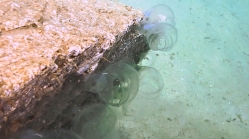
Holotype WAM Z100624, Western Australia, Cape Range Canyon, Indian Ocean (−21.9705 S; 113.1719 E), 12 March 2020, 2012 m, coll. N.G. Wilson, G. Rouse, J. Ritchie, RV Falkor/ROV SuBastian, dive S0333 (slurp), fixed in 10% formalin, 100% ethanol subsample, attached to same rock wall as paratypes. GenBank COI sequence PX658850, 18S sequence PX624314, H3 sequence PX577544. [details]

| Language | Name | |
|---|---|---|
| English | Elven abyss tunicate | [details] |
From editor or global species database