WoRMS taxon details
Cassidulina teretis Tappan, 1951 †
113085 (urn:lsid:marinespecies.org:taxname:113085)
accepted
Species
Cassandra teretis (Tappan, 1951) † · unaccepted > superseded combination
Islandiella teretis (Tappan, 1951) † · unaccepted (superseded combination)
marine, brackish, fresh, terrestrial
fossil only
Tappan, H. (1951). Northern Alaska index Foraminifera. <em>Contributions from the Cushman Foundation for Foramininiferal Research.</em> 2: 1-8., available online at http://www.cushmanfoundation.org/archival-publications/
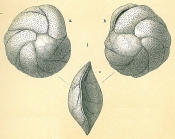
page(s): p. 7 pl. 1, fig. 30; note: Pleistocene of the Gubik Formation, Alaska. [details] Available for editors [request]
page(s): p. 7 pl. 1, fig. 30; note: Pleistocene of the Gubik Formation, Alaska. [details] Available for editors
[request]
Distribution Fossil versus Recent specimens allocated to Cassidulina teretis Tappan display slight differences in both ecological...
Taxonomic remark A thorough description of this species was made by Tappan (1951). Only an emendation of the apertural description will be...
Distribution Fossil versus Recent specimens allocated to Cassidulina teretis Tappan display slight differences in both ecological distribution and morphology.
C. teretis had its first occurrence during the Middle to Upper Miocene and its last well-documented occurrence shortly after the palaeomagnetic Brunhes/Matuyama boundary in the Norwegian Sea, whilst it apparently disappeared from the North Atlantic as early as a little after the Gauss/Matuyama boundary. C. neoteretis presumably evolved from C. teretis between about 2.0 and 2.3 Ma in the northern North Atlantic and migrated northward inhabiting the Norwegian Sea as C teretis became extinct here at about 0.7 Ma. All Recent specimens belong to C. neoteretis.
Specimens of C. teretis have been documented from both arctic and boreal regions in inner shelf to bathyal environments (between about 50 and 2000 m water depth), whereas the Recent distribution of C. neoteretis is slightly more limited: arctic and cold boreal regions at water depths between 150 and 3000 m, most commonly between 1000 and 1500 m.
(Seidenkrantz (1995)). [details]
C. teretis had its first occurrence during the Middle to Upper Miocene and its last well-documented occurrence shortly after the palaeomagnetic Brunhes/Matuyama boundary in the Norwegian Sea, whilst it apparently disappeared from the North Atlantic as early as a little after the Gauss/Matuyama boundary. C. neoteretis presumably evolved from C. teretis between about 2.0 and 2.3 Ma in the northern North Atlantic and migrated northward inhabiting the Norwegian Sea as C teretis became extinct here at about 0.7 Ma. All Recent specimens belong to C. neoteretis.
Specimens of C. teretis have been documented from both arctic and boreal regions in inner shelf to bathyal environments (between about 50 and 2000 m water depth), whereas the Recent distribution of C. neoteretis is slightly more limited: arctic and cold boreal regions at water depths between 150 and 3000 m, most commonly between 1000 and 1500 m.
(Seidenkrantz (1995)). [details]
Taxonomic remark A thorough description of this species was made by Tappan (1951). Only an emendation of the apertural description will be...
Taxonomic remark A thorough description of this species was made by Tappan (1951). Only an emendation of the apertural description will be added here: Tappan (1951) described the aperture as ‘elongate, extending from the base of the final chamber in a crescent paralleling the anterior margin of the chamber, reaching nearly three-fourths the distance from the base of the chamber to the peripheral keel’. The aperture is partly covered by a narrow, serrate plate formed by the infolded chamber wall (type HI aperture, according to definition by Nomura (1983a)). The serration along the edge of the apertural plate is not dissimilar, but more distinct (though also more sporadic) and with bigger teeth than that of Cassidulina laevigata s.l. d’Orbigny (see Mackensen & Hald, 1988 and compare Pl. 4, figs 1-5 and PI. 4 figs 6, 8). The serration is most prominent in the best preserved specimens. This documents that the serration is a primary character of the species and is not due to post mortem dissolution. The size of the specimens measured in this study varies with the greatest diameter between 250 and 550pm, the bulk of the specimens, however, having a greatest diameter of 400-450 pm.
(Seidenkrantz (1995)). [details]
(Seidenkrantz (1995)). [details]
Hayward, B.W.; Le Coze, F.; Vachard, D.; Gross, O. (2026). World Foraminifera Database. Cassidulina teretis Tappan, 1951 †. Accessed through: World Register of Marine Species at: https://www.marinespecies.org/aphia.php?p=taxdetails&id=113085 on 2026-10-02
Date
action
by
 The webpage text is licensed under a Creative Commons
Attribution 4.0 License
The webpage text is licensed under a Creative Commons
Attribution 4.0 License
Nomenclature
original description
Tappan, H. (1951). Northern Alaska index Foraminifera. <em>Contributions from the Cushman Foundation for Foramininiferal Research.</em> 2: 1-8., available online at http://www.cushmanfoundation.org/archival-publications/
page(s): p. 7 pl. 1, fig. 30; note: Pleistocene of the Gubik Formation, Alaska. [details] Available for editors [request]
basis of record Gross, O. (2001). Foraminifera, <B><I>in</I></B>: Costello, M.J. <i>et al.</i> (Ed.) (2001). <i>European register of marine species: a check-list of the marine species in Europe and a bibliography of guides to their identification. Collection Patrimoines Naturels,</i> 50: pp. 60-75 (look up in IMIS) [details]
page(s): p. 7 pl. 1, fig. 30; note: Pleistocene of the Gubik Formation, Alaska. [details] Available for editors
[request]basis of record Gross, O. (2001). Foraminifera, <B><I>in</I></B>: Costello, M.J. <i>et al.</i> (Ed.) (2001). <i>European register of marine species: a check-list of the marine species in Europe and a bibliography of guides to their identification. Collection Patrimoines Naturels,</i> 50: pp. 60-75 (look up in IMIS) [details]
Taxonomy
status source
Seidenkrantz, M.-S. (1995). <i>Cassidulina teretis</i> Tappan and <i>Cassidulina neoteretis</i> new species (Foraminifera): stratigraphic markers for deep sea and outer shelf areas. <em>Journal of Micropalaeontology.</em> 14(2): 145-157., available online at https://doi.org/10.1144/jm.14.2.145
note: Fossil species: "C. teretis had its first occurrence during the Middle to Upper Miocene and its last well-documented occurrence shortly after the palaeomagnetic Brunhes/Matuyama boundary in the Norweg...
[details] Available for editors [request]
note: Fossil species: "C. teretis had its first occurrence during the Middle to Upper Miocene and its last well-documented occurrence shortly after the palaeomagnetic Brunhes/Matuyama boundary in the Norweg...
Fossil species: "C. teretis had its first occurrence during the Middle to Upper Miocene and its last well-documented occurrence shortly after the palaeomagnetic Brunhes/Matuyama boundary in the Norwegian Sea, whilst it apparently disappeared from the North Atlantic as early as a little after the Gauss/Matuyama boundary."
[request]Other
context source (Deepsea)
Intergovernmental Oceanographic Commission (IOC) of UNESCO. The Ocean Biogeographic Information System (OBIS), available online at http://www.iobis.org/ [details]
additional source Wollenburg, J. E.; Matthiessen, J. (2026). Pleistocene benthic foraminifera bioevents in the Central Arctic Ocean: stratigraphic and paleoceanographic implications. <em>Climate of the Past.</em> 22(7): 1305-1362., available online at https://doi.org/10.5194/cp-22-1305-2026
note: Fossil [details]
additional source Wollenburg, J. E.; Matthiessen, J. (2026). Pleistocene benthic foraminifera bioevents in the Central Arctic Ocean: stratigraphic and paleoceanographic implications. <em>Climate of the Past.</em> 22(7): 1305-1362., available online at https://doi.org/10.5194/cp-22-1305-2026
note: Fossil [details]
 Present Present in aphia/obis/gbif/idigbio Inaccurate Introduced: alien Containing type locality
From editor or global species database
Distribution Fossil versus Recent specimens allocated to Cassidulina teretis Tappan display slight differences in both ecological distribution and morphology.C. teretis had its first occurrence during the Middle to Upper Miocene and its last well-documented occurrence shortly after the palaeomagnetic Brunhes/Matuyama boundary in the Norwegian Sea, whilst it apparently disappeared from the North Atlantic as early as a little after the Gauss/Matuyama boundary. C. neoteretis presumably evolved from C. teretis between about 2.0 and 2.3 Ma in the northern North Atlantic and migrated northward inhabiting the Norwegian Sea as C teretis became extinct here at about 0.7 Ma. All Recent specimens belong to C. neoteretis.
Specimens of C. teretis have been documented from both arctic and boreal regions in inner shelf to bathyal environments (between about 50 and 2000 m water depth), whereas the Recent distribution of C. neoteretis is slightly more limited: arctic and cold boreal regions at water depths between 150 and 3000 m, most commonly between 1000 and 1500 m.
(Seidenkrantz (1995)). [details]
Ecology Typical of cold waters (inf. 11 °C) in high latitudes (Mackensen and Hald, 1988). [details]
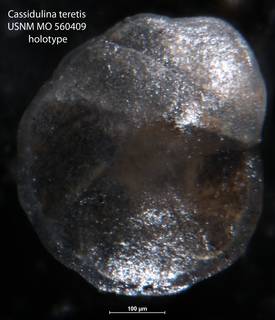
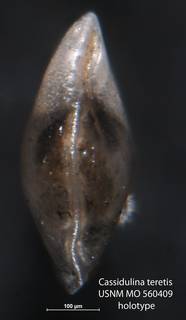
Original description Test free, lenticular, with an umbilical boss on each side, composed of clear shell material; coiled and biserially arranged chambers alternating on the two sides of the peripheral keel, about 8 to 10 chambers visible along the periphery, chambers extending from the umbilical boss on one side, across the peripheral keel and about halfway to the umbilical boss of the opposite side, chambers appearing ovate in outline on the side where they reach the umbo, with the small subtriangular portion extending on the opposite side between the two adjacent ovate-appearing chambers of that side; sutures distinct and thickened, but flush with the surface, gently curved; wall calcareous, with rather large perforations, surface smooth; aperture elongate, extending from the base of the final chamber in a crescent paralleling the anterior margin of the chamber, reaching nearly three-fourths the distance from the base of the chamber to the peripheral keel. Greatest diameter of holotype 0.55 mm, least diameter 0.49 mm, greatest thickness 0.23 mm. Other specimens are between 0.36 and .0.55 mm in greatest diameter.
(Tappan (1951)). [details]
Taxonomic remark A thorough description of this species was made by Tappan (1951). Only an emendation of the apertural description will be added here: Tappan (1951) described the aperture as ‘elongate, extending from the base of the final chamber in a crescent paralleling the anterior margin of the chamber, reaching nearly three-fourths the distance from the base of the chamber to the peripheral keel’. The aperture is partly covered by a narrow, serrate plate formed by the infolded chamber wall (type HI aperture, according to definition by Nomura (1983a)). The serration along the edge of the apertural plate is not dissimilar, but more distinct (though also more sporadic) and with bigger teeth than that of Cassidulina laevigata s.l. d’Orbigny (see Mackensen & Hald, 1988 and compare Pl. 4, figs 1-5 and PI. 4 figs 6, 8). The serration is most prominent in the best preserved specimens. This documents that the serration is a primary character of the species and is not due to post mortem dissolution. The size of the specimens measured in this study varies with the greatest diameter between 250 and 550pm, the bulk of the specimens, however, having a greatest diameter of 400-450 pm.
(Seidenkrantz (1995)). [details]

To Biodiversity Heritage Library (1 publication) (from synonym Islandiella teretis (Tappan, 1951) †)
To Biodiversity Heritage Library (3 publications)
To European Nucleotide Archive, ENA (Cassidulina teretis)
To GenBank (1 nucleotides; 0 proteins)
To NMNH Paleobiology Collection (Cassidulina teretis USNM MO 560409 holotype 1)
To NMNH Paleobiology Collection (Cassidulina teretis USNM MO 560409 holotype 2)
To PESI
To PESI (from synonym Islandiella teretis (Tappan, 1951) †)
To ITIS
To Biodiversity Heritage Library (3 publications)
To European Nucleotide Archive, ENA (Cassidulina teretis)
To GenBank (1 nucleotides; 0 proteins)
To NMNH Paleobiology Collection (Cassidulina teretis USNM MO 560409 holotype 1)
To NMNH Paleobiology Collection (Cassidulina teretis USNM MO 560409 holotype 2)
To PESI
To PESI (from synonym Islandiella teretis (Tappan, 1951) †)
To ITIS
From editor or global species database
Hosted externally
Hosted externally