Foraminifera taxon details
Eoparastaffellina Vdovenko, 1971 †
1259109 (urn:lsid:marinespecies.org:taxname:1259109)
accepted
Genus
Eoparastaffella (Eoparastaffellina) subglobosa Vdovenko, 1971 † accepted as Eoparastaffellina subglobosa (Vdovenko, 1971) † (type by original designation)
Eoparastaffella (Eoparastaffellina) Vdovenko, 1971 † · unaccepted (Nomen translatum Opinion of...)
Nomen translatum Opinion of Vachard and Arefifard (2015)
marine, brackish, fresh, terrestrial
fossil only
feminine
(of Eoparastaffella (Eoparastaffellina) Vdovenko, 1971 †) Vdovenko, M. V. (1971). Новые виды и формы рода Eoparastaffella - New species and forms of the genus Eoparastaffella. <em>Палеонтологический сборник - Paleontological Collection.</em> 7(2): 6-12.
page(s): p. 7 [details] Available for editors [request]
page(s): p. 7 [details] Available for editors
[request]
Description Р. широкоовоидная до субсферической, инвол., навивание в нач....
Status Vachard and Arefifard (2015) p. 21: "Although many authors have recently stated that this name is superfluous, the genus...
Description Р. широкоовоидная до субсферической, инвол., навивание в нач. оборотах со смещением оси до 45°. Н. карбон (н.-ср. визе); Донбасс, Львовский прогиб, В. -Евр.
(Rauzer-Chernousova et al. (1996)).
Test broadly ovoid to subspherical, involute, coiling in the initial whorls with an axial displacement of up to 45°. Lower Carboniferous (Lower-Middle Visean); Donbas, Lviv trough, Eastern Europe. [details]
(Rauzer-Chernousova et al. (1996)).
Test broadly ovoid to subspherical, involute, coiling in the initial whorls with an axial displacement of up to 45°. Lower Carboniferous (Lower-Middle Visean); Donbas, Lviv trough, Eastern Europe. [details]
Status Vachard and Arefifard (2015) p. 21: "Although many authors have recently stated that this name is superfluous, the genus...
Status Vachard and Arefifard (2015) p. 21: "Although many authors have recently stated that this name is superfluous, the genus (or at least subgenus) might be conserved because it corresponds to the transition of ancestral loeblichiids (by its rounded periphery) and true primitive Fusulinida characterized by a carina only present in the genus Eoparastaffella sensu stricto." [details]
Hayward, B.W.; Le Coze, F.; Vachard, D.; Gross, O. (2025). World Foraminifera Database. Eoparastaffellina Vdovenko, 1971 †. Accessed at: https://www.marinespecies.org/foraminifera/aphia.php?p=taxdetails&id=1259109 on 2026-09-11
Date
action
by
original description
(of Eoparastaffella (Eoparastaffellina) Vdovenko, 1971 †) Vdovenko, M. V. (1971). Новые виды и формы рода Eoparastaffella - New species and forms of the genus Eoparastaffella. <em>Палеонтологический сборник - Paleontological Collection.</em> 7(2): 6-12.
page(s): p. 7 [details] Available for editors [request]
new combination reference Vachard, D.; Arefifard, S. (2015). Foraminifers and algae of the late Tournaisian–early Viséan boundary interval (MFZ8–9) in the Gachal Formation (Central Iran). <em>Revue de Micropaléontologie.</em> 58(3): 185-216., available online at https://doi.org/10.1016/j.revmic.2015.07.001 [details] Available for editors [request]
page(s): p. 7 [details] Available for editors
[request]new combination reference Vachard, D.; Arefifard, S. (2015). Foraminifers and algae of the late Tournaisian–early Viséan boundary interval (MFZ8–9) in the Gachal Formation (Central Iran). <em>Revue de Micropaléontologie.</em> 58(3): 185-216., available online at https://doi.org/10.1016/j.revmic.2015.07.001 [details] Available for editors
[request]From editor or global species database
Description Р. широкоовоидная до субсферической, инвол., навивание в нач. оборотах со смещением оси до 45°. Н. карбон (н.-ср. визе); Донбасс, Львовский прогиб, В. -Евр.(Rauzer-Chernousova et al. (1996)).
Test broadly ovoid to subspherical, involute, coiling in the initial whorls with an axial displacement of up to 45°. Lower Carboniferous (Lower-Middle Visean); Donbas, Lviv trough, Eastern Europe. [details]
Status Vachard and Arefifard (2015) p. 21: "Although many authors have recently stated that this name is superfluous, the genus (or at least subgenus) might be conserved because it corresponds to the transition of ancestral loeblichiids (by its rounded periphery) and true primitive Fusulinida characterized by a carina only present in the genus Eoparastaffella sensu stricto." [details]

From editor or global species database
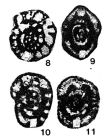
Image from typetaxon