WoRMS taxon details
Eunereis longissima (Johnston, 1840)
130375 (urn:lsid:marinespecies.org:taxname:130375)
accepted
Species
Heteronereis mitis Grube, 1870 · unaccepted (subjective synonym)
Nereis (Eunereis) longissima Johnston, 1840 · unaccepted (superseded original combination...)
superseded original combination with subgeneric attribution
Nereis edenticulata Quatrefages, 1866 · unaccepted (subjective synonym)
Nereis longissima Johnston, 1840 · unaccepted (superseded original combination)
Nereis regia Quatrefages, 1850 · unaccepted (subjective synonym)
Rullierinereis tenerifensis Núñez, Brito & Bacallado, 1984 · unaccepted (subjective synonym)
marine, brackish, fresh, terrestrial
recent only
(of Nereis longissima Johnston, 1840) Johnston, G. (1840). Miscellanea Zoologica. [Continued from vol. iv. p. 375.] Contributions towards a history of Irish Annelids (1). <em>Annals of Natural History; or, Magazine of Zoology, Botany, and Geology.</em> 5: 168-179, 9 text-figures., available online at https://www.biodiversitylibrary.org/page/2248020
page(s): 178-179, fig. 9 [details]
page(s): 178-179, fig. 9 [details]
Type locality contained in Irish Exclusive economic Zone
type locality contained in Irish Exclusive economic Zone [from synonym] [view taxon] [details]
Description The bristle worm Eunereis longissima can reach a length of up to 50 cm, although only smaller specimens with a maximum...
Distribution N. longissima occurs from the subtidal zone of the Wadden Sea and the Delta area down to a depth of 50 m in the Oyster...
Distribution With only eight observations and a maximum density of 16 ind./m2 Eunereis longissima was a rare phenomenon in the entire...
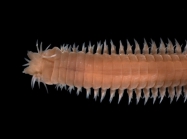
Description The bristle worm Eunereis longissima can reach a length of up to 50 cm, although only smaller specimens with a maximum length of 20cm have been found on the Belgian part of the North Sea. The striking head structures with tentacles, palps, antennae and four eyes are characteristic. Living specimens have a red to iridescent dark brown colour. [details]
Distribution N. longissima occurs from the subtidal zone of the Wadden Sea and the Delta area down to a depth of 50 m in the Oyster...
Distribution N. longissima occurs from the subtidal zone of the Wadden Sea and the Delta area down to a depth of 50 m in the Oyster Ground, where it is quite abundant. In the offshore part of the Southern Bight N. longissima is almost absent. [details]
Distribution With only eight observations and a maximum density of 16 ind./m2 Eunereis longissima was a rare phenomenon in the entire...
Distribution With only eight observations and a maximum density of 16 ind./m2 Eunereis longissima was a rare phenomenon in the entire near-coastal zone in the 1976-1986 period. In the 1994-2001 period the number of observations increased and densities up to 100 ind./m2 were noted. The species still mainly occurred near the coast, but clearly avoided the eastern coastal zone. [details]
Read, G.; Fauchald, K. (Ed.) (2024). World Polychaeta Database. Eunereis longissima (Johnston, 1840). Accessed through: World Register of Marine Species at: https://www.marinespecies.org/aphia.php?p=taxdetails&id=130375 on 2024-04-18
Date
action
by
 The webpage text is licensed under a Creative Commons Attribution 4.0 License
original description
(of Rullierinereis tenerifensis Núñez, Brito & Bacallado, 1984) Núñez, Jorge; Brito, María del Carmen; Bacallado, Juan José. (1984). Nueva contribución al conocimiento de la familia Nereidae (Annelida Polychaeta), con la descripción de una nueva especie para las Islas Canarias. <em>Anales de la Facultad de Ciencias, Universidad de La Laguna.</em> 10(1-2): 13-24.
page(s): 16-18, fig. 2, table 1 [details] Available for editors [request]
original description (of Nereis longissima Johnston, 1840) Johnston, G. (1840). Miscellanea Zoologica. [Continued from vol. iv. p. 375.] Contributions towards a history of Irish Annelids (1). <em>Annals of Natural History; or, Magazine of Zoology, Botany, and Geology.</em> 5: 168-179, 9 text-figures., available online at https://www.biodiversitylibrary.org/page/2248020
page(s): 178-179, fig. 9 [details]
original description (of Heteronereis mitis Grube, 1870) Grube, Adolph Eduard. (1870). Über die Beziehungen der <i>Nereis</i> i. e. S. zu den <i>Heteronereis</i>. <em>Jahres-Bericht der Schlesischen Gesellschaft für vaterländische Cultur, Breslau.</em> 47: 52-54., available online at https://www.biodiversitylibrary.org/page/46566662 [details]
original description (of Nereis edenticulata Quatrefages, 1866) Quatrefages, A. de. (1866 (1865)). Histoire naturelle des Annelés marins et d'eau douce. Annélides et Géphyriens. <em>Librarie Encyclopédique de Roret. Paris.</em> <b>Volume 1.</b> 1-588., available online at http://books.google.com/books?id=FV9IAAAAYAAJ [details]
original description (of Nereis regia Quatrefages, 1850) Quatrefages, Armand de. (1850). Études sur les types inférieurs de l'embranchement des annelés. Mémoire sur le système nerveux des annélides proprement dites. <em>Annales des sciences naturelles, Paris.</em> Série 3, 14: 329-398, plates 6-10., available online at http://www.biodiversitylibrary.org/page/13433776 [details]
context source (Deepsea) Intergovernmental Oceanographic Commission (IOC) of UNESCO. The Ocean Biogeographic Information System (OBIS), available online at http://www.iobis.org/ [details]
context source (Schelde) Maris, T.; Beauchard, O.; Van Damme, S.; Van den Bergh, E.; Wijnhoven, S.; Meire, P. (2013). Referentiematrices en Ecotoopoppervlaktes Annex bij de Evaluatiemethodiek Schelde-estuarium Studie naar “Ecotoopoppervlaktes en intactness index”. <em>Monitor Taskforce Publication Series, 2013-01. NIOZ: Yerseke.</em> 35 pp. (look up in IMIS) [details]
context source (BeRMS 2020) Bio-environmental research group; Institute of Agricultural and Fisheries research (ILVO), Belgium; (2015): Macrobenthos monitoring in function of the Water Framework Directive in the period 2007-2009. [details]
basis of record Bellan, G. (2001). Polychaeta, <i>in</i>: Costello, M.J. <i>et al.</i> (Ed.) (2001). European register of marine species: a check-list of the marine species in Europe and a bibliography of guides to their identification. <em>Collection Patrimoines Naturels.</em> 50: 214-231. (look up in IMIS) [details]
additional source Muller, Y. (2004). Faune et flore du littoral du Nord, du Pas-de-Calais et de la Belgique: inventaire. [Coastal fauna and flora of the Nord, Pas-de-Calais and Belgium: inventory]. <em>Commission Régionale de Biologie Région Nord Pas-de-Calais: France.</em> 307 pp., available online at http://www.vliz.be/imisdocs/publications/145561.pdf [details]
additional source Ehlers, E. H. (1868). Die Borstenwürmer (Annelida Chaetopoda) nach systematischen und anatomischen Untersuchungen dargestellt. <em>Wilhelm Engelmann, Leipzig.</em> 2: 269-748, plates XII-XXIV., available online at http://biodiversitylibrary.org/page/1985162 [details]
additional source Hartman, Olga. (1959). Capitellidae and Nereidae (marine annelids) from the Gulf side of Florida with a review of freshwater Nereidae. <em>Bulletin of Marine Science of the Gulf and Caribbean.</em> 9(2): 153-168., available online at http://www.ingentaconnect.com/content/umrsmas/bullmar/1959/00000009/00000002/art00002 [details] Available for editors [request]
additional source Fauchald, K. (1977). The polychaete worms, definitions and keys to the orders, families and genera. <em>Natural History Museum of Los Angeles County: Los Angeles, CA (USA), Science Series.</em> 28:1-188., available online at http://www.vliz.be/imisdocs/publications/123110.pdf [details]
redescription Jirkov, I.A. (2001). [Polychaeta of the Arctic Ocean] (In Russian) Polikhety severnogo Ledovitogo Okeana. Yanus-K Press, Moscow, 632 pp., available online at https://www.researchgate.net/publication/259865957_Jirkov_2001_Polychaeta_of_the_North_Polar_Basin [details] Available for editors [request]
redescription Vieitez, J.M.; M.A.; Alós, C.; Parapar, J.; Besteiro, C.; Moreira, J.; Nunez, J.; Laborda, J.; and San Martin, G. (2004). Annelida Polychaeta I. Fauna Iberica. Ramos, M.A. et al (Eds.). Museo Nacional de Ciencias Naturales, CSIC, Madrid, Vol. 25:1-530 [sections separate authorship not recognised here]. [details]
redescription Bakken, Torkild; Wilson, Robin S. (2005). Phylogeny of nereidids (Polychaeta, Nereididae) with paragnaths. <em>Zoologica Scripta.</em> 34(5): 507-547., available online at http://dx.doi.org/10.1111/j.1463-6409.2005.00200.x [details] Available for editors [request]
new combination reference Malmgren, Anders Johan. (1865). Nordiska Hafs-Annulater. [part two of three]. <em>Öfversigt af Königlich Vetenskapsakademiens förhandlingar, Stockholm.</em> 22(2): 181-192., available online at https://biodiversitylibrary.org/page/32339457
page(s): 183 [details]
page(s): 16-18, fig. 2, table 1 [details] Available for editors
[request] original description (of Nereis longissima Johnston, 1840) Johnston, G. (1840). Miscellanea Zoologica. [Continued from vol. iv. p. 375.] Contributions towards a history of Irish Annelids (1). <em>Annals of Natural History; or, Magazine of Zoology, Botany, and Geology.</em> 5: 168-179, 9 text-figures., available online at https://www.biodiversitylibrary.org/page/2248020
page(s): 178-179, fig. 9 [details]
original description (of Heteronereis mitis Grube, 1870) Grube, Adolph Eduard. (1870). Über die Beziehungen der <i>Nereis</i> i. e. S. zu den <i>Heteronereis</i>. <em>Jahres-Bericht der Schlesischen Gesellschaft für vaterländische Cultur, Breslau.</em> 47: 52-54., available online at https://www.biodiversitylibrary.org/page/46566662 [details]
original description (of Nereis edenticulata Quatrefages, 1866) Quatrefages, A. de. (1866 (1865)). Histoire naturelle des Annelés marins et d'eau douce. Annélides et Géphyriens. <em>Librarie Encyclopédique de Roret. Paris.</em> <b>Volume 1.</b> 1-588., available online at http://books.google.com/books?id=FV9IAAAAYAAJ [details]
original description (of Nereis regia Quatrefages, 1850) Quatrefages, Armand de. (1850). Études sur les types inférieurs de l'embranchement des annelés. Mémoire sur le système nerveux des annélides proprement dites. <em>Annales des sciences naturelles, Paris.</em> Série 3, 14: 329-398, plates 6-10., available online at http://www.biodiversitylibrary.org/page/13433776 [details]
context source (Deepsea) Intergovernmental Oceanographic Commission (IOC) of UNESCO. The Ocean Biogeographic Information System (OBIS), available online at http://www.iobis.org/ [details]
context source (Schelde) Maris, T.; Beauchard, O.; Van Damme, S.; Van den Bergh, E.; Wijnhoven, S.; Meire, P. (2013). Referentiematrices en Ecotoopoppervlaktes Annex bij de Evaluatiemethodiek Schelde-estuarium Studie naar “Ecotoopoppervlaktes en intactness index”. <em>Monitor Taskforce Publication Series, 2013-01. NIOZ: Yerseke.</em> 35 pp. (look up in IMIS) [details]
context source (BeRMS 2020) Bio-environmental research group; Institute of Agricultural and Fisheries research (ILVO), Belgium; (2015): Macrobenthos monitoring in function of the Water Framework Directive in the period 2007-2009. [details]
basis of record Bellan, G. (2001). Polychaeta, <i>in</i>: Costello, M.J. <i>et al.</i> (Ed.) (2001). European register of marine species: a check-list of the marine species in Europe and a bibliography of guides to their identification. <em>Collection Patrimoines Naturels.</em> 50: 214-231. (look up in IMIS) [details]
additional source Muller, Y. (2004). Faune et flore du littoral du Nord, du Pas-de-Calais et de la Belgique: inventaire. [Coastal fauna and flora of the Nord, Pas-de-Calais and Belgium: inventory]. <em>Commission Régionale de Biologie Région Nord Pas-de-Calais: France.</em> 307 pp., available online at http://www.vliz.be/imisdocs/publications/145561.pdf [details]
additional source Ehlers, E. H. (1868). Die Borstenwürmer (Annelida Chaetopoda) nach systematischen und anatomischen Untersuchungen dargestellt. <em>Wilhelm Engelmann, Leipzig.</em> 2: 269-748, plates XII-XXIV., available online at http://biodiversitylibrary.org/page/1985162 [details]
additional source Hartman, Olga. (1959). Capitellidae and Nereidae (marine annelids) from the Gulf side of Florida with a review of freshwater Nereidae. <em>Bulletin of Marine Science of the Gulf and Caribbean.</em> 9(2): 153-168., available online at http://www.ingentaconnect.com/content/umrsmas/bullmar/1959/00000009/00000002/art00002 [details] Available for editors
[request] additional source Fauchald, K. (1977). The polychaete worms, definitions and keys to the orders, families and genera. <em>Natural History Museum of Los Angeles County: Los Angeles, CA (USA), Science Series.</em> 28:1-188., available online at http://www.vliz.be/imisdocs/publications/123110.pdf [details]
redescription Jirkov, I.A. (2001). [Polychaeta of the Arctic Ocean] (In Russian) Polikhety severnogo Ledovitogo Okeana. Yanus-K Press, Moscow, 632 pp., available online at https://www.researchgate.net/publication/259865957_Jirkov_2001_Polychaeta_of_the_North_Polar_Basin [details] Available for editors
[request] redescription Vieitez, J.M.; M.A.; Alós, C.; Parapar, J.; Besteiro, C.; Moreira, J.; Nunez, J.; Laborda, J.; and San Martin, G. (2004). Annelida Polychaeta I. Fauna Iberica. Ramos, M.A. et al (Eds.). Museo Nacional de Ciencias Naturales, CSIC, Madrid, Vol. 25:1-530 [sections separate authorship not recognised here]. [details]
redescription Bakken, Torkild; Wilson, Robin S. (2005). Phylogeny of nereidids (Polychaeta, Nereididae) with paragnaths. <em>Zoologica Scripta.</em> 34(5): 507-547., available online at http://dx.doi.org/10.1111/j.1463-6409.2005.00200.x [details] Available for editors
[request] new combination reference Malmgren, Anders Johan. (1865). Nordiska Hafs-Annulater. [part two of three]. <em>Öfversigt af Königlich Vetenskapsakademiens förhandlingar, Stockholm.</em> 22(2): 181-192., available online at https://biodiversitylibrary.org/page/32339457
page(s): 183 [details]
 Present Present in aphia/obis/gbif/idigbio Inaccurate Introduced: alien Containing type locality
From other sources
Biology Sexually ripe specimens have been observed in April and May. Most probably the larvae have a planktonic development. E. longissima lives in burrows. When conditions become unfavourable it will rapidly and repeatedly move and set up a new tube at other locations. E. longissima is mainly a non-selective deposit feeder, feeding on algae and dead animals. The species itself is eaten by flatfish (Hartmann-Schröder, 1971; Wolff, 1973; Fauchald & Jumars, 1979). [details]Description The bristle worm Eunereis longissima can reach a length of up to 50 cm, although only smaller specimens with a maximum length of 20cm have been found on the Belgian part of the North Sea. The striking head structures with tentacles, palps, antennae and four eyes are characteristic. Living specimens have a red to iridescent dark brown colour. [details]
Distribution N. longissima occurs from the subtidal zone of the Wadden Sea and the Delta area down to a depth of 50 m in the Oyster Ground, where it is quite abundant. In the offshore part of the Southern Bight N. longissima is almost absent. [details]
Distribution With only eight observations and a maximum density of 16 ind./m2 Eunereis longissima was a rare phenomenon in the entire near-coastal zone in the 1976-1986 period. In the 1994-2001 period the number of observations increased and densities up to 100 ind./m2 were noted. The species still mainly occurred near the coast, but clearly avoided the eastern coastal zone. [details]
Habitat Its density distribution suggests a preference for substrates with an admixture of mud. [details]
Habitat Eunereis longissima is typically found in sediments with a median grain size of 100 to 250 μm. The species has a broad mud content tolerance but tends to prefer (relative occurrence: > 50%) sediments with a mud content of 10-20%. [details]
Morphology A species with a long, rather flattened body of up to 150 mm in length, with over 200 segments. The head is conical, truncate, with two frontal antennae, two biarticulate palps and four relatively small eyes. The first segments bears four pairs of cirri. Like all nereids, the species has an eversible proboscis and two terminal jaws. The small number of teeth on the proboscis are characteristic for this species. The body segments are rather uniform, with prominent, powerful parapodia bearing distinct lamellae. lt is blue-grey, reddish or pinkish in colour (Hartmann-Schröder, 1971; Hayward & Ryland, 1990). [details]
To Barcode of Life (3 barcodes)
To Biodiversity Heritage Library (23 publications)
To Biodiversity Heritage Library (55 publications) (from synonym Nereis longissima Johnston, 1840)
To European Nucleotide Archive (ENA)
To GenBank (2 nucleotides; 0 proteins)
To PESI (from synonym Rullierinereis tenerifensis Núñez, Brito & Bacallado, 1984)
To PESI
To PESI (from synonym Nereis longissima Johnston, 1840)
To USNM Invertebrate Zoology Annelida Collection (1 record) (from synonym Nereis longissima Johnston, 1840)
To ITIS
To Biodiversity Heritage Library (23 publications)
To Biodiversity Heritage Library (55 publications) (from synonym Nereis longissima Johnston, 1840)
To European Nucleotide Archive (ENA)
To GenBank (2 nucleotides; 0 proteins)
To PESI (from synonym Rullierinereis tenerifensis Núñez, Brito & Bacallado, 1984)
To PESI
To PESI (from synonym Nereis longissima Johnston, 1840)
To USNM Invertebrate Zoology Annelida Collection (1 record) (from synonym Nereis longissima Johnston, 1840)
To ITIS